

Courtesy Michigan Medicine
In combination with deep breathing, a finger labyrinth—a small version of a walking labyrinth designed to be traced with your finger–can calm the nervous system and bring your mind to the present moment.
Sandra Drabant, art therapist, and Bruce Paul, chaplain, from Rogel’s Patient and Family Support Services, lead workshops with Rogel patients to create finger labyrinths. Here, they offer some ideas on how to use a finger labyrinth to enhance mindfulness and support your wellbeing.
Download our sample labyrinth pattern and follow the directions below. We've also included a video showing how to create your own labyrinth.
- Slowly inhale through your nose. Trace your finger along the path to the center. Slowly exhale through a small opening with your mouth and return to the beginning of the labyrinth.
- Use your non-dominant hand to slowly trace the path. Pause in the center and take 3 deep breaths. Retrace the path out of the finger labyrinth and notice the texture of the paper. If your mind wanders bring it back without judgement to the physical feeling under your finger and the sound of your breath.
Continue reading THRIVE, spring 2026
Featured News & Stories

News Release
Understanding Your Pathology Report
Get advice for what to do – and what not to do – when preparing for a surgery or biopsy, and when pathology results land in your patient portal.

News Release
Living In the Unknown
Rogel Cancer Center's Patient and Family Services offer therapists to help patients and families navigate cancer’s emotional impact, restore well-being and find renewed meaning.

News Release
No One is You and That is Your Power
After a low-grade glioma diagnosis and surgery at 35, Claire Sloma reflects on community, letting go of control and redefining success in life and work.

News Release
The Mindset of an Athlete
Steve Burns, a former soccer coach, shares how he faced a 2024 relapse of large B-cell lymphoma in his brain, adapting to CNS lymphoma treatment one round at a time.

News Release
The Sixth Vital Sign: Your Wellbeing
Learn why comprehensive cancer centers screen for emotional distress and how support helps patients cope with uncertainty, symptoms and cancer treatment.
Health Lab
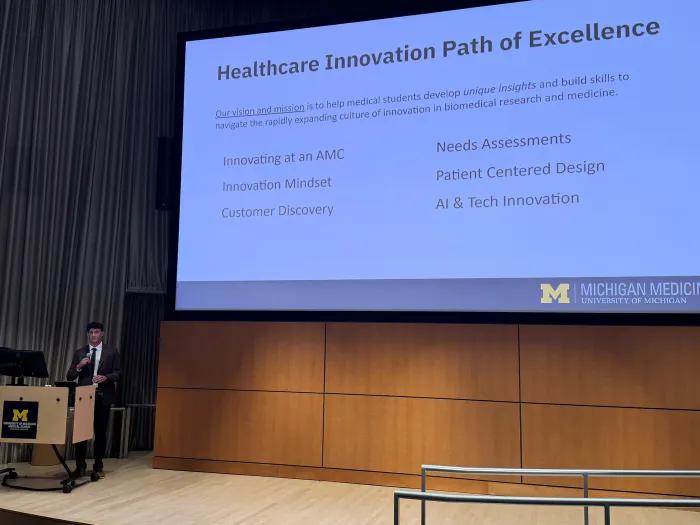
Medical students develop novel technological solutions for unmet patient needs
University of Michigan medical students showcased AI-driven healthcare innovation projects focused on melanoma support, transplant recovery and primary care access.
