
Kelly Malcom
Lead Research Communicator
Malcom is a lead research communicator for Michigan Medicine and research communications strategist for the U-M Medical School, with more than 20 years of experience in strategic communications, marketing, and health and science writing. She covers the basic science departments, pulmonary and critical care medicine, infectious disease, pathology and anesthesiology. Contact: [email protected]


News Release
$3.9 million NIH grant to fuel U-M effort to develop first targeted therapy for fatal childhood brain disorder
A team led by Dr. Michelle Hastings will advance a new RNA-based medicine for the most common form of CLN3 Batten disease toward clinical trials

Health Lab
Bigger data reveals the second, third and fourth switches controlling a gene
A University of Michigan study reveals the untapped potential of the NIH-sponsored Trans-Omics for Precision Medicine, or TOPMed, program.

Health Lab
Rabies is on the rise: Experts offer advice
With rabies on the rise, infectious disease experts from Michigan Medicine share advice.

Health Lab
Who’s at risk for painful periods?
A University of Michigan-led study looked more closely at dysmenorrhea, which is pain that comes with menstruation, in girls before and after their first periods.

Health Lab
Psychedelics and anesthetics create mirror image patterns in the brain
A new study takes a data driven approach and reveals that psychedelics and anesthetics create “mirror image” patterns of large-scale brain organization, with opposite network features.

Health Lab
How a common virus's hijack of cell repair processes may promote cancer
Researchers at the University of Michigan look at details surrounding EBV’s reactivation from latent infection, known as the lytic phase of viral replication.

Health Lab
Study overturns 100-year-old assumption about common bacteria in the lungs
A new U-M study overturns a 100-year-old assumption about one common bacterial resident of the lungs, Prevotella melaninogenica.

Health Lab
Mutations attracted to the X chromosome amplify disease risk
Researchers have discovered that the human X chromosome attracts an unusual kind of DNA mutation, potentially doubling the associated risk of certain genetic disorders, including haemophilia and muscular dystrophy.

Health Lab
Lung health expert weighs in on Zyn and other nicotine pouches
Michigan Medicine’s MeiLan Han, M.D., provides her professional and medical thoughts on the use of nicotine pouches.
Health Lab
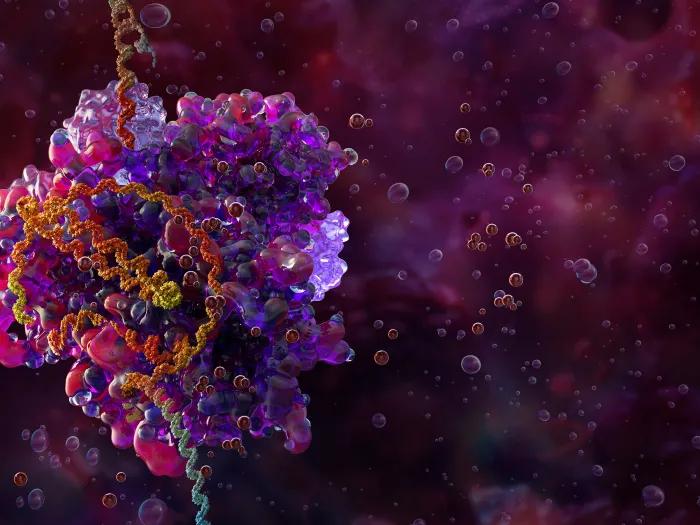
CRISPR acts as commander-in-chief for backup defenses in bacteria
A new study uncovers a previously underrecognized feature of the type I CRISPR-Cas system in the bacteria Neisseria: the presence of additional embedded innate immunity genes.

Health Lab
Scientists discover that bacteria use an understudied polymer found in all life to protect cell functions during stress
New study discovers that polyphosphate, a molecule that exists in all lifeforms but has to date been hard to study, could be a fundamental element worth exploring, say Michigan Medicine researchers.

Health Lab
New algorithmic tool enables to scientists to see cells “talk” to one another
A new U-M study, featured in Nature Genetics, details a technique to infer cell-cell communication using spatial transcriptomics

Health Lab
The Y chromosome is home to surprising jumping genes
Researchers at Michigan Medicine are studying deer mice to outline how the Y chromosome defends itself against decay by acquiring gene families while holding its own to maintain fertility.

Health Lab
Supplementing with peptides: Good for extra pep or a needless step?
Health Lab talks to Jorge Ruas, Ph.D., of the U-M Department of Pharmacology, about peptides, how they work and whether supplementing them lends any benefit.

Health Lab
New study reveals a missing step in a weight control pathway that could be targeted for obesity treatment
New research led by Liangyou Rui, Ph.D., of the Department of Molecular & Integrative Physiology at the University of Michigan Medical School outlines a missing step in one of these alternative pathways, an important discovery in the fight against obesity.
