U-M Health recognized as Michigan’s No.1 hospital by U.S. News & World Report
U-M Health only hospital in the state named to the nation’s Honor Roll of hospitals
5:00 AM
Authors |

ANN ARBOR, Mich. – University of Michigan Health has been recognized as the top hospital in Michigan, according to U.S. News and World Report’s Best Hospitals Rankings for 2023-2024.
U-M Health was also the only hospital in the state named to the nation’s Honor Roll of hospitals, recognizing the institution for strong overall performance.
U-M Health is the clinical division of Michigan Medicine, the academic medical center of the University of Michigan.
“It’s an honor for U-M Health to receive continued recognition for our exceptional level of patient care,” said David Miller, M.D., M.P.H., president of the U-M Health System and executive vice dean for clinical affairs for the U-M Medical School.
“We are grateful for the hard work and commitment of our team members who make our patients a priority every single day.”
U.S. News generates its rankings by evaluating data from 4,500 hospitals on four different categories, including patient experience, outcomes, care-related factors, and expert opinions from physician surveys.
“These rankings are one measure of U-M Health’s dedication to delivering high-quality care to every patient who comes through our doors,” said Marschall S. Runge, M.D., Ph.D., dean of the U-M Medical School, CEO of Michigan Medicine and executive vice president of medical affairs for the University of Michigan.
“We are proud of our teams whose commitment to innovation and exemplary care helps earn this honor.”
U-M Health is ranked No. 8 in the country for ophthalmology, and received national rankings in the following specialties:
- Cancer
- Cardiology and Heart Surgery
- Diabetes and Endocrinology
- Ear, Nose, and Throat
- GI and GI Surgery
- Geriatrics
- Neurology and Neurosurgery
- Orthopedics
- Pulmonology
- Rehabilitation
- Urology
- Rheumatology
U.S. News & World Report also awards "high performing" designation to hospitals for a number of specific procedures and conditions. U-M Health, as well as Sparrow Health System and UM Health-West, are named as high performing in a range of specialties.
Additionally, U-M Health was also recently ranked No.9 in Expertscape’s All-Around Expert Medical Centers for high rankings in 21 different medical and surgical specialties. U-M Health is among just 29 hospitals in the country rated as expert in all 21 specialties tracked by Expertscape.
To learn more about other U-M clinical care honors, visit https://www.uofmhealth.org/about-umhs/honors-awards.
For detailed data about the safety and quality of care at U-M, visit www.uofmhealth.org/quality-safety.
About Michigan Medicine: At Michigan Medicine, we advance health to serve Michigan and the world. We pursue excellence every day in our top rated hospitals, clinics and home care operations, as well as educate the next generation of physicians, health professionals and scientists in our U-M Medical School.
Michigan Medicine includes the highly regarded U-M Medical School and University of Michigan Health, which includes C.S. Mott Children’s Hospital, Von Voigtlander Women’s Hospital, University Hospital, the Frankel Cardiovascular Center, Rogel Cancer Center, U-M Health West and Sparrow Health System. The U-M Medical School is one of the nation's biomedical research powerhouses, with total research funding of more than $500 million.
More information is available at www.michiganmedicine.org
Featured News & Stories
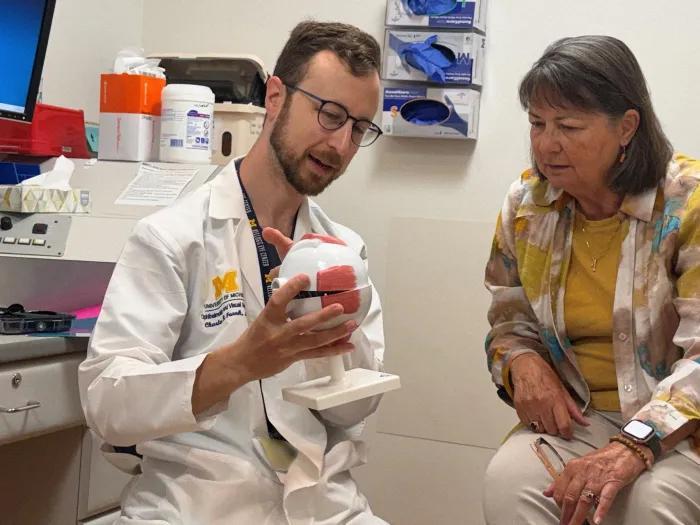
Eye surgeries bring patient’s vision into focus

How to discuss health care and end-of-life wishes during the holidays

Court appointed medical guardian study reveals role in care of highly vulnerable older adults

From patient to artist: A project close to her heart

New heart, three medals and a shot at the world stage