Motivational speaker reunites with Survival Flight nurses after sudden aortic dissection
A father of three was in the middle of a virtual work presentation when he experienced an emergent heart problem; a reunion with nurses fills in the blanks of his journey
10:00 AM
Author |
Joshua Spears was in the middle of a virtual presentation for work, when he suddenly felt something was wrong.
“According to the people watching, I said, 'I have to go. I have to call 911.' Somehow, I managed to make the call,” said the motivational speaker who was home alone at the time.
Beyond that, Spears has almost no recollection of the series of medical events that followed that day in May 2023 and threatened his life.
An ambulance rushed Spears to a local hospital, where doctors determined he had an aortic dissection, a tear in the wall of the main artery that carries blood from the heart to the rest of the body.
This tear can cause blood to flow between the layers of the aorta, which can lead to a number of serious complications.
In Spears’ case, the condition had caused a blockage of a cerebral artery, leading to left sided heart dysfunction.
He was also experiencing low blood pressure and required medication to keep it up.
That’s when he was airlifted by Survival Flight, Michigan Medicine’s critical care transport program, to University of Michigan Health Frankel Cardiovascular Center for an emergency open-heart operation led by U-M cardiac surgeon Shinichi Fukuhara, M.D.
“These types of situations generally do not bode well for most, and knowing this we understood time was of the essence and did everything we could to expedite his transport,” said U-M flight nurse Paul Munger.
“Upon arriving in the emergency room for a quick exam, we took him straight to the operating room in the cardiovascular center for surgery.”
Spears recalls various sensations and feelings he experienced during the event but not much else.
"It was really weird," he said.
"I heard my brother’s voice, telling me, 'You’re going to get through this.' But at the same time, I was completely out of it and having hallucinations. I thought I was in a circus tent at one point. When I finally did come to, my family was telling me what happened, but I wasn’t even able to talk with them yet.”
Spears found himself determined to fill the gaps in his memory from that day.
He was able to piece together a few things from listening to his own 911 call, but he still needed to know more.
"It was one of the most significant events in my life," he said.
"I wanted to know what happened because it’s unique. My surgeons told me it’s so rare to survive something like this.”
It’s estimated that up to 50% of people who experience aortic dissection will die before reaching the hospital.
While the survival rate has improved significantly, the condition remains deadly if not recognized and repaired early.
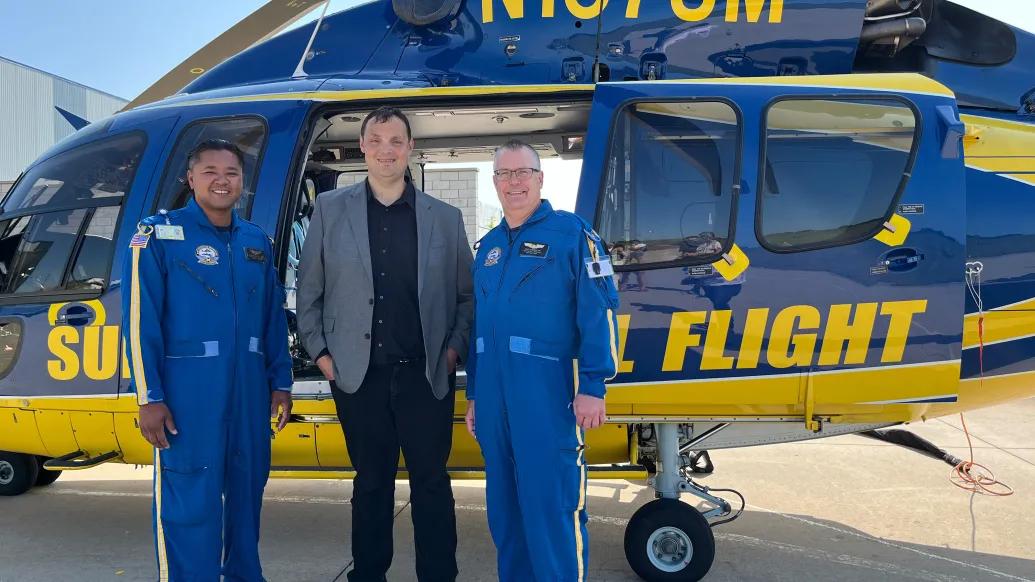
Spears learned more about his story in July 2024 when he visited Survival Flight’s Livingston County base to meet with the crew who flew him to his surgery.
There, he was reunited with his flight nurses, including Munger and Johnnie Peoples.
“To see his progress one year later is nothing short of astounding,” Munger said.
“He has demonstrated he is a fighter in his ability to recover from such a devastating event. We are proud to serve our community and be a part of the Michigan difference.”
Munger and Peoples brought Spears’ family around the base, gently joking that he looks “a lot better” than he did the first time they met.
They viewed the very helicopter that transported Spears, and even caught a glimpse of Survival Flight’s Learjet taking off.
“Coming back here, spending time with Paul and Johnny and the rest of the team, and getting a chance to say thank you — it’s been a form of therapy for me,” Spears said.
“I’m so grateful for the opportunity to be out here so I could get a chance to thank them all for saving my life, and helping my kids have a dad and my wife have a husband. I just am eternally thankful.”
The experience has given him and his family a deep appreciation of healthcare professionals.
“They’re real people with lives and families, but at that moment, they were angels for me," he said.
Spears continues to progress in his recovery.
He still has limited use of his left arm and sometimes walks with a cane.
He’s still navigating his career but is looking forward to using his story, along with his experience as a motivational speaker, to help others in the medical field.
What’s most important to him now, though, is appreciating his second chance at life with wife, Julie, and his three sons Charlie, 14; Danny, 12; and Benji, 8.
"I want to be a better dad, a better husband and just enjoy life,” he said.
“The goal I had when I was in the hospital, and I'm certainly not there yet, was to try and get through all this with a smile on my face and feel a level of peace.”
Sign up for Health Lab newsletters today. Get medical tips from top experts and learn about new scientific discoveries every week by subscribing to Health Lab’s two newsletters, Health & Wellness and Research & Innovation.
Sign up for the Health Lab Podcast: Add us on Spotify, Apple Podcasts or wherever you get you listen to your favorite shows.

Health Lab
Explore thousands of health news & research stories by visiting the Health Lab homepage for more.
Media Contact

Public Relations
Department of Communication at Michigan Medicine
In This Story

Shinichi Fukuhara
Clinical Associate Professor
Stay Informed
Want top health & research news weekly? Sign up for Health Lab’s newsletters today!
Featured News & Stories

Gene editing is coming for common diseases. Are we ready?

Digital alerts support timely treatment decisions of critically ill cardiac patients

Is the United States Lagging Behind Europe in Memory Improvement?
Reducing infections after heart surgery could save Medicare $441 million per year
Young father survives aortic dissection after delayed diagnosis