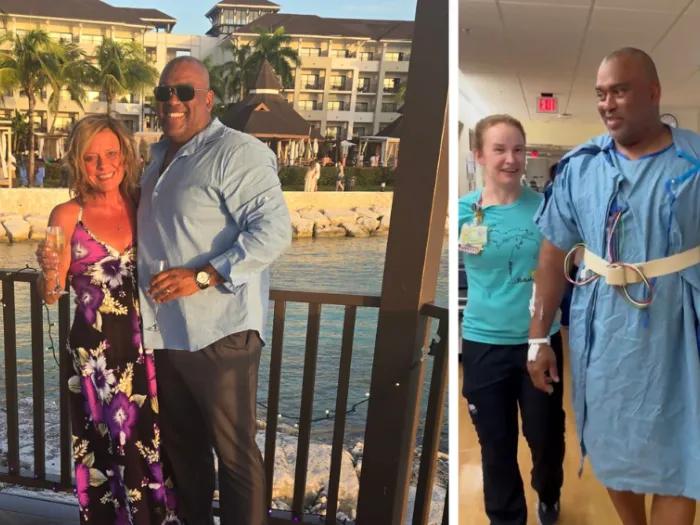
Learn to Save a Life with Hands-Only CPR
Without swift intervention, sudden cardiac arrest can be deadly. Hands-only CPR can double or triple a victim’s chances of recovery.
7:00 AM
Author |
When someone experiences sudden cardiac arrest (SCA), the heart stops beating, often without warning.
MORE FROM MICHIGAN: Sign up for our weekly newsletter
SCA can happen anytime, anywhere and to anyone — often active, healthy people with no known medical conditions. In most cases, it is fatal.
"When a person goes into cardiac arrest, they have essentially died," says Teri Shields, R.N., a nurse at the University of Michigan Frankel Cardiovascular Center. "Their only chance of recovery is CPR and the shock from an automated external defibrillator, or AED."
It's why Shields is passionate about training others in the hands-on technique, a critical way to help get oxygenated blood to the organs — especially the brain.
"A person giving CPR takes over the function of the heart muscle to pump blood," Shields says.
According to the American Heart Association, performing hands-only CPR at a brisk, steady pace (the tempo of the classic disco song "Stayin' Alive" is recommended) can double or even triple a victim's chance of survival.
Approximately 85 percent of cardiac arrests happen outside the hospital, so the more people who know how to perform CPR, the better.
Says Shields: "Chances are, you could be saving the life of someone you know and love."
Breaking down barriers
Many people are hesitant to perform CPR, even though the American Heart Association reports that hands-only CPR — a process that involves hard and fast chest compressions with interlaced hands — has proved to be as effective as conventional CPR (compressions and mouth-to-mouth breathing) for cardiac arrest.
SEE ALSO: 6 Reasons Schools Need to Run AED Drills
Still, bystanders might fear causing further harm or failing to perform CPR properly, says Shields.
"Some are afraid of being sued, although this fear is unfounded because of protection offered by Good Samaritan laws in the majority of states, including Michigan," Shields says.
One important finding from recent studies suggests more people are willing to perform hands-only CPR if an emergency dispatcher guides them over the telephone, Shields says.
Others might not know the warning signs of sudden cardiac arrest — or how to react.
"A person in cardiac arrest can mimic someone having a seizure," says Eugene Chung, M.D., a Michigan Medicine electrophysiologist and sports cardiologist. "A bystander may not know how to perform CPR or they may think CPR still involves mouth-to-mouth breathing."
They may also assume that adolescents or athletes aren't at risk.
"A cardiac arrest doesn't immediately come to mind with a young person performing at such a high level," Chung says. "But a cardiac arrest should be presumed in these cases, with CPR administered immediately, along with an AED. There is no time to lose."
Michigan Medicine emergency medicine specialist Robert Neumar, M.D., reinforces that notion: "The sooner chest compressions are started, the more effective they are. Every second counts. Recognizing cardiac arrest immediately and acting quickly will maximize the chances of saving a life."
Strength in numbers
Shields and Neumar are passionate about educating others in administering CPR and using an AED. Both are pioneers in the SaveMiHeart initiative, which brings together leaders and volunteers committed to improving outcomes for victims of cardiac arrest.
SaveMiHeart, in partnership with the Michigan Department of Health, the American Heart Association, the University of Michigan, Wayne State University and others, is promoting HEARTSafe Communities — an effort to increase survival from sudden cardiac arrest by helping communities improve their system of care.
High schools are also getting on board. In January, the Michigan Legislature passed a bill requiring that all Michigan high school students receive training in CPR and AED usage through a Basic Life Support class.
As a result, approximately 100,000 new "rescuers" will be added to Michigan's CPR-certified population each year, a boost that could raise survival rates for sudden cardiac arrest victims.
"This increase in the number of trained rescuers in Michigan will surely save lives," Shields says.

Health Lab
Explore thousands of health news & research stories by visiting the Health Lab homepage for more.
Media Contact

Public Relations
Department of Communication at Michigan Medicine
Stay Informed
Want top health & research news weekly? Sign up for Health Lab’s newsletters today!
Featured News & Stories

E-Bikes are everywhere, but most parents say they don’t know enough about them
School night bedtime tips every parent should know

E-bikes are faster than ever. Are families prepared for the risks?
Celebrating cardiac arrest survivors and their lifesavers
5 hot weather tips that could save an older adult’s life