Free Apps Support Transplant Patients in Navigating their Health Care Visits
Two new, free apps help to navigate the complex transplant journey for kidney and liver transplant patients.
4:18 PM
Author |
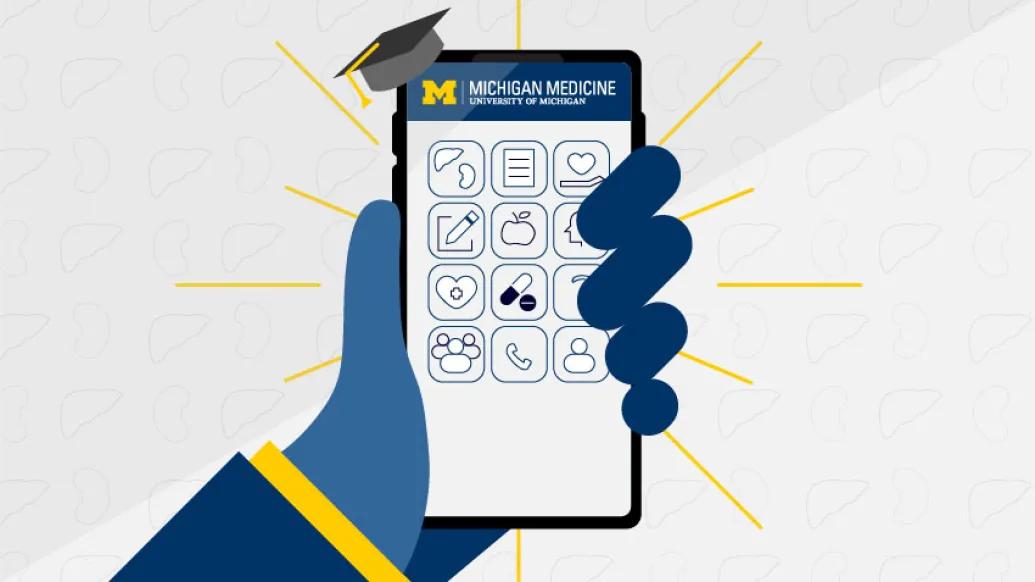
The lighted screen of a smart phone has become a beacon for potential and current kidney and liver transplant patients and their supporters.
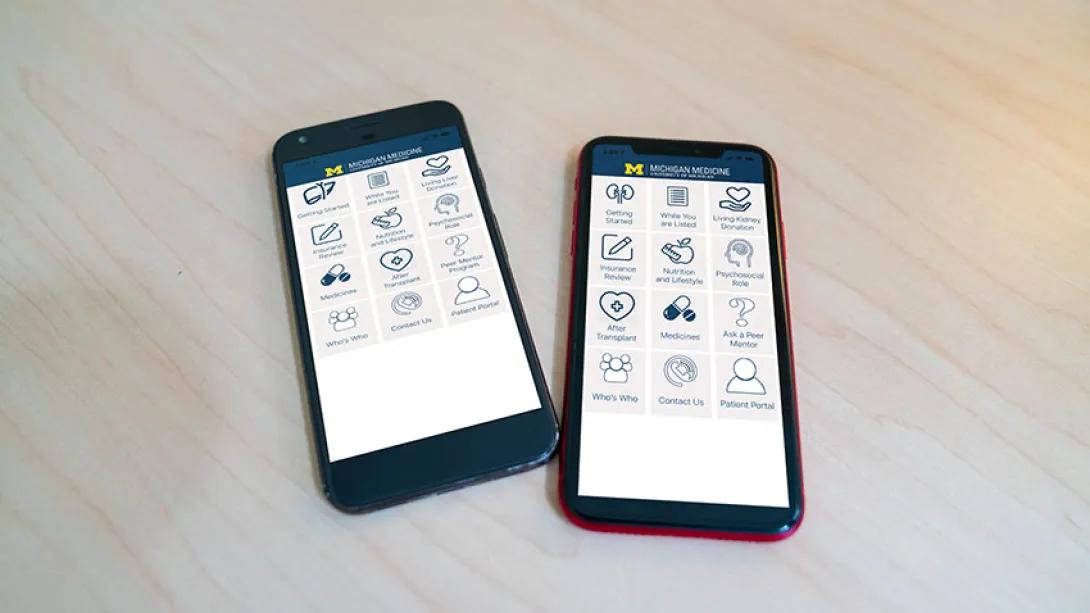
Michigan Medicine Transplant Center has developed two free apps — one for kidney transplant education, the other, liver transplant education — that shed light on how to navigate the complex transplant journey. They include lessons on everything from the tests required to be placed on the donor waitlist to what medicines prevent rejection and everything in between.
The liver app was launched in May, while the kidney app has been available since February 2018 and downloaded worldwide, says Stacy Brand, M.B.A., the outreach manager at the Transplant Center, who spearheaded the development with Megan Podschlne, project manager for the Transplant Center. It was the model for the liver transplant app.
LISTEN UP: Add the new Michigan Medicine News Break to your Alexa-enabled device, or subscribe to our daily updates on iTunes, Google Play and Stitcher.
"We are harnessing the power of technology to help educate current and potential transplant patients as well as their family and friends outside of the hospital, who are an important part of the equation," Brand says.
The apps, available on the iOS and Android platforms under the names Kidney Transplant Education and Liver Transplant Education, work in tandem with a thick binder that Brand gives every organ transplant patient.
"We call the binder the transplant bible and the app is a condensed version of the bible, making it easy to look up something while on the go and it can be shared with others," Brand says.
A cross-disciplinary team worked on both the binder and the app, ensuring that all the patient's information needs are met. The team included a social worker, nephrologist (hepatologist for the liver app), surgeon, pharmacist, financial coordinator, peer mentor, dietitian, advanced practice providers, living donor team, transplant specialty financial coordinator and a transplant coordinator to curate the content. Brand, Podschlne and department intern Mahmoud Abdulkarim consulted transplant recipients as well to have them weigh in on the app to make it even more user-friendly. App developer Imran Shirajee put it all together.
The origin of the app
The kidney app answered the need to better inform potential organ donors and recipients of their next steps. They may have to undergo certain tests or meet certain benchmarks, like lose weight or have teeth fixed, before they make the list. This can take a long time depending on their needs, test availability and overall health, Brand says. The app answers questions that may have escaped their memory from their initial visit.
Once listed, the average wait time for a kidney in Michigan is five to seven years, Brand says. While every year they return to the transplant center for an evaluation checkup, having the app gives them an easy outlet to have questions answered while making them feel connected to the process, Brand says.
Margo Klug, a retired farmer from Hartford, Michigan, who underwent a kidney transplant in 2014, wishes the app were around when she was on her transplant journey along with her son, Kevin, who donated a kidney to her. She frequently dog-eared the pages of her transplant bible.
MORE FROM MICHIGAN: Sign up for our weekly newsletter
"As someone with chronic kidney disease, my brain wouldn't always retain information so having an easy to use resource at my fingertips would have been helpful," Klug says.
Sharing knowledge, strength
Klug is now a volunteer peer mentor who counsels others going through a kidney transplant. She also drives 2.5 hours each month to meet a new rotation of University of Michigan Medical School students and residents learning about kidney transplants.
She believes so strongly in the app, which she uses frequently to log on to the patient portal and keep up-to-date on her appointments, that she brings it up with every patient, student and resident she meets, often passing her smart phone around to 10 different onlookers to try it out.
"These are our future doctors and they need to see the other side of things, so I show this app because it's a tremendous tool they should learn about to help their patients, who will benefit from using it," Klug says.
The apps have been well received, Brand said. Nearly 2,000 users worldwide have downloaded the kidney transplant education app. In its first three weeks, the liver app was downloaded 110 times
"After seeing the kidney app in action, the liver transplant team wanted one," Brand says.
Unlike the kidney app's more than two years to develop, the liver one only took a year until it launched.
"We've already had inquiries from the lung transplant team about doing one for them," Brand says.
Their patients are seeking a guiding light too.
Make an Appointment and Get Evaluated
To make an appointment to evaluate your need within our Transplant Center, call a patient care representative at 1-800-333-9013.

Health Lab
Explore thousands of health news & research stories by visiting the Health Lab homepage for more.
Media Contact

Public Relations
Department of Communication at Michigan Medicine
Stay Informed
Want top health & research news weekly? Sign up for Health Lab’s newsletters today!
Featured News & Stories

A second chance at life

Exceptional response to immunotherapy gives patient with liver cancer more milestones to celebrate

Better prenatal care data could help prevent maternal complications, experts say

Liver cancer can be preventable. Do you know the treatable risk factors?
Many hospitals still don’t do enough to prevent UTIs from catheters