Pathologists find evidence of pre-existing chronic lung disease in people with long COVID
Some symptoms may be caused by damage developed before patients contracted the coronavirus.
10:20 AM
Author |
For nearly two years, the collective attention of researchers worldwide has focused on understanding what infection with SARS-CoV-2, the coronavirus that causes COVID-19, does to the human body.
As a result, scientists have amassed evidence of a wide range of effects on the heart, lungs, brain and various other organs. Much of that insight has been gathered from autopsies of people who died from COVID-19. Yet, for the millions of people who survived the infection only to experience lingering symptoms, referred to colloquially as long COVID, much remains unknown.
Researchers at University of Michigan Health, part of Michigan Medicine, are examining lung biopsies from patients living with persistent respiratory symptoms, such as shortness of breath, to help better define the pattern of damage associated with COVID-19. Their work has led to a surprising finding: some patients' symptoms could be due to damage that existed before getting COVID-19.
"Some of the early publications and popular press around long COVID has implied or assumed that once you had COVID, everything that happens next is COVID-related," said senior author Jeffrey Myers, M.D., professor of anatomic pathology. "Of course, that might or might not be true.
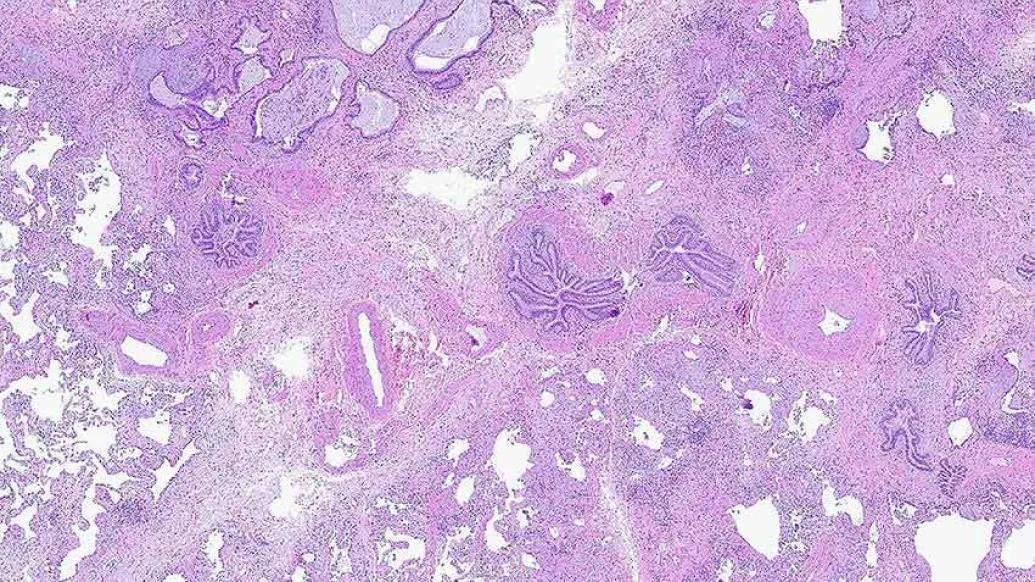
Myers, along with Kristine E. Konopka, M.D., associate professor of thoracic pathology, and their Department of Pathology team, examined lung biopsies from 18 living patients who had ongoing respiratory symptoms or abnormal CT scans after recovering from COVID-19. Five patients were reported to have lung disease prior to their COVID-19 diagnosis. Fourteen patients had what is known as ground glass opacities on radiological scans, areas of the lungs that appear as a cloudy gray color as opposed to the dark color of normal air-filled lungs, on a chest X-ray or CT scan.
MORE FROM THE LAB: Subscribe to our weekly newsletter
The most common finding in this set of patients was a condition known to pathologists as usual interstitial pneumonia, or UIP, also known clinically as idiopathic pulmonary fibrosis, or IPF, a well-studied chronic lung disease. IPF is the most common type of pulmonary fibrosis and causes scarring and stiffening of the lungs.
"We were seeing a lot of UIP, which isn't the pattern we tend to associate with acute lung injury," said Konopka, lead author on the study. "So, we think these are patients who had lung disease prior to COVID and maybe they just weren't being followed by primary care physicians. They then had COVID, are still sick, and their UIP is finally being picked up."
The notion that a person could have chronic lung damage and not know it was unheard of until relatively recently, noted Myers.
"The assumption was if you had UIP/IPF, you were sick and you would know you had it. We've learned for a variety of reasons, including the rate at which we use radiology of the chest, there are people walking around with UIP/IPF that aren't sick. If you test with typical tests for lung function, they come back normal."
However, UIP/IPF is a progressive disease that gets worse with time and an infection, such as with SARS-CoV-2, can lead to accelerated illness or even death, what is known as an acute exacerbation of IPF, explained Myers. "SARS-CoV-2 comes along and does to the lung, from a pathology perspective, exactly what happens with an acute exacerbation."
Like Podcasts? Add the Michigan Medicine News Break on iTunes, Google Podcasts or anywhere you listen to podcasts.
Biopsies from these patients show evidence of the underlying pre-existing lung scarring with, layered on top, evidence of diffuse alveolar damage, a pattern of lung tissue damage commonly seen in patients with acute respiratory distress syndrome of any cause.
Myers and Konopka note that without full clinical histories, including tests from before the patients' COVID diagnosis, it is impossible to say for certain that SARS-CoV-2 did not cause UIP. However, they hope their findings will encourage clinicians think twice about automatically attributing respiratory symptoms to long COVID.
"You shouldn't make assumptions but ask the right questions, the first of which would be 'I wonder if this is really COVID?'," said Myers. "What you do after that depends on the answer to that question."
Paper cited: "Usual Interstitial Pneumonia is the Most Common Finding in Surgical Lung Biopsies from Patients with Persistent Interstitial Lung Disease Following Infection with SARS-CoV-2," EClinicalMedicine. DOI: 10.1016/j.eclinm.2021.101209

Health Lab
Explore thousands of health news & research stories by visiting the Health Lab homepage for more.
Media Contact

Public Relations
Department of Communication at Michigan Medicine
Stay Informed
Want top health & research news weekly? Sign up for Health Lab’s newsletters today!
Featured News & Stories

U-M-led consortium to receive up to $52 million in NIH funding to study why viral respiratory infections affect children differently
The AI is listening: Implications of machine generated clinical notes on health care
Many hospitals still don’t do enough to prevent UTIs from catheters

$3.9 million NIH grant to fuel U-M effort to develop first targeted therapy for fatal childhood brain disorder
15 years of data will help uncover how flu spreads—and how to reduce its impact