AI helps predict treatment outcomes for patients with diseased dental implants
The algorithm FARDEEP offers a personalized approach to identify patients who better respond to regenerative therapies.
5:00 AM
Author |
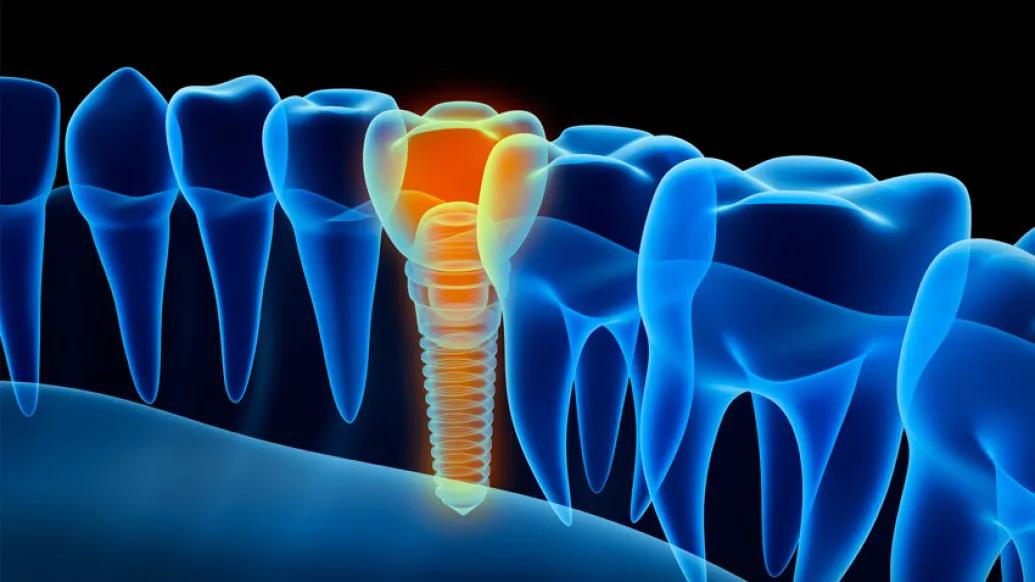
Although dental implant-supported crowns offer aesthetic, functional and natural-feeling tooth replacements, and the market is estimated to reach $6.8 billion by 2024, the emerging endemic of peri-implantitis has severely compromised the long-term success of implant dentistry.
Roughly one-quarter of dental implant patients are threatened by peri-implantitis, a destructive inflammatory process that infects the tissue and bone around dental implants. It can lead to progressive bone loss, bleeding, pus and eventual loss of the dental implants and associated crowns or dentures that they support. Replacement of a new dental implant at the previously damaged site is often challenging because of poor bone quality and delayed healing.
Unfortunately, there is currently no reliable way to assess how patients will respond to treatment of this condition.
To that end, a team led by the University of Michigan School of Dentistry developed a machine learning algorithm — a form of artificial intelligence — to assess an individual patient's risk of regenerative outcomes after surgical treatments of peri-implantitis.
Like Podcasts? Add the Michigan Medicine News Break on iTunes, Google Podcasts or anywhere you listen to podcasts.
The algorithm is called FARDEEP, which stands for Fast and Robust Deconvolution of Expression Profiles. In the study, researchers used FARDEEP to analyze tissue samples from a group of patients with peri-implantitis, who were receiving reconstructive therapy. They quantified the abundance of harmful bacteria and certain infection fighting immune cells in each sample.
According to senior author and assistant professor of dentistry Yu Leo Lei, D.D.S., Ph.D., patients who were at low risk for periodontal disease showed more immune cells that were highly adept at controlling bacterial infections. Lei, who has an appointment at the University of Michigan Health Rogel Cancer Center, also added that the team was surprised that the types of cells associated with better outcomes for implant patients challenge conventional thinking.
"Much emphasis has been placed on the immune cell types that are more adept at wound healing and tissue repair," he said. "However, here we show that immune cell types that are central to microbial control are strongly correlated with superior clinical outcomes."
Surgical management can reduce bacterial burdens across all patients. Nonetheless, only the patients with more immune cell subtypes for bacterial control can suppress the recolonization of pathogenic bacteria and show better regenerative outcomes.
MORE FROM THE LAB: Subscribe to our weekly newsletter
"Regenerative therapy for peri-implantitis is expensive and treatment outcomes are unpredictable," said first author Jeff Wang, a U-M clinical assistant professor and principal investigator for the regenerative treatment of peri-implantitis clinical trial. "It would be very helpful if we could use the information to determine the best course of treatment, or maybe we'd decide that the more sensible option would be to replace an old implant with a new one, despite the challenge to rebuild the bone."
According to Wang, in the future, it may be possible to predict the risk of peri-implantitis before a dental implant is placed. More human clinical trials are required before FARDEEP is ready to be used widely by clinicians.
"However, this proof-of-concept study offers a personalized approach to identify the types of patients that better respond to regenerative therapies," said co-author William Giannobile, a professor of oral medicine, infection and immunity, and dean of the Harvard School of Dental Medicine, who was previously at the U-M School of Dentistry.
This article was additionally edited by Allison Mi.
This was originally published on the University of Michigan website.

Health Lab
Explore thousands of health news & research stories by visiting the Health Lab homepage for more.
Media Contact

Public Relations
Department of Communication at Michigan Medicine
Stay Informed
Want top health & research news weekly? Sign up for Health Lab’s newsletters today!
Featured News & Stories

How have diagnostic and treatment decisions for prostate cancer changed in recent years?
Immune system protein is a cancer killer on its own, new study shows

Online resources and coaching helped people seek genetic testing for cancer

Top 7 tips for choosing Medicare prescription drug coverage for 2027

‘Molecular glue’ stabilizes protein that inhibits development of non-small cell lung cancer and uterine cancer