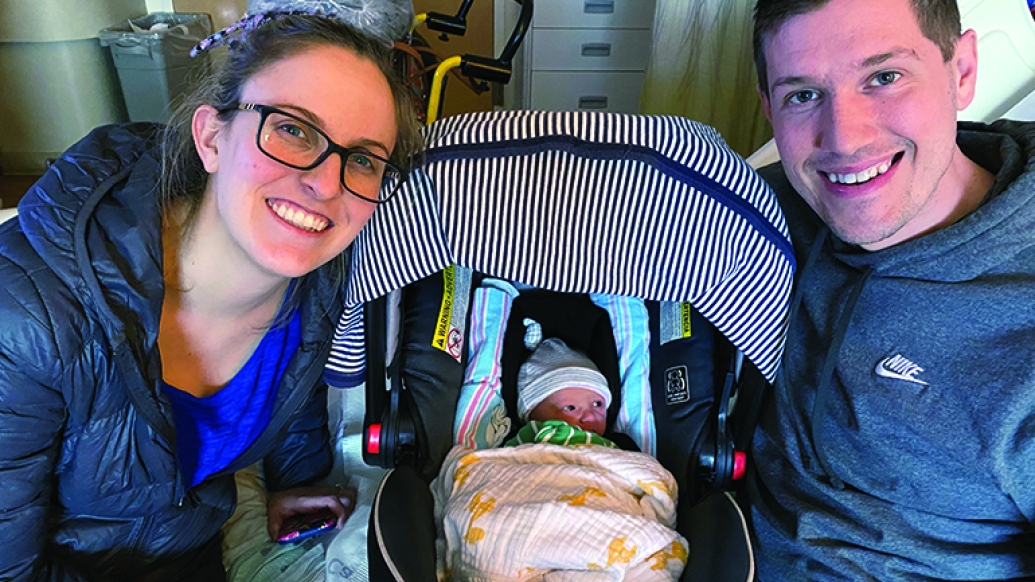
Michele and Bobby Johnson were sure they had plenty of time before the birth of their son. At one day short of 38 weeks, Michele was thrilled that her pregnancy had made it to term. Three years ago, their first son, James, was born 10.5 weeks early and spent 52 days in the neonatal intensive care unit at C.S. Mott Children's Hospital. "U-M is really special to us," says Michele. "They're the reason that he's doing as well as he is now. He's just a normal boy."
This time around, everything was blissfully normal. Michele's labor began at 11 a.m. on March 29. A couple of hours later, the couple dropped James off with his grandparents and started the 30-minute drive from Northville to Von Voigtlander Women's Hospital. Michele's contractions were about six minutes apart at that point, and they were feeling calm.
"We were halfway there when, all of a sudden, labor progressed really fast," says Michele. "Everything accelerated," including Bobby's speed on the highway. "I was panicked that we weren't going to get there on time. It was really scary, honestly."
When Bobby pulled into the circle drive at C.S. Mott Children's Hospital and Von Voigtlander Women's Hospital, he ran to the door and yelled for help. But because of COVID-19 protocols, there were several layers of Guest Services and Security staff between the Johnsons and health care providers. Bobby ran back to the passenger side of the car to get Michele out, but her door was locked. "I was in too much pain to do something like unlock the door," says Michele. Bobby raced to the driver's side, reached across Michele to unlock her door, ran back to the passenger side, and opened the door just in time for their baby to fall into his hands.
Bobby got the umbilical cord out of the way and hugged his son. Unsure if the newborn was breathing, Bobby pulled him away. Jack started crying, "and we knew everything was going to be OK," says Michele. That's when a nurse, walking into the hospital to begin her shift, came to their aid. "She told us to put him on my chest, which neither of us had thought of." It wasn't something Michele had experienced with the birth of her first child. Because James was so premature, he was whisked away immediately for emergency care.
It was a chilly day, and they scrounged what blankets they could find in their car to cover Jack. Things had gone so quickly that when the hospital workers arrived to help, "it was essentially over," says Michele. "It was kind of funny at that point. I had my pants off, and I was trying to get onto a stretcher outside in front of all those people."
Unlike many women who were nervous to give birth at a hospital during the pandemic, Michele thought it was her best option. Her labor was unexpectedly short, but, she says, "It was a happy shock. … It was such a relief just knowing he was a healthy baby, and no one was freaking out."
Michele chalks her equilibrium about the pandemic up to wisdom gained with her first son's birth. "There's a lot you can't predict with delivery," she says. "It's very easy to get caught up in stuff that's a little different than you expect." Before Jack was born, Johnson had been researching epidurals and pain medication for her delivery. But she ended up having another natural birth. "Not by choice," she notes, with a laugh.
The Johnsons' short stay at Von Voigtlander was quiet and uneventful. People were keeping to their rooms as a pandemic precaution, and the Johnsons were assured there were no COVID-19 patients on the labor and delivery floor. Back at home, the only thing bothering Michele was Jack's 2-day-old checkup. She had to take him to a Michigan Medicine clinic in Canton because the one nearer her home had been closed for the pandemic. But they ended up being the only people in the waiting room.
There have been some benefits to caring for a newborn during quarantine, Michele says. She's glad there's no pressure to get Jack out in public or have guests over to see the new baby. Even their two-week checkup was done via video. "We're home 24/7, and I don't have the fear of missing out as much, because everyone else is home 24/7 as well."
Featured News & Stories

NASCAR star’s death shows how sepsis can kill anyone if not caught

Addressing Senior Social Isolation in the Community

Serious disparities persist in maternal death rates in the U.S.
How donor eggs helped one couple build the family they always hoped for
The Impact of Social Isolation and Loneliness on Cognitive Health