Two degrees, one vision

Author | Katie Whitney

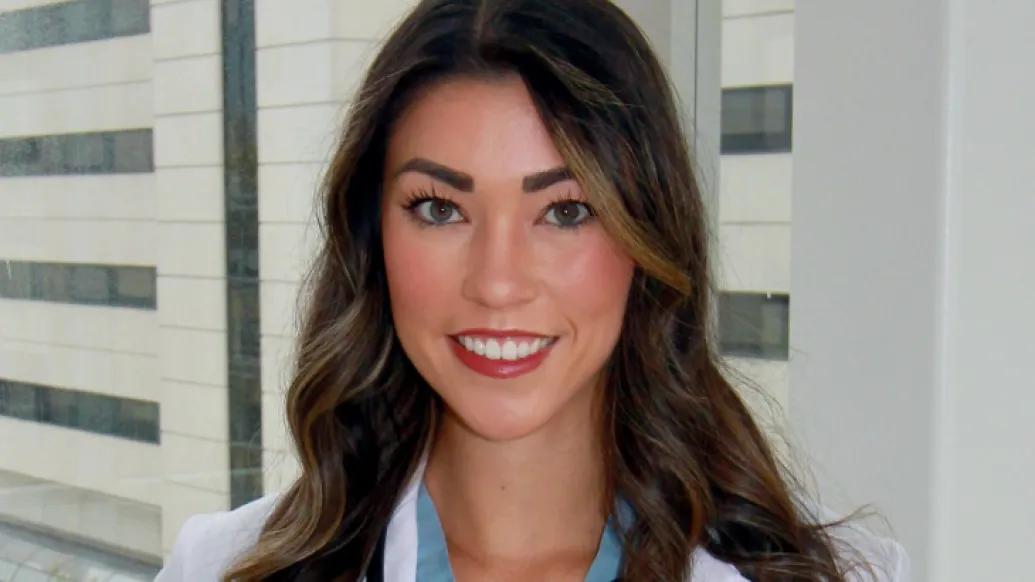
A young Asian American woman with long curled brown hair, wearing blue scrubs, a white doctor's coat, and a stethoscope

Before medical school, Serena Bidwell worked as a health services researcher at Stanford University.

“My boss there — I credit her a lot — she told me I could spend 10% of my time working on anything of interest to me as long as it was productive,” Bidwell says.

Bidwell used that freedom to develop a collaboration between Stanford and SMASH, an Oakland, California-based nonprofit that offers summer STEM programs to high schoolers.

When it was time for her to choose a medical school, she wanted a place that, like her boss at Stanford, would give her the support to pursue her passion. She was particularly interested in Doctors of  Tomorrow, a pipeline program that prepares Detroit-area high school students for careers in health care.

“Doctors of  Tomorrow is a huge reason I decided to come to Michigan,” she says.

Since she arrived at U-M in 2019, Bidwell has worked with Doctors of  Tomorrow, stepping into leadership roles and helping the program transition to a virtual plat­form during the pandemic. She’s had to think deeply about the different experiences of the students she’s been working for. “If we do something virtual, will they all be able to access it?” she asked herself. “Do they have internet? Will they have enough time in their schedule to participate if they have additional responsibilities at home?”

Bidwell is pursuing two degrees at U-M — an M.D. and an MBA — with a focus on nonprofit development. Her desire to give back to underserved communities was inspired by her parents:

“A lot of it stems from my parents’ backgrounds. My dad grew up on a farm. He milked cows before school, and he was the only one of his brothers to go to college. For him, education was a means of elevating his career. He ended up being a high school math teacher and administrator. My mom was the daughter of two immigrants from Taiwan. She grew up in poverty and got through medical school on Pell grants. Now, she is a surgeon-scientist with an NIH-funded research lab. Both of them have had education as a core value. Both have struggled in the sense that they came from very little and were able to persevere. I was given two parents who excelled because of their education. Now, I’m trying to give back to the next generation.”


More Articles About:

U-M Medical School Medical School Doctors of Tomorrow Medical Students

Related

Medicine at Michigan

Medicine and Law

A dual enrollee is focusing on his “why.”

Featured News & Stories

UMich Med Mosaic on blue background with colorful geometric shapes
UMich Med Mosaic

Beyond the White Coat: Global & Local Health Experiences

In this UMich Med Mosaic, host Mackenzie Kay talks with medical students Amanda Cassetti, Emily Gitlin and Evelina Hristova about how they’ve engaged in service through initiatives like the U-M Student-Run Free Clinic, Wolverine Street Medicine and Global REACH. They reflect on building trust with patients, navigating care in nontraditional settings and the importance of ethical engagement. The conversation explores how these experiences have shaped their skills and aspirations and reinforced that service can be a critical part of becoming a physician.
Well-Being at Michigan Medicine with Dr. Elizabeth Harry
Well-Being at Michigan Medicine

Supporting Student Success: Building Well-Being into Medical Education

Medical school has always been demanding, but today's learners face new pressures—from increasing uncertainty and academic intensity to stigma around asking for help. In this episode, Elizabeth Harry, M.D., welcomes Seetha Monrad, M.D., Associate Dean for Medical Student Education, and Erin McKean, M.D., Assistant Dean for Student Affairs, to discuss how Michigan Medicine is embedding well-being into medical education through thoughtful assessment, expanded mental health resources and a culture that helps students succeed without lowering expectations.
Michigan Medicine Presents in spotlights on blue background
Michigan Medicine Presents

Michigan Medicine Presents: Tommy Wang, M.D., Dean, University of Michigan Medical School

Join MD student Cassie Evans and PhD student Sam Collie for a wide-ranging conversation with Dean Tommy Wang, M.D. As he reflects on his journey to medicine and academic leadership, Dr. Wang shares his perspectives on student well-being, artificial intelligence, education, research and patient care through the lens of his new role as dean of the University of Michigan Medical School.
U-M hospital
Health Lab

Doctors in the house: History of medical interns and residents at Michigan Medicine

Terms like house officers, interns, residents, PGY, and clinical fellows are all part of academic medicine today. But these ways of describing clinical training stages all grew over times since the late 1800s.
A person wears a protype infant sling on the front of their body. The sling has a special window to allow light to reach the baby.
Health Lab

Medical student’s invention aims to help infants with jaundice

University of Michigan medical student Daniel John has created BiliRoo, a low-cost, non-electric device designed to treat jaundice in newborns
The Fundamentals Podcast Hero Card Final 1800 x 1350
The Fundamentals

The Race to Uncover the Hidden Causes of Idiopathic Pulmonary Fibrosis

Season four of The Fundamentals is here, and we're celebrating by doing a special two-episode release to launch the season! On this episode of The Fundamentals, we talk to two clinician scientists determined to unlock the mysteries of idiopathic pulmonary fibrosis. Dr. Marc Peters-Golden and his mentee, Dr. Sean Fortier, discuss their research and the race to uncover the hidden causes of IPF to offer new hope to patients. Be sure to check out our second launch episode and our entire back catalog on The Fundamentals website, or on your favorite podcast player.