Starting medical education on day one of undergrad
Med School alums remember Inteflex, a decades-long program that blended undergraduate and medical studies, granting first-year students admission to the Medical School
Author |
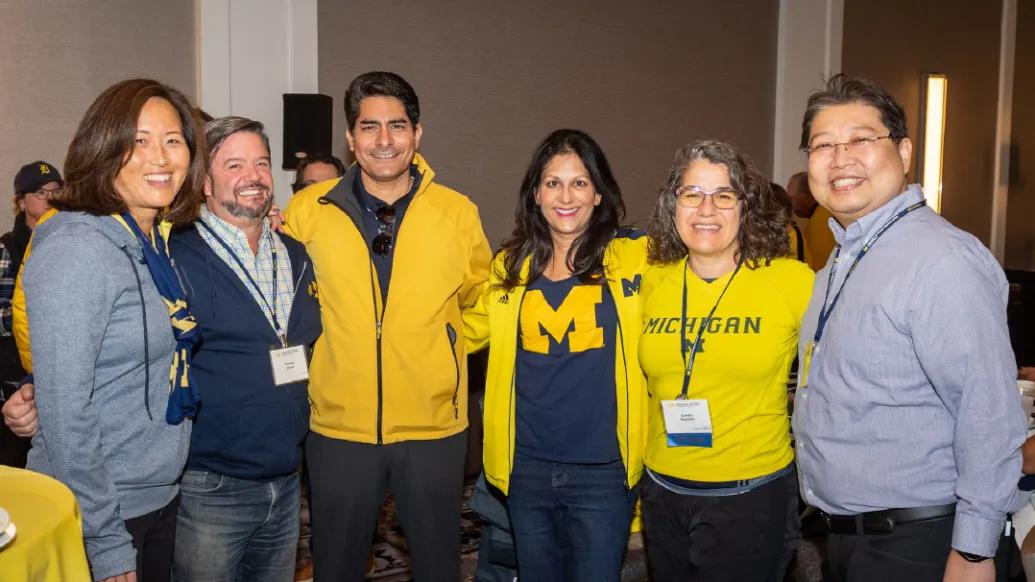
Lewis Sandy was already accepted into medical school during his freshman year at the University of Michigan, but he took engineering classes, just in case he decided to switch his major.
But the next summer changed everything. Sandy was a student in Inteflex, the Integrated Premedical-Medical Program, a bygone program designed to accelerate the path to a medical degree. One of Inteflex’s signature classes was Introduction to Patient Care, a first-year preceptorship that sent students to live with physicians throughout the state.
Sandy spent summer 1977 in Crystal Falls, a tiny town in the Upper Peninsula. He shadowed a family doctor, one of four local medical professionals. The experience solidified his future.
“It was a mixture of science and people and dealing with a whole diversity of biomedical issues, family issues, social issues,” Sandy says. “And I said, ‘This is terrific. Forget about engineering. I’m sticking with the program.’”
Sandy (M.D. 1982) was one of the Inteflex alumni from across decades who gathered in October 2022 to reflect on the program’s history and impact.
Art Meets Medicine
Fifty 17- and 18-year-olds made up Inteflex’s first class in 1972. The program was experimental, an alternative path intended to accelerate medical education and train more humane doctors. The original curriculum took six years, blending courses in the College of Literature, Science, and the Arts, Inteflex-specific seminars and classes, and clinical clerkship. At the end of six years, the students earned both a bachelor’s degree and an M.D. Susan Cohen Zeltzer (M.D. 1981) entered Inteflex in 1975, drawn to the program’s residential nature and reduced academic pressure. Until 1994, Inteflex students were granted automatic admission to the Medical School.
“Inteflex allowed a path toward medicine for people who might not have chosen to go through the rigors of premed and the competition to get a spot yet had so much value to add to the field of medicine and to give to people in the future,” says Zeltzer, whose career was focused on practicing and teaching family medicine before she retired in 2020.
In Inteflex, Zeltzer studied dance, English, and philosophy alongside biology and chemistry. She recalls one classmate who played French horn, and another on the football team — Mark DeSantis (M.D. 1981), one of a few Wolverine athletes who were part of Inteflex in the 1970s.
Betty Chu (M.D. 1995) played clarinet in the marching band and participated in club volleyball while she was a medical student. She said Inteflex’s emphasis on medicine as an art has resonated throughout her career, from her OB/ GYN residency to her role as chief quality officer for Henry Ford Health.
The Inteflex philosophy especially hit home during her preceptorship. At age 18, she spent the summer in Whitehall, where, among many valuable experiences, she observed her first childbirth.
“Before you really knew anything about the science of medicine, you got to see medicine practiced in all different varieties and settings and be connected to the compassion and the heart of medicine,” Chu says.
A Legacy of Care
The Inteflex curriculum evolved over the years in response to student needs and changes at the Medical School, stretching to seven years in 1982 and eight years in 1994.
In 1997, a committee of students, counselors, alumni, and staff reviewed the program, leading to U-M’s decision to discontinue Inteflex. The last students entered in 1998, and the Inteflex offices closed in 2002.
Still, the legacy of Inteflex continues in the generations of physicians across Michigan and the country whose education started in the program. Inteflex graduates have supported each other’s careers — Zeltzer, for example, mentored four students for their preceptorships in Detroit before the program closed, and two of those students later lived with her family during their family medicine rotations.
The interdisciplinary mission of Inteflex also lives on in Michigan Medicine’s Paths of Excellence program, which includes an option for medical students to integrate arts and humanities into their education.
Though the final Inteflex students graduated from medical school more than 15 years ago, the program’s ideas continue to influence medical educators and health care providers today. Sandy, now executive vice president for clinical advancement at UnitedHealth Group, says above all, Inteflex showed him there are always multiple ways to do things.
“That philosophy is something that we need more of in health care,” he says.
Sources: Ann Arbor News, Sept. 10, 1972, Ann Arbor District Library; Bentley Historical Library Integrated Premedical-Medical Program (University of Michigan) records: 1972-2002; Michigan Daily, Sept. 23, 1982, and Oct. 28, 1994, The Michigan Daily Digital Archives
Featured News & Stories
Is the United States Lagging Behind Europe in Memory Improvement?
The Care Ecosystem: Supporting People Living with Dementia and Their Families
College of Pharmacy alum advances U-M Medical School addiction research
Rethinking how clinicians learn to feel disease
Rethinking care: How ‘de-implementation’ can improve quality and reduce burnout