A Paralympian medical student feels grateful for unexpected gifts
How cancer and a scholarship changed the course of Sam Grewe’s life
Author |
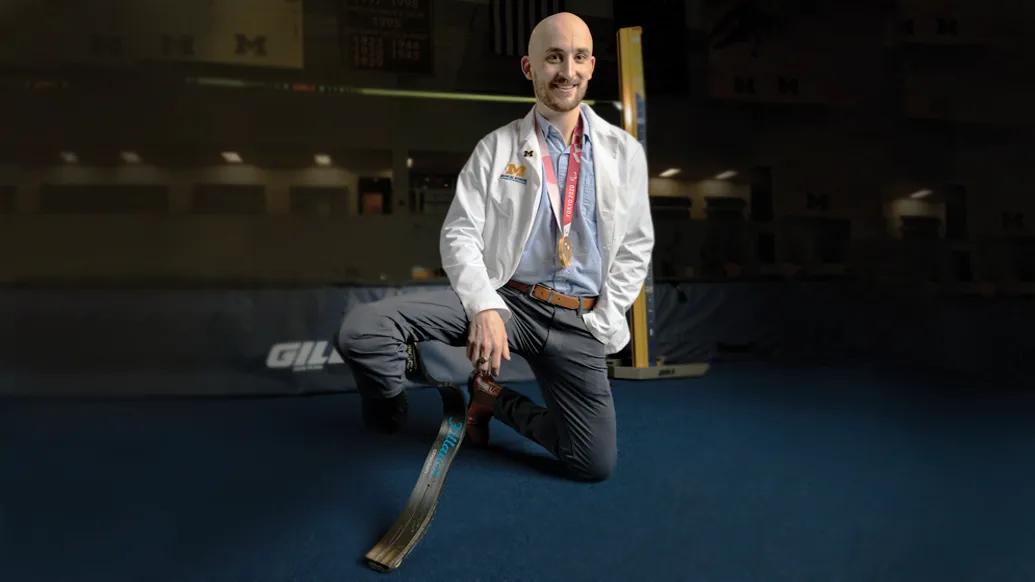
It was a gift, Sam Grewe recognizes now.
It came on Christmas Eve, 2011. Grewe, age 13, was in his hometown of Middlebury, Indiana. He learned that the fist-size growth attacking his femur was osteosarcoma.
His fight hospitalized him for two years. He elected to have his leg amputated using a rare procedure called rotationplasty, which uses the ankle joint to create a new knee joint. Grewe, then a seventh grader, chose this rare surgery because two working knees would help him stay involved in athletics — football, basketball, and lacrosse were his passions.
Now, having finished his second year of medicalschool at U-M and prepping for the 2024 Paralympics in Paris, he credits that life-changing diagnosis and amputation for making him who he is today.“As awful and challenging as it was ... I believe I learned so many lessons,” Grewe says. “I developed a really important perspective on life.”
A life-changing phone call
When Grewe left the hospital for the final time, he realized he wanted to become a physician.
“I really got a good glimpse into what it means to be a good doctor,” he says. He wanted to help someone else through the experience.
His lofty ambition had an obstacle, though. He missed his middle school education because of his health, so he buckled down on the books. It worked. He was accepted into all the medical schools he applied for, including Stanford, Yale, Harvard, and U-M.
One phone call made the decision easy for him.
A half hour after being accepted into the Harvard Medical School, Steven Gay, M.D.’s name popped upon Grewe’s phone.
“I remember it being kind of alarming. Why is the dean calling me?” Grewe recalls. Gay, who was then dean of admissions at the U-M Medical School, told Grewe he won a Dean’s Scholarship, a full-tuition award that would allow him to take an additional one-year degree if he would like.
Grewe was stunned.
“A lot was happening that day as far as what decisions I was going to have to make and rather quickly with deadlines approaching,” he says. “To get that phone call was truly life changing.”
Any concerns about taking out loans evaporated. “Honestly, one of the cool things about the Dean’s Scholarship is it allows recipients to pursue the career that they want” rather than one that would pay off the loan, he says.
Besides free tuition, U-M had other pluses, too. It helped that Mady Martinez, his girlfriend, got into the Medical School. Grewe also was happy with U-M’sAdaptive Sports & Fitness program.
Chasing gold
It was a prosthetist who originally nudged him intopara-athletics. Grewe dove in, discovering the world of high jumping in 2014.
A year later, he competed internationally for the United States. He won the world title for high jump T42, a classification to compete against other above-the-knee amputee athletes. He went on to represent Team USA and won a silver medal in Rio de Janeiro at the 2016 Paralympics.
After beginning an undergraduate degree at the University of Notre Dame, he joined the track andfield team. That helped him prepare for the pandemic-delayed 2021 Tokyo Paralympics.
Facing his toughest competition, he won gold for Team USA.
“I won, but it was a day of bad jumps because it was pouring rain. It was like a monsoon,” he says. He was constantly slipping on the track, but he knew what it took to triumph over adversity.
Now he’s working to balance his Paralympic training with his new priority: medical school.
“My goal is not necessarily a gold medal, but just to be on a team and to go and experience it one more time,” Grewe says. “Because it’s been such an important identity for me being a Paralympic athlete, I want to be able to inspire others and be in that role.
Featured News & Stories
Beyond the White Coat: The Med Student Tradition Behind Michigan’s Smoker
Rethinking how clinicians learn to feel disease
College of Pharmacy alum advances U-M Medical School addiction research
Rethinking care: How ‘de-implementation’ can improve quality and reduce burnout

The Questions That Shape the Future of Medicine