When Victor Agbafe was asked to be the national director for medical student outreach for the #ThisIsOurShot campaign, he was ready to fight in what he calls "the battle of 2021": getting shots into arms. He knew his understanding of both medicine and policy would help the cause. "When the end of your life comes, can you look back and say, 'We used our talents and blessings to help create a better society, a better tomorrow for the people to come'? … That's my 'why.'"
Agbafe is now in his second year of medical school, and he already has a dizzying CV. As an undergraduate at Harvard, he interned for senator Elizabeth Warren, spent a summer at a policy think tank, and researched the connection between state policy and health outcomes for his senior thesis. He served on the Joe Biden Health Policy Committee from May-November 2020. He's written for publications ranging from USA Today and Politico to Medpage Today, Health Affairs blog, and Stat News on topics such as health care for Black Americans, COVID-19, a proposed mental health corps, telehealth, medical misinformation, and insurance coverage. Now he's taking on medical school at the University of Michigan and — at the same time — law school at Yale University.
He says medicine and law both have their own language. "If I understand a system's language, I can ask higher level questions. When it comes to … medical care and policy, understanding the law will allow me to ask those deeper probing questions. As physicians in training, we need to understand and engage in the political and policy worlds, because political outcomes have an impact on our ability to best care for patients and improve public health."
Although he has a keen understanding of the minutiae of politics, he never strays far from the big picture. "How do we create a society where people have a chance to self-actualize and pursue their dreams? None of that is possible if you don't have good health and access to health care," he says.
While Agbafe takes on the weighty commitments of medical school and law school, he says running, listening to music, and taking road trips with friends and family on breaks keep him grounded. He also credits faith and family. "Those are things that help me stay grounded on the 'why' and remind me to appreciate life and the lessons it offers through the ups and downs — what this is all about.
"And then in a broader lens, my interests in health policy, the writing I like to do, the health services research I get to do here at Michigan — those are things that give me joy. Trying to make an impact in things I feel passionate about and making friends along the way — that prevents burnout.
"I've been thinking about this lately: How can I find joy and maximize appreciation for the everyday aspect of the journey? The write-up on the patient I get to see, the feedback I get from a mentor, interacting with my classmates. More and more I think less about a final destination than about the process and people I get to enjoy it with."
Featured News & Stories

Beyond the White Coat: The Med Student Tradition Behind Michigan’s Smoker
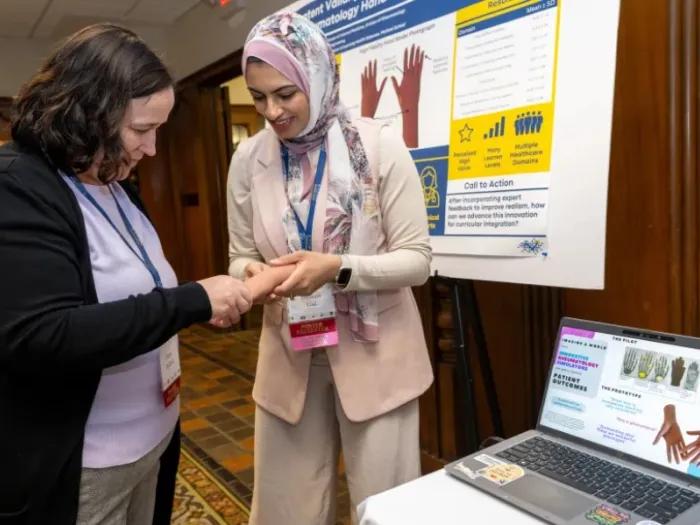
Rethinking how clinicians learn to feel disease
College of Pharmacy alum advances U-M Medical School addiction research
Rethinking care: How ‘de-implementation’ can improve quality and reduce burnout

The Questions That Shape the Future of Medicine