Medical School graduate marks another milestone with the ECMO legend who helped save her life

Author | Katie Whitney
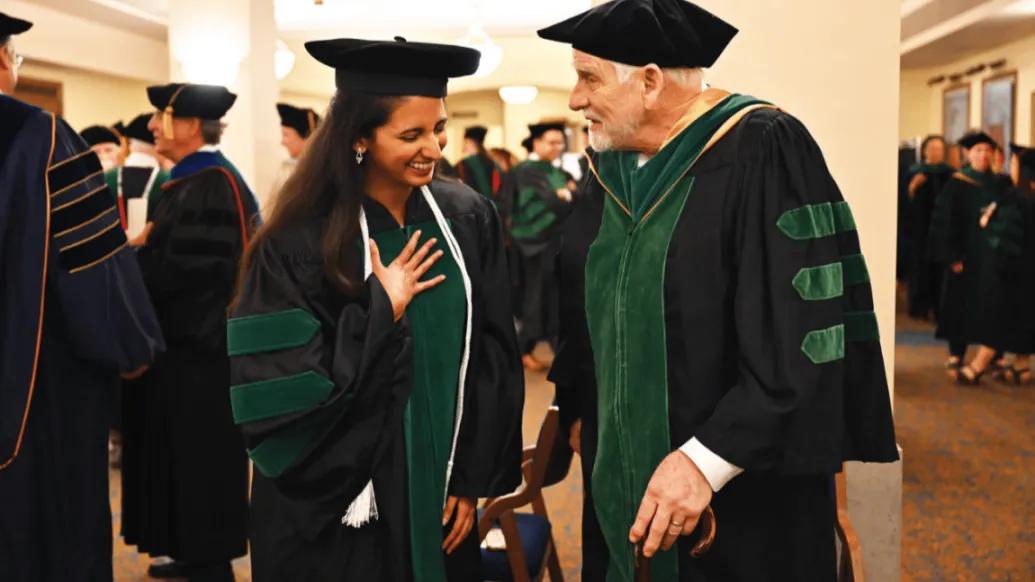
Two people in black and green graduation robes share a happy moment of celebration in a crowded lobby. The woman on the left is younger and smiling or laughing. The older man on the right is carrying a cane and smiling at the woman.
Hannah Abraham (M.D. 2023) and Robert Bartlett (M.D. 1963) at the 2023 U-M Medical School graduation ceremony. Photo by Austin Thomason.

Hannah Abraham (M.D. & Ph.D. 2023) was born with her umbilical cord wrapped around her neck. Close to asphyxiation, she was airlifted to C.S. Mott Children’s Hospital and placed on extracorporeal membrane oxygenation, or ECMO, where she remained for days. Robert Bartlett (M.D. 1963), professor emeritus of surgery, who is credited with developing ECMO, was part of the care team that saved Abraham’s life.

Decades later, Abraham enrolled at U-M, where she continued her relationship with Bartlett. She worked in his lab as an undergraduate, and she was even cloaked by Bartlett at the 2015 White Coat Ceremony when she began medical school.

In May, Abraham graduated from the Medical School, and Bartlett was there to mark another milestone in her life, giving Abraham her diploma during the commencement ceremony.


More Articles About:

Medical School

Featured News & Stories

women looking at model hand in front of poster and computer on table next to them
Health Lab

Rethinking how clinicians learn to feel disease
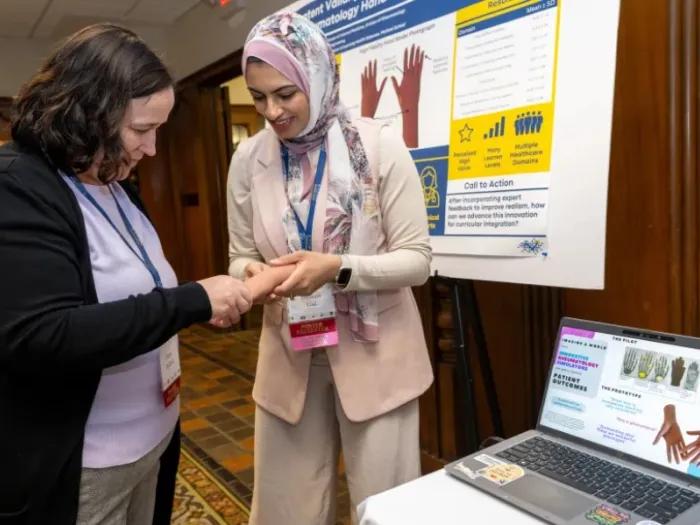
For most doctors, learning to recognize swollen joints begins in the classroom. A clinical assistant professor in Michigan Medicine's Division of Rheumatology saw a gap in how to distinguish subtle swelling in joints, thus creating a hand simulator to help.
Portrait of Thomas Macek. He's wearing a navy blazer and light blue button-down shirt.
Philanthropy News

College of Pharmacy alum advances U-M Medical School addiction research
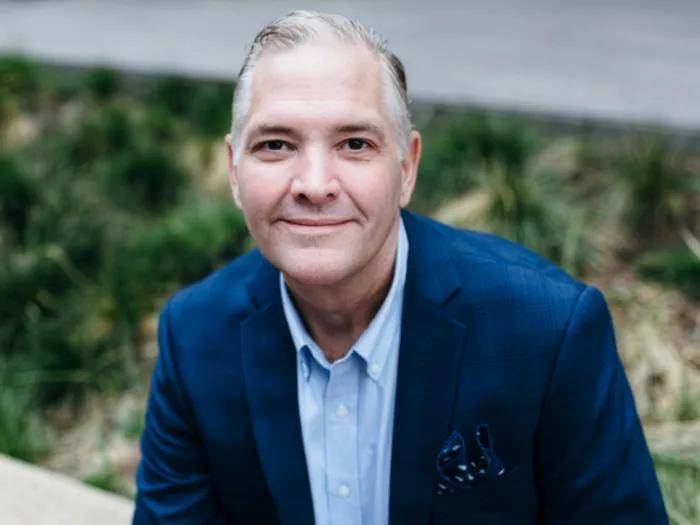
Grateful for support that help launched his career in pharmacology research and drug development, Tom Macek, Ph.D., has made a gift to the University of Michigan Medical School to advance addiction research.
Well-Being at Michigan Medicine with Dr. Elizabeth Harry
Well-Being at Michigan Medicine

Rethinking care: How ‘de-implementation’ can improve quality and reduce burnout
In this episode of Well-Being at Michigan Medicine with Dr. Elizabeth Harry, Dr. Eve Kerr explores the concept of de-implementation—scaling back unnecessary tests, treatments, and administrative hurdles. Kerr shares how eliminating low-value practices can reduce clinician overload, lower patient costs, and improve overall health outcomes. Discover how both healthcare organizations and local frontline teams can foster a culture of high-value care by eliminating outdated processes.
The Fundamentals Podcast Hero Card Final 1800 x 1350
The Fundamentals

The Questions That Shape the Future of Medicine
On this episode of The Fundamentals, we talked to Dr. Thomas J. Wang, dean of the University of Michigan Medical School, about the fundamental questions that have shaped his career and continue to drive biomedical research. Dean Wang discusses his work in cardiovascular research, the enduring impact of the Framingham Heart Study, the potential of AI and emerging health data, and the importance of collaboration between academia and industry. He also shares advice for the next generation of scientists and physicians and explains why sustained investment in biomedical research is essential to improving human health.
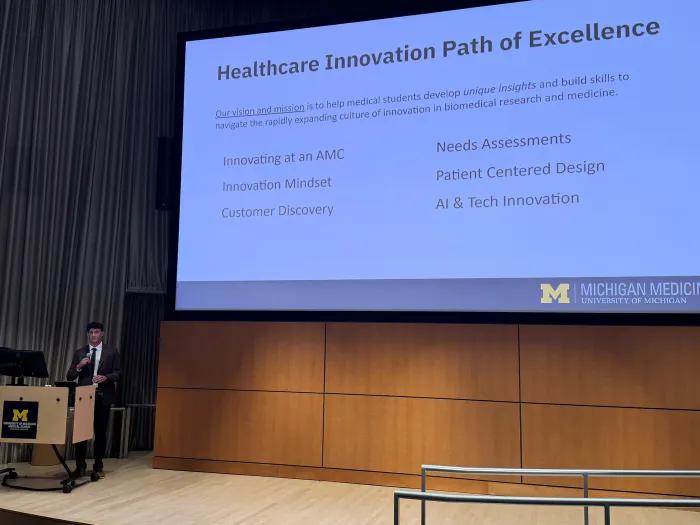
presentation on stage with slideshow up
Health Lab

Medical students develop novel technological solutions for unmet patient needs

University of Michigan medical students showcased AI-driven healthcare innovation projects focused on melanoma support, transplant recovery and primary care access.
UMich Med Mosaic on blue background with colorful geometric shapes
UMich Med Mosaic

Beyond the White Coat: Global & Local Health Experiences

In this UMich Med Mosaic, host Mackenzie Kay talks with medical students Amanda Cassetti, Emily Gitlin and Evelina Hristova about how they’ve engaged in service through initiatives like the U-M Student-Run Free Clinic, Wolverine Street Medicine and Global REACH. They reflect on building trust with patients, navigating care in nontraditional settings and the importance of ethical engagement. The conversation explores how these experiences have shaped their skills and aspirations and reinforced that service can be a critical part of becoming a physician.