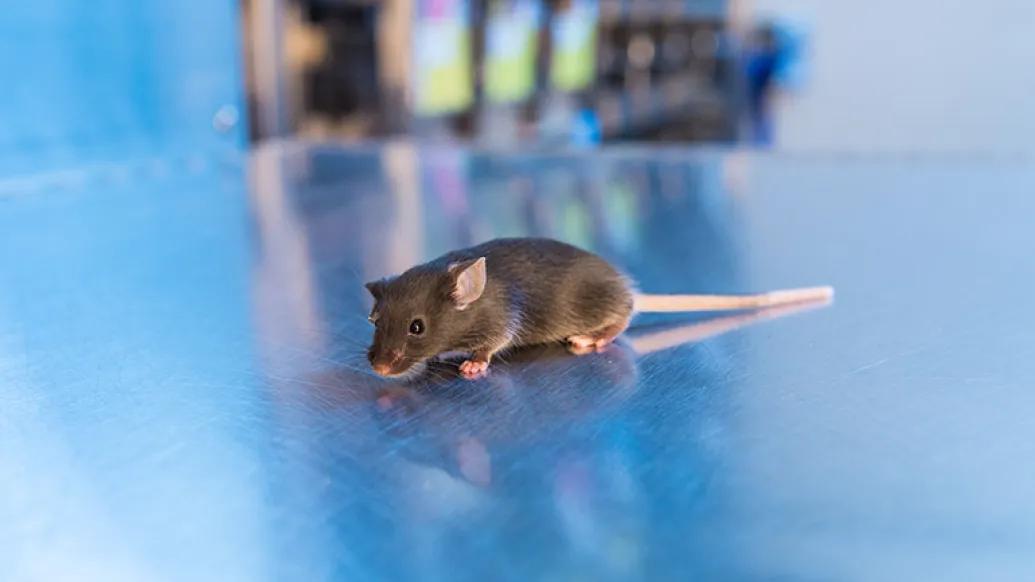
U-M researchers are genetically engineering a mouse that could have massive implications for our understanding of COVID-19. Phil King, Ph.D., professor of microbiology and immunology, with the help of researchers in his lab and the U-M Transgenic Animal Model Core, has figured out how to solve a big problem in COVID-19 research.
What was wrong with the old mouse?
In short, mice can't get COVID-19, so using a standard mouse model to look at the mechanism of the disease has heretofore been impossible. Some animals get COVID-19 and others don't. It has to do with a specific protein: SARS-CoV-2 connects to cells via the ACE2 protein on the surface of the cells. Within the human ACE2 protein, there are 22 amino acid residues that make physical contact with the spike protein from the virus. That's important in figuring out whether animal species will be susceptible. Macaque monkeys, for example, have 22 identical residues, making them susceptible to the virus. Mice, however, have only 14. In order to study COVID-19 in a mouse model, researchers need a mouse with the right ACE2 residues.
Why use mice at all, if there are other species that are already susceptible to infection by SARS-CoV-2?
"The mouse is a major tool in biology and medicine, in terms of understanding disease pathogenesis," says King. The mouse is ideal for this kind of research because its genome is able to be manipulated, there are lots of defined inbred strains (considered to be genetically identical), and "there are many more tools in this species than in any other species that would allow us to dissect the mechanism of disease."
How do you make a mouse susceptible to COVID-19?
The simple answer is that you insert human ACE2 into a mouse. This has already been done in some experiments, so researchers know that when human ACE2 is inserted into a mouse, that mouse becomes susceptible to SARS-CoV-2.
But there are a few drawbacks to these early experiments, says King. These experiments show unnatural patterns of tissue expression of human ACE2, over- or under-expression of ACE2 in tissues, and an inability to remove human ACE2 in select cells and tissues.
"That's where we come in," says King. In his lab, researchers are able to put human ACE2 into places where it's normally expressed in a mouse, but most importantly, they also are able to remove human ACE2 in select cell types. "So if we wanted to know how important, for example, the infection of an endothelial cell was to the overall pathogenesis of COVID-19, versus the infection of an epithelial cell, the goal would be to put the human ACE2 into the mouse, but then … ablate expression of that human ACE2 just in endothelial cells," leaving the human ACE2 expressed at its normal level in all other cell types.
The implications
Using this new mouse, researchers will study the effects of COVID-19 on lung cells, gut cells, nasal cells, immune cells, and endothelial cells that line blood vessels and lymphatic vessels. Where does the virus do the most damage? "How important, for example, is the nasal epithelium and ciliated epithelium in the lung airways for transmission of the virus from one individual to another?" asks King. "Is there a reservoir of virus in these epithelial cell types and is it virus from that reservoir that's being spread through air droplets?" If we know where the disease does most of its dirty work, we can begin to create targeted therapies for COVID-19.
This may have implications for other respiratory viruses as well. COVID-19 is a respiratory virus, but it also causes blood vascular problems, such as deep vein thrombosis (DVT). Though this pathology is less common in other respiratory viruses, it does happen with severe respiratory infections. King experienced it himself at the end of the last flu season. Although he was immunized, he contracted influenza and wound up in the emergency room with DVT, despite being a runner and having no risk factors that would have predicted DVT. This experience offered some additional motivation to understand how COVID-19 might lead to thrombosis, although his primary motivation in this research project is the greater good.
Tweaking the model
King has anticipated one problem with his new mouse model. Mice need ACE2 for vital functions, such as regulating blood pressure. If you remove human ACE2 in a specific cell type without turning back on the mouse ACE2, the mouse can experience cardiac fibrosis, hypertrophy, inflammation, abnormal cytokine levels, hypertension, pulmonary vascular congestion, weight loss, and increased morbidity. Of course, some of those symptoms are seen in COVID-19 patients, making any results observed using this method uninterpretable, says King. To fix this problem, the researchers will use Cre-Lox recombination to reactivate endogenous mouse ACE2 in the specific cell type whenever the human ACE2 gets ablated.
Where will the discoveries happen? It may not be at U-M.
King's project may lead to a collaboration with other institutions. In order to give mice SARS-CoV-2, researchers need a facility with a biosafety level 3 (BSL3). This second-highest biosafety level is required for any work involving microbes that can cause serious infection when inhaled. Right now, Michigan Medicine has a BSL3 lab, but it's only for tissue culture, not animals. Without an animal BSL3 lab, King will collaborate with researchers outside of Michigan Medicine to carry out the last stage of the work.
Note: The University of Michigan strictly adheres to all animal research guidelines. In addition to those guidelines, U-M researchers are committed to principles known as "the three Rs": reducing the number of animals used to the minimum required for the study, replacing animals with less sentient or non-animal models whenever possible, and refining all practices to provide the best animal welfare possible. Learn more about the Animal Care & Use Program at U-M.
Featured News & Stories
High dose oxytocin protocol linked to lower postpartum hemorrhage rates

Intuition pushed mom to keep checking for breast cancer

Antipsychotic Use in Nursing Homes: Balancing Medication Safety, Policy, and Dementia Care
4 ways to teach your teen safe driving habits

Human Rabies Exposures Growing Across the Country