Core Values
The U-M Medical Group has rolled out an initiative to promote collaboration between primary care and subspecialty physicians and improve patient access
Author |
Medical care has become increasingly specialized over the last two decades. In fact, visits to specialists account for more than half of all medical office visits in the U.S., according to the American Association of Medical Colleges, or AAMC, a national organization focused on quality and safety among academic medical centers. As more and more patients access specialty services, wait times are getting longer and coordinating care across multiple providers has become more challenging.
The University of Michigan is part of a AAMC initiative to increase access to and efficiency of specialty medical services by improving collaboration and communication between primary care and specialty physicians. The initiative is called Project CORE — Coordinating Optimal Referral Experiences — and it uses tools in the electronic medical record, or EMR, to refine the referral process.
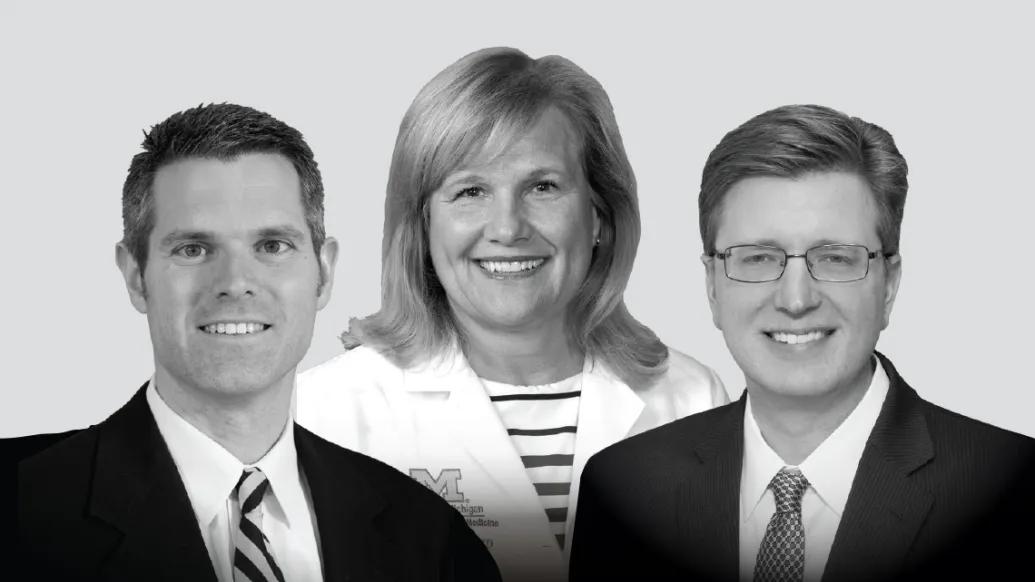
"I think patients choose to come to U-M because they recognize the excellence across all providers, and I think they have a general expectation that we're working really well together," says Rob Ernst (M.D. 1991, Residency 1995), clinical assistant professor and senior associate chief of general medicine for ambulatory care. "As our health system has grown, it has become increasingly more difficult to maintain close personal and professional relationships between primary care providers at community-based ambulatory health centers and specialists who work … at the main hospitals. The CORE project will be an innovative way to leverage our EMR to bridge those gaps and better provide the fully integrated care that our patients expect."
To streamline physician collaboration, the CORE model encourages the use of eConsults and enhanced referrals, both of which are implemented and used by providers in the EMR.
The CORE project will be an innovative way to leverage our EMR to bridge … gaps and better provide the fully integrated care that our patients expect. –Rob Ernst, M.D.
An e-consult allows a primary care physician, or PCP, to electronically consult with a specialist regarding specific questions about a patient's care plan. The intent is for the specialist to provide guidance on straightforward, low-complexity issues in lieu of an in-person patient visit, so that the patient's care can remain with the PCP. Traditionally, this type of exchange, referred to in the medical community as a "curbside consult," has been informal. Using the EMR for eConsults allows for more transparency and better documentation of these exchanges. In addition, there is compensation to the specialist for their consultative advice and to the PCP for submitting the eConsult, and for following up with the patient with the specialist's advice.
When a specialist visit is necessary, CORE's enhanced referrals create condition-specific templates within the EMR that help PCPs prepare patients. For example, the specialist may require new patients to complete a series of tests, or the PCP can help clarify the purpose of a specialty visit — whether the goal is for the specialist to take over their care or for the PCP and the specialist to co-manage the care. The templates will populate the referral in the EMR with relevant parts of the patient history and pre-referral evaluations. Enhanced referrals aim to make new-patient specialty office visits more meaningful and potentially reduce the need for return visits.
"An important part of our overall team goal is that we want to decrease the number of unnecessary patient visits," says John Stoffel, M.D., professor of urology, associate chair of ambulatory urology, associate medical director of ambulatory care services and specialty services lead for the CORE project at U-M. "We want the time they spend with the physicians to be high-value. We want to be able to make sure patients are getting the best care within the shortest amount of time by allowing our physicians to communicate more freely in a transparent and recordable way."
The CORE initiative, which the U-M Medical Group has implemented for referrals between U-M providers only, is being funded internally, with all Medical Group departments contributing. The initiative has been rolling out since early 2016 in neurology, endocrinology and rheumatology.
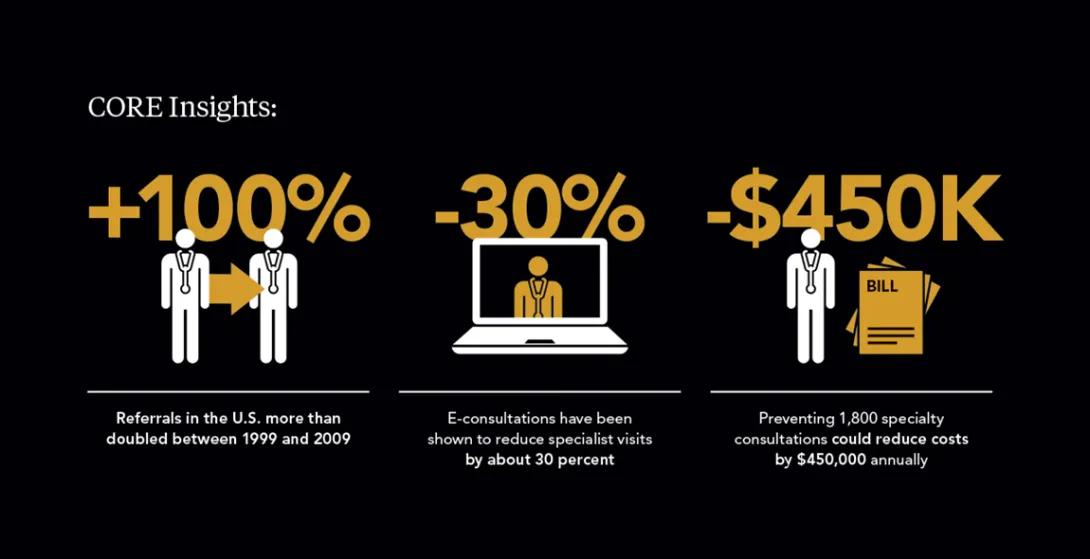
"The patients love it," says David Serlin, M.D. (Residency 2003), assistant professor of family medicine, associate chair for family medicine clinical programs, and the family medicine lead for CORE. "In the past, if I had a patient with diabetes, for example, and I had questions about their care management, I'd refer them for a visit to the endocrinologist. But because of the wait list for that specialty, we might not be able to get them in for an appointment for a couple of months. With an e-consult, I can get an answer from the endocrinologist within two or three days — sometimes within a day. [CORE] extends my capabilities, gets the patients answers to their questions more quickly, and frees up an appointment slot for another patient who really needs to be seen by an endocrinologist. It's a win, win, win."
More than a quarter of primary care and family medicine physicians have utilized the system since it began. Project leaders say they hope to apply CORE in every division and department within the next two years.
"There was a lot of organizational readiness when we were selected by the AAMC to participate," says Connie Standiford, M.D., executive medical director of the U-M Medical Group and ambulatory care services. "It's a new way of providing care that has proven to be successful at the pilot organizations from both the patient and provider perspective. The U-M Medical Group was forward-thinking in funding this initiative to help improve our access and our patient experience."
CORE was piloted at the University of California, San Francisco, and U-M is part of the second wave of AAMC organizations to roll it out. The first wave included Dartmouth-Hitchcock; the University of California, San Diego Medical Center; University of Iowa Hospitals and Clinics; University of Virginia Medical Center; and University of Wisconsin Health. The other five institutions in the second wave with U-M are East Carolina University Physicians; Greenville Health System; Ohio State University; University of Washington Medicine; and Wake Forest Baptist Health. The AAMC has provided support for each medical center, including online resources, site visits and opportunities for the institutions to share best practices during conference calls and in-person meetings.
Additionally, the U-M is recording key metrics — such as changes in patient wait times for specialist appointments — and will present results to the AAMC after one year of program implementation. But project leaders expect CORE and its benefits to continue to evolve long after that milestone.
"This is not a one-time implementation of a program," Stoffel says. "The idea is to develop and promote a culture of communication between specialists and primary care physicians. I think we all have common goals and we are all here for a common reason, and the U-M health care system has always advocated for quality care and good access for patients."
Featured News & Stories
AI, Well-Being and the Human Connection

The Care Ecosystem: Supporting People Living with Dementia and Their Families

The Kidney Warning Signs You’re Missing— And Why Waiting is Dangerous
Cyclospora: What to Know About the Parasite Sweeping the Nation

Got cyclosporiasis? How to take care of yourself and others