Celebrating 175 years of the Medical School: #54–69
This article is part of a special magazine issue celebrating the 175th anniversary of the U-M Medical School with profiles of 175 people who have been important in its history. See the full issue here.
Academic medicine involves teaching, research, and clinical care, each with its own joys and rewards. For me, infectious diseases was the most joyful and rewarding, especially at the VA, where I was able to teach students, residents, and fellows, work in my research lab, and care for truly wonderful patients.
—#54 Carol Kauffman (M.D. 1969, Residency 1971)
Kauffman is professor emerita of internal medicine at U-M. She spent more than four decades as chief of infectious diseases at the Ann Arbor VA. Kauffman was presented with the Veterans Affairs Society of Practitioners of Infectious Diseases Lifetime Achievement Award in 2015.
#55 Discovery opens new field of cancer research
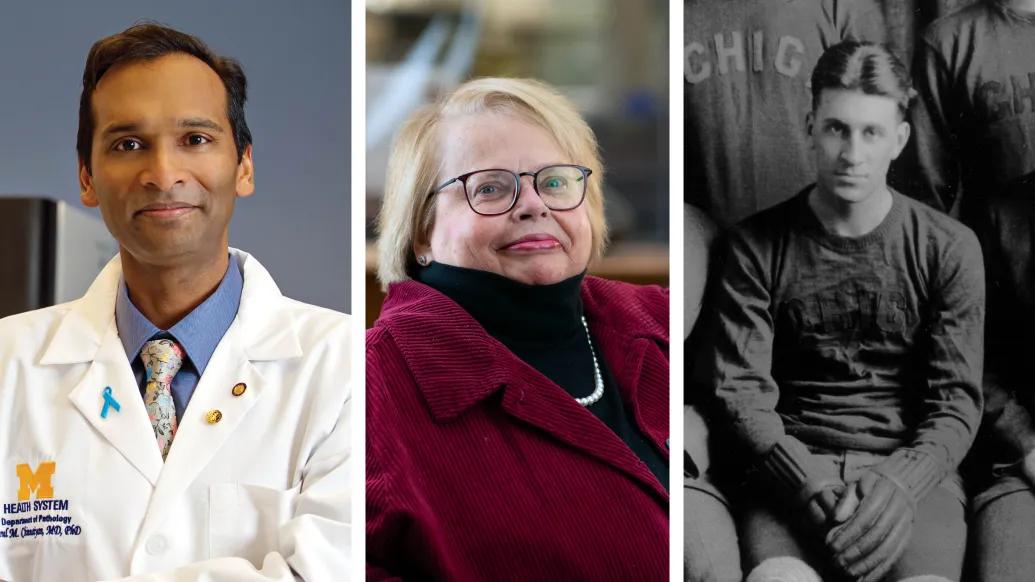
How prostate cancer develops was a mystery that puzzled scientists for many years. But in 2005, Arul Chinnaiyan (M.D. and Ph.D. 1999) published an enlightening discovery. In the 2000s, he helped build a database that allows scientists to share their knowledge about genes and cancer. At the same time, he was studying prostate tumors. Comparing his data to that of the database, Chinnaiyan discovered that in about half of the patients with prostate cancer, there was a fusion gene, which forms when chromosomes break apart and two genes join together. This particular fusion resulted in male sex hormones causing extra cell growth, which can lead to prostate cancer.
Chinnaiyan’s discovery opened a new field of research where scientists are now looking for fusion genes in other cancers. This has already led to a new treatment for lung cancer. For prostate cancer, the discovery has been a game-changer in early diagnosis, which can now be done with a urine sample.
In 2022, Chinnaiyan, who is the S.P. Hicks Professor of Pathology, and professor of urology, received the prestigious Sjöberg Prize for this work.
Source: “Sjöberg Prize 2022” YouTube video, Royal Swedish Academy of Sciences
#56 Dean of women
Eliza Mosher (M.D. 1875) graduated from the U-M Medical School only five years after the school opened its enrollment to women. In the 1890s, she was working as a physician in New York when then U-M president James Burrill Angell appointed her to be a professor of hygiene and the first dean of women. In her role, she acted as liaison to the 600 women at the university at a time when they were far outnumbered by male students. Mosher was the first female faculty member at the Medical School.
Source: “A Dangerous Experiment: Women at the University of Michigan,” U-M College of Literature, Science, and the Arts
#57 FIRSTS: Hockey and neurosurgery pioneer
In January 1923, Edgar “Eddie” Kahn (M.D. 1924) scored the first goal in the U-M hockey program’s 102-year history. He also was a pioneer in neurosurgery and served as chief of the neurosurgery department at U-M for 22 years.
Source: “He shoots, he scores!,” Michigan Today, February 18, 2013
#58 Sports neurologist
Jeffrey Kutcher, M.D. (Residency 2002), is an internationally recognized neurologist who specializes in diagnosing and managing concussions, post-concussion syndrome, and other neurological conditions in athletes. Prior to starting the Kutcher Clinic for Sports Neurology, Kutcher was the team neurologist for Michigan Athletics. He founded and directed the U-M NeuroSport Program, and established a sports neurology fellowship at U-M in 2012. He is the team physician for U.S. Ski and Snowboard, traveling with the team to the Olympic Games in 2014, 2018, and 2022. He is director of the NBA concussion program and has helped develop concussion policies for the NCAA.
Source: kutcherclinic.com
The inaugural Inteflex class of 1972 was propelled from high school to residency via a unique and accelerated transformative process that forever changed our lives and careers by focusing on patient-centered care in a collaborative way without the distractions of a competitive environment to successfully reach the next milestone. I will be forever thankful for Inteflex. Go Blue!
#59 Richard Paul Bonfiglio (M.D. 1978)
Bonfiglio is a physical medicine and rehabilitation specialist who was part of Inteflex, an alternative six-year curriculum that blended undergraduate and medical classes with clinical clerkship. Students earned both a bachelor’s degree and an M.D. The program was intended to train more humane doctors. Inteflex officially ended in 2002, but Bonfiglio still feels the positive effects of his education. “The greatest joy in medicine is a lifetime of sharing miracles with those that we serve,” he said in 2022.
#60 A dynasty of doctors, all at one university
From an early age, Robert Breakey (M.D. 1981) remembers hearing captivating stories about the exploits of his illustrious ancestors, the “Breakey Boys.” Four successive generations of Breakeys had earned degrees from the Medical School before Robert, starting with his great great grandfather, William Fleming Breakey (M.D. 1859). In wartime, Breakey doctors risked injury and death to care for the sick and wounded on the battlefields and front lines of the Civil War, Spanish-American War, and World War I. They also served their country in the military during World War II and the Korean War. In peacetime, the Breakey Boys ushered the practice and pedagogy of medicine into contemporary times by pioneering new medical specialties and modernizing the curriculum and teaching methods at U-M. The other Breakey Boys include James Fleming Breakey (M.D. 1894), Robert Stevens Breakey (M.D. 1924), and Barry Austin Breakey (M.D. 1953).
Source: “The Breakey Boys,” Michigan Today
#61 Pathology leader
After graduating cum laude from the Medical School, Gerald Abrams (M.D. 1955) continued at U-M, completing his internship and residency in pathology before being appointed to the faculty in 1959. Abrams left for two years of military service before returning to spend his entire career in the Department of Pathology. He became an expert in both gastrointestinal and cardiovascular pathology. A devoted teacher and mentor, Abrams contributed to the education of nearly 10,000 graduates of the Medical School. In 2014, the Department of Pathology established the Gerald D. Abrams Collegiate Professorship through donations made by former medical students and residents in honor of his teaching career.
Source: Obituary from the Department of Pathology
#62 Biochemist, rose grower, and ... sleuth?
During his 42-year career at the Medical School, Adam Christman, Ph.D., conducted pioneering medical research that helped solve multiple criminal cases. One of Christman’s major achievements was developing a carbon monoxide detection method. In 1936, a young woman named Bernice Blank died after a fire in her home. Forensic pathologists, using Christman’s method, discovered that Blank was dead before the fire ever started — a clear indication that she had been murdered. Her husband was convicted of the crime. Outside the lab, Christman was an award-winning gardener who was known to many simply as “the man who grows roses.”
Source: Ann Arbor District Library
Empowering women, for me, is about opening up doors and providing opportunities for women to succeed. Talent comes in many shapes, sizes, and colors. It is not defined by gender or race but rather by mind and soul. I seek to empower all people to create dreams and then to be able to reach for their dreams.
Muraszko is a professor of neurosurgery and former chair of the department. She was the first woman to head a neurosurgery department at any medical school in the U.S. She has spina bifida and has also been an advocate for accessibility, especially in the design of the new University of Michigan Health D. Dan and Betty Kahn Health Care Pavilion. “You won’t get to the front desk in a wheelchair and find yourself incapable of seeing someone easily,” Muraszko says.
Every human deserves an advocate. But women — and particularly women during their reproductive journeys — most certainly deserve advocates and voices of support. Many pregnancies are profoundly complicated, and those women and families deserve providers who walk that walk with them, hold their hands, and have the medical knowledge and skills to help them through whatever they may need. And that is who and what I wanted to be.
#64 Deborah Berman (M.D. 1999, Residency 2003, Fellowship 2010)
Berman is a professor of obstetrics and gynecology in the division of maternal fetal medicine. She leads the Perinatal Wellbeing Program at University of Michigan Health Von Voigtlander Women’s Hospital. The program is the first of its kind in the nation to offer evidence-based music therapy in addition to other services tailored to the needs of pregnant people.
#65 National Medal of Science winner
Former President Joe Biden awarded Huda Akil, Ph.D., the National Medal of Science in 2023. Akil is the Gardner C. Quarton Distinguished University Professor of Neurosciences at U-M, and she received the nation’s highest scientific honor for her groundbreaking research investigating the genetic, environmental, and developmental factors that shape the risk of mental health disorders.
Source: Michigan Medicine Department of Communications
#66 Atomic energy leader
John C. Bugher (M.D. 1929, M.S. 1931) worked for the U.S. Atomic Energy Commission from 1951–1955. He helped test fission and thermonuclear devices, leading to improved weapons, and his work contributed to developments in uses of atomic energy in the medical field. Bugher attended the First International Conference on the Peaceful Uses of Atomic Energy in Geneva, Switzerland, in 1955 as an official advisor to the U.S. delegation.
Source: Rockefeller Archive Center
#67 Type 2 diabetes discovery
In 1958, Stefan S. Fajans (M.D. 1942), then a professor of internal medicine in the division of metabolism, endocrinology, and diabetes, began studying a Michigan family with more than 360 members spanning seven generations. That family, which became known as the “R-W pedigree,” included 74 members with a form of non-insulin–dependent diabetes. However, the disease appeared unusually early in this family — it was diagnosed in children and adolescents, unlike the usual onset of type 2 diabetes after age 40. Fajans’ study of this family, as well as others, led him to name this subtype of type 2 diabetes as Maturity Onset Diabetes of the Young (MODY) in 1964. This form of diabetes appears in approximately 50% of each successive generation and is due to a mutation of a single gene. Fajans co-published the first paper to describe a genetic marker of MODY and the gene itself.
Source: University Record obituary; U-M Medical School biography
#68 FIRSTS: Comparative neuroanatomy genius
Elizabeth Crosby attended the University of Chicago, where she earned her Ph.D. in neuroanatomy in 1915. For her thesis, titled “The forebrain of Alligator mississippiensis,” she meticulously dissected the brain of an alligator and drew what she saw. The work remains important today.
In 1918, Crosby became the first woman to become a full professor at the Medical School. She also was the first woman to give the Henry Russel Lecture, the highest honor given to U-M senior faculty. Crosby was a renowned scientist who researched comparative neuroanatomy, which compared vertebrates to discover how the human brain evolved and functions. President Jimmy Carter awarded her the National Medal of Science in 1980 for her groundbreaking research in this field. At U-M, the Elizabeth Crosby Award has honored students and faculty for their excellence in the basic sciences since 1957.
Source: U-M College of Literature, Science, and the Arts; Medicine at Michigan, Winter 2022
#69 Neurosurgery collaborations
During World War II, Richard Schneider, M.D. (Residency 1948) served in North Africa, Italy, and France on the neurosurgical service of the 36th General Hospital. After the war, Schneider finished his training at U-M and joined the faculty in 1950. He became internationally recognized for his work with brain and spinal cord trauma and was the first to describe a number of clinical syndromes of partial spinal cord injury. Collaborating with Elizabeth Crosby, Ph.D. (see above), he was able to describe in detail the anatomic alterations in these clinical syndromes. Together they authored numerous landmark papers and the classic textbook Correlative Neurosurgery. Schneider made major contributions to the field of head protection, and many of his concepts translated into better helmets for various sports.
Featured News & Stories
Milestones in the history of women in medicine and biomedical science at U-M
A long time coming: The saga of today’s University Hospital
Pioneers and pathbreakers: Black History milestones at Michigan Medicine
Celebrating 175 years of the Medical School: #2–16
Celebrating 175 years of the Medical School: #17–30