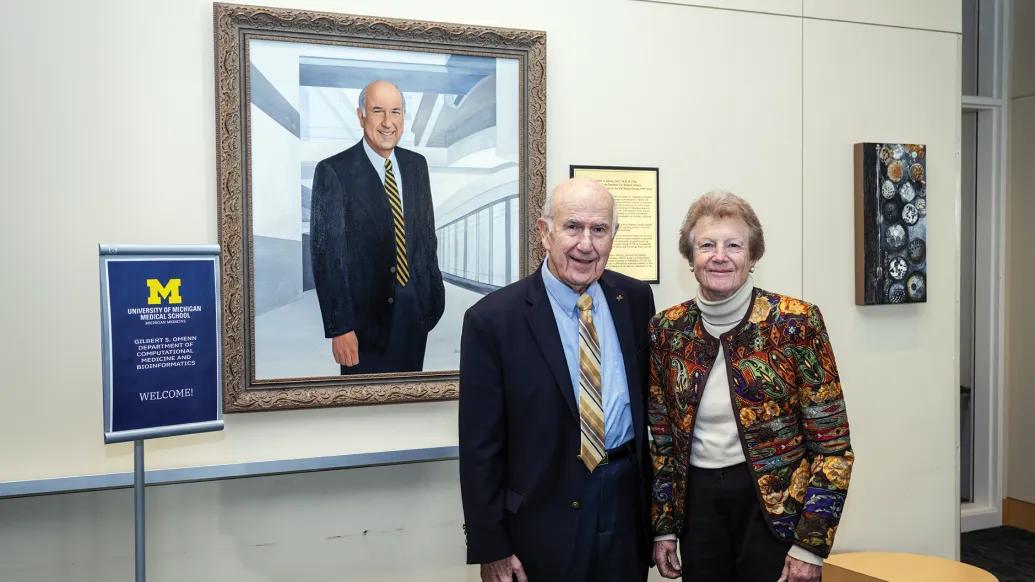
Computational medicine, artificial intelligence (AI), and bioinformatics are being used to expand our understanding of life, enhance health, and transform health care. In recognition of this prospect, Gilbert S. Omenn, M.D., Ph.D., and his wife, Martha A. Darling, have made a generous gift of $25 million to the Department of Computational Medicine and Bioinformatics (DCMB) at the Medical School.
With the gift, the Gilbert S. Omenn Department of Computational Medicine and Bioinformatics becomes the first named department at U-M and one of the first named medical school basic science departments in the nation.
“Medicine and public health are being transformed with the power of large datasets, new technologies, and the analytical prowess of deep learning models and artificial intelligence,” says Omenn, who has been engaged in U-M’s development of computational medicine and bioinformatics since becoming the first executive vice-president for medical affairs 25 years ago.
“We are excited about the creative and intellectually ambitious young people entering this field and the national collaborations and bioethical guardrails already being developed,” Omenn and Darling say.
“We are incredibly appreciative of this gift from Gil and Martha that will be transformational in enabling pivotal discoveries and progress in health care. AI and computational medicine will dramatically change health care delivery, and this gift helps us be at the forefront of that innovation,” says Marschall S. Runge, M.D., Ph.D., CEO of Michigan Medicine, executive vice president for medical affairs, McKay Professor, and dean of the Medical School.
“The vision and generosity of Dr. Omenn and Ms. Darling will strengthen and accelerate the University of Michigan’s place as a leader in the values-driven development of AI and bioinformatics,” says U-M president Santa J. Ono, Ph.D. “Coupled with our commitment to human health and wellbeing, this gift will catalyze new discoveries and open new possibilities, redefining treatments and transforming lives.”
Computational medicine leverages mathematics and computers to accelerate biomedical discovery and translational research, with the aim of using data to ultimately develop personalized therapies for disease.
The Omenn-Darling gift will be used for strategic investments to further develop the Omenn DCMB in this field and enhance its national reputation, including the establishment of the Michael A. Savageau Department Chair of Computational Medicine and Bioinformatics and an associated endowed fund. Additionally, $5 million of the funds will enable the department to establish up to five endowed research professorships.
“We are so incredibly fortunate to be beneficiaries of this gift, which will allow us to recruit and retain the best faculty and remain on the cutting-edge of the application of AI, machine learning, and other computational methods for helping humankind,” says Brian Athey, Ph.D., the Michael Savageau Collegiate Professor and founding chair of the Department of Computational Medicine and Bioinformatics.
Omenn is the Harold T. Shapiro Distinguished University Professor of Medicine as well as professor of computational medicine and bioinformatics, of internal medicine, and of human genetics at the Medical School and professor of environmental health sciences at the School of Public Health. He has been a leader within the department since the creation of U-M’s Ph.D. program in bioinformatics in 2000. Recognizing bioinformatics as an emerging field with stakeholders across campus, Omenn and other U-M leaders helped establish the multidisciplinary cross-university Center for Computational Medicine & Bioinformatics (CCMB) in 2005, with Omenn serving as director.
A major goal of the gift is to encourage and strengthen interdisciplinary collaboration through the CCMB, especially within the Department of Internal Medicine, to advance AI-driven research initiatives. Omenn and Darling expect the funding will boost partnerships between basic scientists and clinical investigators in many departments.
Portions of the gift will be used to establish the CCMB Interdisciplinary Collaboration Fund to prime these joint initiatives and to establish the Omenn Endowed Research Professorship for his successor as director of the CCMB.
With the burgeoning use of generative and classical AI and machine learning within biomedical research, the department is actively exploring the capacity for these new technologies to change scientific paradigms. Five million dollars of the gift will establish the Omenn DCMB Novel AI Faculty Recruitment and Retention Fund, with an additional $2.5 million to acquire, maintain, and enhance advanced computing hardware, software, and services.
The gift will also support the department’s educational mission, establishing the Bioinformatics Graduate Program Endowed Fund to support the department’s M.S. and Ph.D. training programs. This includes recruiting highly qualified students and trainees, providing fellowships to deserving students, building pipeline programs at the undergraduate and high school levels, establishing remote learning and training programs, and developing collaborative interdisciplinary experiential learning opportunities internally, with industry, and in national science policy forums.
About the Donors
Gilbert S. Omenn, M.D., Ph.D., and Martha A. Darling have lived their lives contributing to advancements that impact the world and the people in it. Omenn was recruited in 1997 to be the first executive vice president for medical affairs and CEO of the University of Michigan Health System after 15 years as dean of the School of Public Health & Community Medicine at the University of Washington and Fred Hutchinson Cancer Research Center, and Darling retired from her senior position in the Boeing Company and became deeply engaged in community leadership in Ann Arbor. Each served as a White House Fellow in the 1970s and in senior positions in the White House and the Senate subsequently. Omenn also was a Hughes Investigator in human genetics and protein research.
They are active in university, cultural, public policy, and community affairs in Ann Arbor and nationally. Darling chairs Washtenaw County Success by 6 and serves on the boards of the Ford School of Public Policy, the Ann Arbor Symphony Orchestra, the National Wildlife Federation Action Fund (receiving the National Conservationist of the Year Award in 2016), the Salzburg Global Seminar, the PBS Foundation, and Reed College. Previously, she served on the boards of the University Musical Society, the Ann Arbor Area Community Foundation, the Princeton Woodrow Wilson School, the White House Fellows Foundation, and the White House Commission on Presidential Scholars.
Omenn is director of the U-M Center for Computational Medicine & Bioinformatics, investigator in the U-M component of the national study of the Proteogenomics of Cancers, leader of the global Human Proteome Project, co-founder of the international Consortium for Clinical Characterization of COVID-19 infections using Electronic Health Records, and director of several biotech companies, the Hastings Center, Weizmann Institute of Science in Israel, Institute for Systems Biology in Seattle, Institute for Bioengineering at Princeton, Department of Biomedical Informatics at Harvard, and the Emerging Leaders Program at the National Academy of Medicine. He chairs several U-M committees.
Omenn and Darling are purpose-driven philanthropists, supporting a wide range of causes and institutions. At U-M they have supported the Medical School, Ford School of Public Policy, the University Musical Society, and the Livingston Awards for early-career journalists. They also have made consequential contributions to Reed College, the Hastings Center, Weizmann Institute, Harvard Medical School, and the Omenn-Darling Bioengineering Institute at Princeton University.
Featured News & Stories

What’s changing in Medicaid and what can you do?
Study outlines a new framework for direct cell reprogramming

New insight into how lipodystrophy can affect overall health
Is the United States Lagging Behind Europe in Memory Improvement?
Nerf gun accident causes retinal detachment in pediatric patient