Helping Postdocs Step into the Limelight
Institutional supports — and an exciting competition — are amplifying the voices of an often overlooked group of research trainees.
8:47 AM
Author |
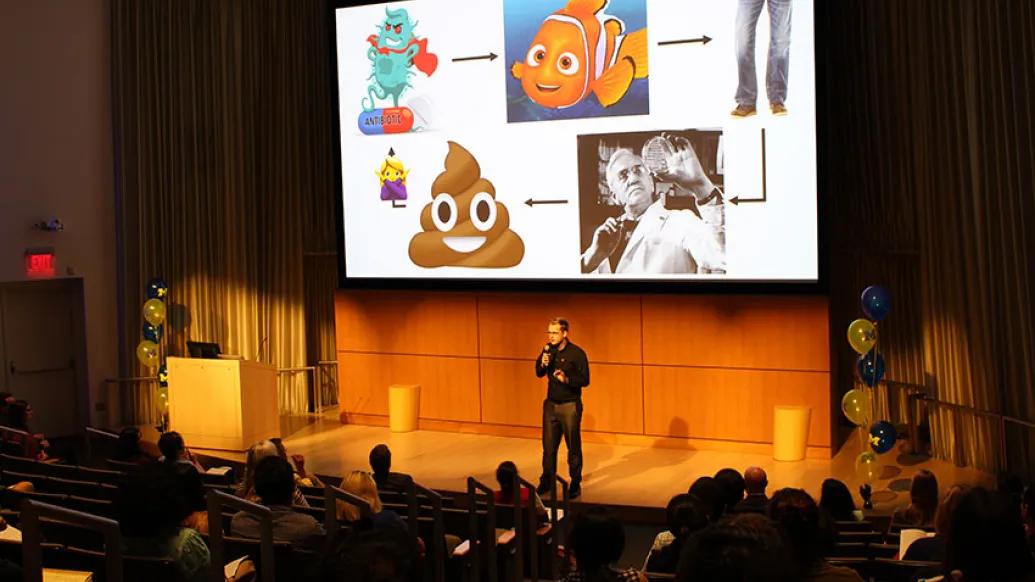
Deep inside labs across the country toil a class of scientists who exist in a sort of limbo: not students, but nevertheless still training. Already equipped with a Ph.D., but not yet independent scientists, they can be likened to apprentices, each working under a more senior principal investigator (PI) who serves as a mentor. Postdoctoral researchers, known colloquially as postdocs, are the unsung heroes of research labs.
LISTEN UP: Add the new Michigan Medicine News Break to your Alexa-enabled device, or subscribe to our daily audio updates on iTunes, Google Play and Stitcher.
"The party line is postdocs are slowly working their way towards independence," says Jay Vornhagen, Ph.D., a pathobiologist in the lab of Michael Bachman, M.D., Ph.D. and co-president of the U-M Postdoctoral Association (UM-PDA). "While we are still training, we spend more time managing people and writing than a graduate student would."
Historically, the end goal of becoming a postdoc was to become a tenure-track professor. Yet nationwide, just 10 to 15 percent of postdocs follow this path (22 percent at U-M). The rest enter various fields including industry, government, and non-academic careers, like working for scientific journals or doing other kinds of science communication.
In acknowledgement of how difficult it can be to transition from the closely supervised, collegiate experience of a graduate student, Michigan Medicine has gone to great lengths to make the postdoctoral experience less onerous and to facilitate professional development, while offering counseling and support to enable postdocs to successfully navigate this training period.
"Postdocs often feel isolated from the educational and support networks that exist on campus. Postdoctoral training is also a crucial time when trainees are actively preparing to go into the 'real world' and get ready to use their professional training in a new career," notes Shoba Subramanian, director of curriculum and educational initiatives at the Office of Graduate and Postdoctoral Studies at the U-M Medical School. Last year, the office launched a new Career and Professional Development Team to focus on issues specific to postdocs' futures.
Trainees in transition
So, what is life like for a postdoc? For starters, one of the biggest challenges is money, with salaries on average of $45,000 in 2016, far lower than a $75,000 starting salary in industry for a scientist with a freshly minted Ph.D.
Another challenge is the transitional nature of the job. "We don't get a lot of the benefits of stable employment, like matched retirement or assistance with child care," says Vornhagen. "And because postdocs are only around for at most five years it's difficult to organize our voices."
MORE FROM THE LAB: Subscribe to our weekly newsletter
Still another is the change in balance of power, because postdocs are considered employed research staff rather than students. The postdoc/PI relationship can be rife with dysfunction, especially for international trainees, who rely on their employment for immigration status. Vornhagen notes that a recent survey reveals that one in three postdocs say they have experienced sexual or emotional harassment nationwide.
To help mitigate against some of these issues, the self-led UM-PDA, funded by OGPS and U-M Rackham Graduate School, also provides campus wide support and events to foster community amongst this often overlooked group. In late September, UM-PDA and OGPS helped organize several events during National Postdoc Appreciation Week.
One of the new highlights of the festivities this year was a new chance for postdocs to be seen and heard, organized by Subramanian and the OGPS.
Science is a public service and we really need to get back to that mindset and increasing people's trust in science.Jay Vornhagen, Ph.D.
Called Postdoc180, it invited postdocs to apply for the chance to get on stage and present their research in just three minutes —180 seconds — using only one static PowerPoint slide. The contest was inspired by an international competition — started at the University of Queensland, Australia and aimed at doctoral students — that allows young researchers to practice explaining their work to the general public.
"Postdocs are vital to pushing science forward, but they don't often get the chance to talk to anyone but other researchers about their work," Subramanian said. "Effective communication without using technical jargon is a transferrable skill that is rated as one of the top qualities by many employers. This competition allows them to practice those skills," explains Subramanian.
The ten finalists were selected from a highly competitive group of postdocs from Medical School labs, all aiming for a grand prize of $1,000.
Before the event, the contestants gave each other pep talks as they prepared to present in front of a live audience. They explained that they'd practiced for weeks, trying desperately not to lapse into scientific-speak and to present their often incredibly complex work in the simplest terms possible.
"I told myself to just stick to the basics, otherwise it's easy to slip into the jargon you're used to using every day," said Daysha Ferrer-Torres, Ph.D., a postdoc working in the lab of Jason Spence Ph.D. in Internal Medicine.
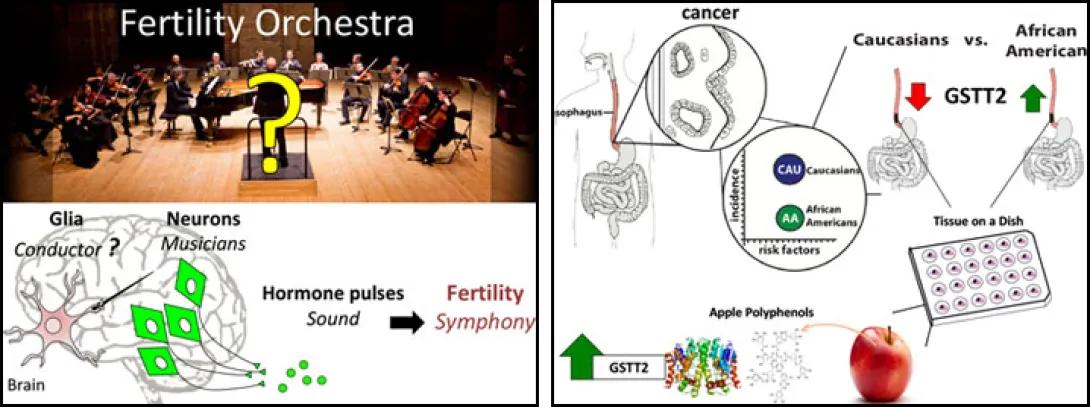
Standing in front of a panel of four judges, including Mary O'Riordan, Ph.D., associate dean of graduate and postdoctoral studies for the medical school, Mike Solomon, Ph.D., dean of graduate studies for Rackham Graduate School, Andrew Raeder, founding partner of the investment banking firm EMA Partners and Jennifer Wilkening, a local high school biology teacher, each contestant took turns explaining everything from racial disparities in esophageal cancer, cellular senescence and aging, to the role of glia cells in the brain and fertility, all in 180 seconds or less.
First prize went to Vornhagen, who used a poop emoji to help explain his research on the bacterial pathogen Klebsiella pneumoniae. He also won the audience-selected People's Choice award.
"The judging was incredibly close," reported O'Riordan. "We're working on increasing public engagement and this format really forces you to distill the science down to easily understood concepts."
Vornhagen credits his win in part to his upbringing in a journalistic household. "My mom is a journalist so public communication was emphasized to me growing up. I am responsible to the people that are relying on me to do this research," he explains. "A large part of my funding comes from government tax dollars. Science is a public service and we really need to get back to that mindset and increasing people's trust in science. Postdocs can become very entrenched in our labs and day-to-day work, but this outreach is incredibly critical."

Health Lab
Explore thousands of health news & research stories by visiting the Health Lab homepage for more.
Media Contact

Public Relations
Department of Communication at Michigan Medicine
Stay Informed
Want top health & research news weekly? Sign up for Health Lab’s newsletters today!
Featured News & Stories

The AI is listening: Implications of machine generated clinical notes on health care

Comprehensive DNA sequencing reveals hidden drivers of cancer

Many older adults make Medicare decisions quickly and most don’t change plans, poll finds

‘Molecular glue’ stabilizes protein that inhibits development of non-small cell lung cancer and uterine cancer

What’s the latest on 7-OH and kratom availability and addiction care?