Diversifying medicine

One student's award-winning vision for breaking down barriers.

5:00 AM

Author | Katie Whitney
woman doctor hallway labcoat
Medicine at Michigan

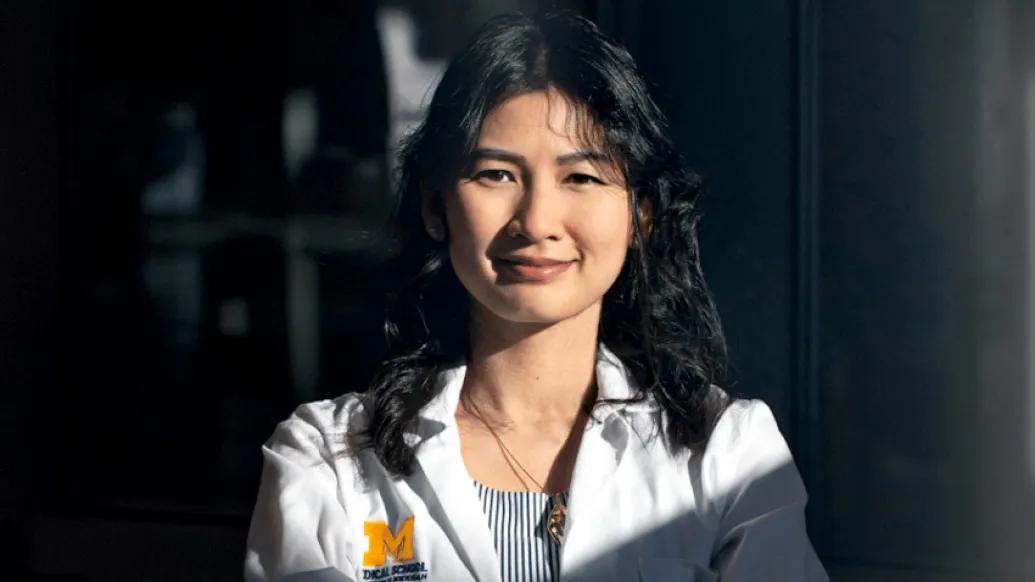
When she was 9 years old, Vy Tran Plata, M.D., moved with her family from a small village in Vietnam to a predominantly Hispanic neighborhood in Atlanta.

She didn't speak English or Spanish — she recalls not even knowing how to ask where the bathroom was on the first day of school. Though she grew up on the low end of the socioeconomic spectrum, her childhood offered her the riches of a close-knit community, eventual fluency in three languages and a drive to succeed. She has since alchemized those early gifts into opportunities that no one from her family has had before.

When she attended Stanford University, she was the first in her family to go to college. Though she was surrounded by students who had innumerable opportunities that weren't available to her, such as the piano lessons her family could not afford, Tran Plata would not have traded the humble upbringing that taught her to be resourceful and resilient for the privilege her peers enjoyed. Her passion for medicine and service motivated her to become a certified medical interpreter in Vietnamese and Spanish while at Stanford. She continues to use that training to facilitate access to medical care for immigrants.

At medical school, she once participated in a simulation designed to help students think about the struggles facing people with low incomes. Students were required to make tough choices, such as deciding whether to pay for rent or go to the doctor.

It was surreal for Tran Plata, who thought, "This is not a simulation for me; it's things I've lived through and decisions my family has had to make."

One of the barriers to medical education Tran Plata has faced is a lack of mentorship and guidance. Growing up, she didn't see any physicians who looked like her, and she didn't know anyone who had gone to medical school.

A new platform idea

Tran Plata and fellow Stanford alum Christine Chen won the distinguished American Medical Association's ChangeMedEd 2021 Bright Ideas Showcase with an idea that could break down that barrier for others.

DiverseCity is their innovative concept for expanding access to world-class mentorship. The online platform will be designed to connect successful physicians who have overcome significant hurdles with aspiring trainees who are seeking relatable role models.

"Aspiring trainees from anywhere in the world could view this wide range of stories that they might not otherwise have access to," said Tran Plata. Users could also follow up directly with questions or prompts for further videos and advice, and the platform could connect them to local pipeline programs and resources.

As AMA notes, when Tran Plata pitched the idea, she cited her own experiences growing up in a community without physician role models. The project seeks to ensure that doesn't happen to the next generation of potential physicians. The pilot version of the digital platform encompassed accomplished physicians sharing the story behind their journeys into medicine. She hopes to scale the efforts with the additional funding.

"There's a hunger for this resource and a hunger for collaboration," she said. "From high school students to med students, there's a place in DiverseCity for everyone."

Done with the first prototype, Tran Plata and Chen are now working on the second phase of the platform.

"All of this is to create a sense of belonging," said Tran Plata, who believes DiverseCity could help support people who are underrepresented in medicine as they power through the myriad challenges of becoming a physician.

This article was additionally edited by Allison Mi.

This article originally was posted by Medicine at Michigan.


More Articles About:

Med-U Medical School Future Think Mental Health Education
Health Lab word mark overlaying blue cells

Health Lab

Explore thousands of health news & research stories by visiting the Health Lab homepage for more.

Media Contact

University Hospital at U-M Health in the spring with flowering trees in foreground and Survival Flight helicopter visible

Public Relations

Department of Communication at Michigan Medicine

[email protected]

734-764-2220

Stay Informed

Want top health & research news weekly? Sign up for Health Lab’s newsletters today!

Subscribe

Featured News & Stories

UMich Med Mosaic on blue background with colorful geometric shapes
UMich Med Mosaic

Beyond the White Coat: Disability, Neurodiversity and Advocacy in Medical School

In this episode of UMich Med Mosaic, host Mackenzie Kay sits down with medical students Jill Maudlin, Sarah Renberg and Bella Johnson to discuss their experiences as disabled and neurodivergent trainees at the University of Michigan Medical School. They reflect on the personal journeys that led them to medicine, the challenges and strengths that accompany living with disabilities and chronic health conditions and the importance of representation within the medical profession. The conversation explores how disability shapes their approaches to patient care, advocacy and teamwork, as well as the role of the Medical Students for Disability Health Advocacy (MSDHA) organization in creating community and advancing accessibility initiatives. They also discuss Michigan’s accommodations in medical education, efforts to improve disability-related curriculum content and the importance of building a culture where disabled and neurodivergent students can thrive.
Minding Memory with a microphone and a shadow of a microphone on a blue background
Minding Memory

Antipsychotic Use in Nursing Homes: Balancing Medication Safety, Policy, and Dementia Care
In this episode, Lauren Gerlach and Matt Davis speak with Theresa Shireman, PhD, Director of the Center for Gerontology and Healthcare Research and a Professor of Health Services, Policy and Practice and Epidemiology at the Brown University School of Public Health. Dr. Shireman’s research focuses on pharmaceutical policy, pharmacoepidemiology, health services research, and medication use among vulnerable populations. Dr. Shireman discusses her recent study, "Impact of Federal Antipsychotic Use Policy in Nursing Homes on New Diagnoses for Approved Indications in Dementia Residents," published in the Journal of the American Geriatrics Society. The study examines whether federal policies designed to reduce antipsychotic use in nursing homes were associated with increases in new diagnoses of conditions, such as schizophrenia, that exclude residents from publicly report antipsychotic quality measures. Using an interrupted time-series design, the researchers examined changes following the 2012 National Partnership to Improve Dementia Care and the 2015 addition of antipsychotic use to the Nursing home Five-Star Quality Rating System. They found that neither policy was associated with an increase in new exclusionary diagnossees, challenging concerns that nursing homes were increasingly assigning these diagnoses to circumvent restrictions on antipsychotic use. The conversation also explores the benefits and risks of antipsychotic medications for people living with dementia, including the potential for serious adverse effects such as sedation, falls, stroke, and increased mortality. Dr. Shireman discusses how public reporting and financial incentives can influence prescribing practices,the limitations of using a single quality measure to evaluate nursing home care, and the importance of balancing medication safety and residents’ individual needs. The discussion highlights the need for shared decision-making among clinicians, nursing home staff, residents, and families, as well as greater investment in staffing, resources, and nonpharmacological approaches to improve quality of life for people living with dementia. The transcript for this episode can be found here.
Well-Being at Michigan Medicine with Dr. Elizabeth Harry
Well-Being at Michigan Medicine

Learning Together: Making Space for Growth at Work

What if well-being starts with how we learn together? On this episode of Well-Being at Michigan Medicine, Elizabeth Harry, M.D., is joined by Rajesh Mangrulkar, M.D., FNAP, Executive Director of U-M’s Center for Interprofessional Practice and Education (IPE), Executive Director of Michigan Medicine RISE (Research. Innovation. Scholarship. Education), and primary care physician of internal medicine whose work focuses on organizational leadership and innovation, and Johnny McGraw, M.A., Marketing & Communications Specialist for both RISE and IPE, about building teams through human connection, psychological safety and learning. They discuss a meeting practice, why leaders shape culture and how investments in collaboration can help health care teams work without asking people to carry everything alone.
pills close up some powder some round some long
Health Lab

What’s the latest on 7-OH and kratom availability and addiction care?

The United States Drug Enforcement Agency has announced it will place non-botanical products containing 7-OH on Schedule I, joining three other synthetic opioids, effectively removing them the market, leaving natural leaf kratom available amid a shortage of addiction treatment providers.
female surgeon on ground upset hands to face in scrubs and scrub shoes
Health Lab

Depression in OBGYN residents needs more attention, study suggests

New onset depression in obstetrics and gynecology residents in their intern year is common and often untreated, and linked to depression history, higher work hours and less sleep.
cell phone upclose in hands
Health Lab

Emergency room intervention pairs smartphone, telehealth counseling to reduce risky firearm behavior

Among U.S. teens and young adults, firearm violence accounts for about 65,000 emergency department visits annually, and 60% of all firearm deaths in this age group are the result of interpersonal violence.