U-M Program Helps Young Adults with Disabilities Get Ready for Workforce
A program that offers individuals with disabilities job placements at U-M is a large collaborative effort. How it’s helping one young chef thrive.
1:00 PM
Author |
Colton Schick has always enjoyed cooking.
"It's just fast-paced," the 20-year-old says, "and that's what I like."
MORE FROM MICHIGAN: Sign up for our weekly newsletter
And now, the pursuit also gives him a sense of pride.
Colton is a part of the Bridge to Work Program, a collaboration between the Michigan Medicine Department of Physical Medicine and Rehabilitation, University of Michigan Human Resources, Michigan Rehabilitation Services and Work Skills Corporation.
The program, established in 2014, provides pathways to employment for young people with pediatric-onset disabilities.
Regardless of a person's circumstances, the goal is the same.
"We're trying to help these young people move forward with vocational plans and hopefully achieve vocational success," says Ned Kirsch, Ph.D., a clinical associate professor emeritus of physical medicine and rehabilitation at Michigan Medicine and a co-founder of the program. "We create work trial opportunities that match a participant's abilities and goals."
Building a bridge
The concept came to life after Kirsch reached out to Michigan Rehabilitation Services' Steve Girardin, district manager, and Tracey House, a vocational rehabilitation counselor, to discuss founding a program that could help the young people frequenting their offices.
SEE ALSO: Hockey Players with Disabilities Show 'They're Not So Fragile'
Michigan Rehabilitation Services is a state agency that works with people with disabilities to prepare them for and help them obtain employment. The agency partners with other organizations, such as Work Skills Corporation, a community-based rehabilitation agency, to provide job coaches for their participants.
Kirsch and Girardin discussed the potential for U-M to offer work experiences for young adults.
They then sought out Jean Tennyson and Tiffany Raymond in U-M's Department of Human Resources to scout and secure job placements across campus and Anita Gibson from Work Skills Corporation to provide job coaching to program participants. Kirsch also worked with university officials to obtain approvals and understand liabilities.
"One of the best parts of Bridge to Work is that it is such a robust, collaborative relationship," Kirsch says.
After obtaining the necessary approvals, the Bridge to Work Program launched a pilot phase with five participants in work trial placements across campus for 12 months. Soon after, the program was evaluated and given the green light to continue.
Kirsch mentions none of this would have been possible without support from his department chair and colleagues.
"Dr. Edward Hurvitz, chair of the Department of Physical Medicine and Rehabilitation, and Linda Grosh, chief department administrator, were instrumental in getting this program approved and running," Kirsch says.
Finding the right fit
Participants in the Bridge to Work Program have to be referred, either by a physiatrist or neuropsychologist in the U-M Department of Physical Medicine and Rehabilitation or a Michigan Rehabilitation Services vocational rehabilitation counselor.
The latter is how Colton was referred to the program.
"We were put in touch with Tracey House at MRS," says Mark Schick, Colton's father. "Colton had already done a job placement through MRS, but it wasn't the right fit for him. Tracey told us about the Bridge to Work Program and that she would put Colton's name in for consideration."
Colton received his job placement in an area he couldn't be more excited about: cooking.
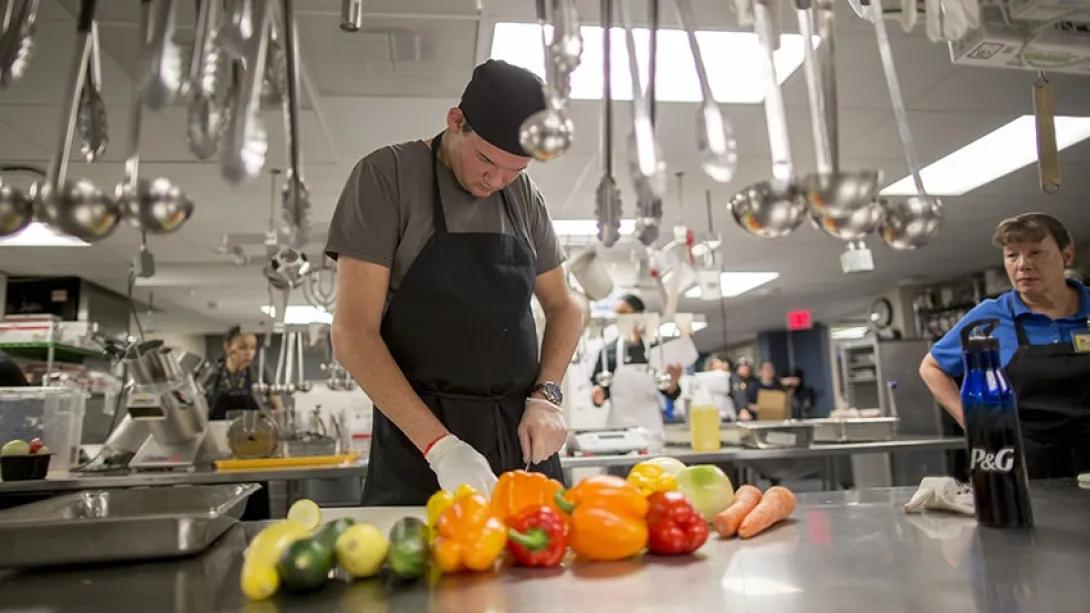
In January 2016, he began his work trial at South Quad Dining Hall on the U-M campus.
"I come in every day with a big smile, and I cook stir-fry for thousands of people," Colton says.
Lois Allen, general manager at U-M Central Campus Dining Service, was happy to facilitate the connection between the Bridge to Work Program and her department. She appreciates her employee's work ethic and positive attitude.
"Colton comes in and does everything our student employees do, from serving in a station to cooking in a station to doing prep in between meals," Allen says. "Basically, whatever we need him to do, he is able to do it."
"He's so personable that you really want to take that time to get to know him. Everyone has really embraced what the program is about, and it's been really fun having him."
Hard at work
Colton's typical day at work involves a variety of tasks.
"He is taking things that have been prepped down in the prep kitchen, interacts with our customers, builds a made-to-order stir-fry for them, cooks it right in front of them and presents it to them at the end," Allen says.
SEE ALSO: How a Pediatrician Helps Her Family Eat Healthfully at Home
For the cook himself, the fast-paced style is a benefit.
"I like doing stir-fry because I'm always moving," Colton says. "If I stop moving I get bored, and stir-fry keeps going. I can do two or three dishes at once."
Colton worked with his job coach from Work Skills Corporation, Brittany Reeves, to ensure everything went smoothly in his new role.
"I met with whoever was on duty while he was working and checked in on his progress through the week to see if there was anything I could do to help," Reeves says.
His work ethic and positive demeanor paid off: Colton was offered a temporary employee position after his work trial was complete.
"He loves working for the University of Michigan," Mark says. "He takes great pride in the fact that he works there, and he's made a lot of friends in the cooking staff. I give the university credit for giving him the opportunity to interact with people. If he was just doing prep work, it wouldn't have been a good fit. That customer-facing aspect is awesome for him."
Colton, meanwhile, has bigger plans for the future.
"I want to own a food truck," Colton says. "It would be Mediterranean and Greek food. My mom and I want to do it."
Moving forward
Despite shifts in financing, the Bridge to Work Program aims to continue creating work trial opportunities.
"MRS subsidized the program but only had so much available funding they could provide," Kirsch says. "We now rely on outside funding to keep the program going and so we can provide young people with disabilities with productive employment opportunities."
Kirsch hopes the program produces more success stories like Colton's. But success, he notes, can be defined in many ways.
"The ultimate goal is not necessarily to get people jobs at the university," Kirsch says. "The goal is to give them experience in a real work setting so they have more to offer an employer when they go out into the world."
If you are interested in making a donation, please contact Matt Douponce in the Michigan Medicine Office of Development at 734-763-5392.
If you know someone interested in joining the Bridge to Work Program, please have them contact Ned Kirsch, Ph.D., at Michigan Medicine ([email protected]) or Steve Girardin at Michigan Rehabilitation Services ([email protected]).

Health Lab
Explore thousands of health news & research stories by visiting the Health Lab homepage for more.
Media Contact

Public Relations
Department of Communication at Michigan Medicine
Stay Informed
Want top health & research news weekly? Sign up for Health Lab’s newsletters today!
Featured News & Stories
4 in 5 parents say having a baby is too expensive

E-Bikes are everywhere, but most parents say they don’t know enough about them
Rheumatologist finds contentment and community through family farm

Expanding camp adventure for all
A method to prevent falls before they happen