This is your gut on sushi
New study provides insights into how the microbiome processes seaweed.
11:00 AM
Author |
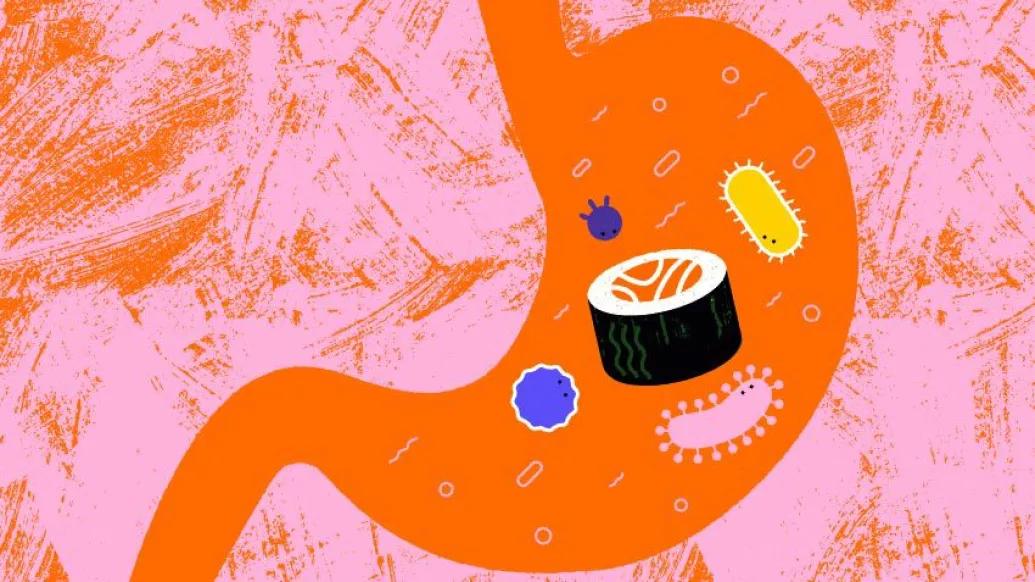
The next time you get a craving for sushi rolls, you may feel a renewed appreciation for the ocean— it's to thank not only for your fish and seaweed wrapper, but, as a new Michigan Medicine study suggests, for the bacteria in your gut that digest seaweed.
The ocean is one of the largest reservoirs of carbon on the planet, much of it locked inside seaweed. Marine bacteria play a critical role in the carbon cycle by breaking down seaweed. A little over a decade ago, researchers found the genes that enable ocean bacteria to degrade the complex carbohydrate known as porphyran, found in cold-water seaweed, in a microbiome sample from a Japanese adult.
The new study, led by Nicolas Pudlo, Ph.D., Gabriel Vasconcelos Pereira, Ph.D., and Eric Martens, Ph.D., of the U-M Medical School, has found that these genes of oceanic origin are more common than previously recognized, entering the human gut microbiome through a process known as lateral gene-transfer.
During digestion, gut bacteria in humans break down dietary fiber, or polysaccharides, found in fruits, vegetables, and grains. However, the polysaccharides found in seaweed have different chemical structures than land-sourced foods. Somehow, genes from the ocean-dwelling Bacteroidetes—a genus of bacteria that is a key player in the microbiome—found their way into the human gut.
"Whether they came directly from an oceanic bacterium someone just happened to consume or through a more complex path into the human gut is still a mystery," said Martens, a professor in the Department of Microbiology and Immunology.
To examine just how extensive the seaweed gene clusters are in gut Bacteroidetes, the team turned to an unusual source: stool samples from U-M undergraduate students.
"We received the samples in small glass tubes and did all of our culturing within the lab's anaerobic chamber," commented Ahmed Ali, one of the student researchers on the study. "I remember working in the chamber was hot and somewhat difficult, but this was definitely offset by the fact that we did not have to 'smell the scientific process' at work," he quipped.
They then analyzed the bacteria's ability to degrade several seaweed-derived polysaccharides, including porphyran, laminarin, alginate and carrageenan.
The team found that genes for processing laminarin were broadly represented in the samples, possibly linked to the related ability to process beta-glucans, sugars also found in oats and whole grains. Yet, the other seaweed polysaccharides were used by fewer bacterial species and present in fewer samples.
"The genes to process agarose and porphyran, two of the more commonly consumed seaweeds in Southeast Asia, tended to be enriched in the people living there," said Martens. Taking a closer look at the geographic distribution of the gene clusters, the team referenced genomic surveys from samples taken from more than 2000 people in Asia, Africa, North and South America, and Europe.
The genes for degrading porphyran were indeed enriched in samples from China and Japan. Genes for processing carrageenan, consumed since 400 B.C in China, and now widely used as a food additive in everything from oat milk to infant formula in the United States, were also enriched in samples from China, Japan and North America.
Adding further intrigue to the evolution of seaweed digestion, the team fortuitously discovered that the bacteria Firmicutes, which are even more prevalent in the human gut than Bacteroidetes, also have picked up the genetic ability to grow on seaweed polysaccharides.
"Firmicutes are known to live in fish intestines and the closest ancestors of the genes that appear to have jumped into human gut Firmicutes were ones found in fish," said Martens.
The study, notes the team, opens new questions about the complex interplay between diet and the adaptation of the human gut microbiome in populations around the world.
Additional authors on the paper include Jaagni Parnami, Melissa Cid, Stephanie Markert, Jeffrey P. Tingley, Frank Unfried, Austin Campbell, Karthik Urs, Yao Xiao, Ryan Adams, Duña Martin, David N. Bolam, Dörte Becher, Thomas M. Schmidt, Wade Abbott, Thomas Schweder and Jan Hendrik Hehemann.
Paper cited: "Diverse events have transferred genes for edible seaweed digestion from marine to human gut bacteria," Cell Host & Microbe. DOI: 10.1016/j.chom.2022.02.001
MORE FROM THE LAB: Subscribe to our weekly newsletter
Like Podcasts? Add the Michigan Medicine News Break on iTunes, Google Podcasts or anywhere you listen to podcasts.

Health Lab
Explore thousands of health news & research stories by visiting the Health Lab homepage for more.
Media Contact

Public Relations
Department of Communication at Michigan Medicine
Stay Informed
Want top health & research news weekly? Sign up for Health Lab’s newsletters today!
Featured News & Stories
The unique way this virus sneaks into a cell’s nucleus could advance the study of cancer-causing pathogens

Cross-Country Research Collaboration Brings New Lupus Estimates

New questionnaire aims to improve understanding of demand avoidance in children, teens
Timing is of the essence for RNA during stress
New anti-cancer strategy shows promise in preclinical studies