Study Suggests New Potential Approach Against Fatal Childhood Brain Cancer
In mouse models of DIPG, simultaneously attacking two metabolic pathways led to significant improvements in survival.
11:00 AM
Author |
Progress against DIPG, a fatal childhood brain tumor, is usually a game of inches. Studies that hint at even small gains are cause for celebration.
That's why researchers at the University of Michigan and their collaborators are excited about discoveries that point toward a new potential treatment approach — one that significantly lengthened survival times in two mouse models of DIPG.
The team's findings, which appear in the journal Cancer Cell, suggest that simultaneously targeting two energy-production pathways within the cancer cells could help overcome the effects of a cancer-causing mutation that is one of the hallmarks of DIPG, or diffuse intrinsic pontine glioma, and similar tumors.
LISTEN UP: Add the new Michigan Medicine News Break to your Alexa-enabled device, or subscribe to our daily updates on iTunes, Google Play and Stitcher.
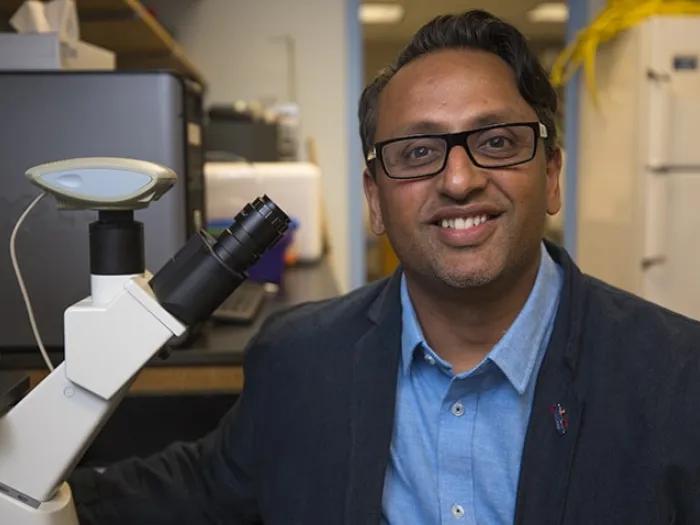
"DIPGs have a characteristic, epigenetic histone mutation — that is, a mutation in the spool that DNA wraps around, and which can affect gene expression," says the study's senior author Sriram Venneti, M.D., Ph.D., a neuropathologist and researcher at the U-M Rogel Cancer Center and Chad Carr Pediatric Brain Tumor Center. "It's not clear exactly how this mutation causes cancer, but it's associated with poor outcomes, which implies these mutations are aggressively driving the biology of these tumors."
An epigenetic change is one that affects how a gene gets used without changing the underlying DNA sequence — similar to the way a playlist of songs can be altered without changing the songs themselves.
"What we discovered, unexpectedly, is that this mutation specifically increases activity in two metabolic pathways in the cell, and that these pathways also directly influence the epigenetic changes within the cell," Venneti says. "So the question was: Can we use metabolic drugs to interrupt these energy production pathways within the cancer cells and at the same time modify the cells' epigenome in a productive way?"
The result in two different mouse models of DIPG was a resounding yes.
Inhibiting each of the two metabolic pathways individually provided a small increase in how long the mice survived, while targeting both pathways at the same time caused the mice to live much longer.
Treatments for DIPG are desperately needed. So, while these are still early stage, pre-clinical results, we are excited about continuing to develop this new strategy toward human clinical trials.Sriram Venneti, M.D., Ph.D.
In one model used in the study, DIPG is always fatal. When the two experimental compounds were given, however, 60% of the mice were still alive, when the experiments were ended.
"Treatments for DIPG are desperately needed. So, while these are still early stage, pre-clinical results, we are excited about continuing to develop this new strategy toward human clinical trials," Venneti says.
DIPG is usually diagnosed in children between the ages of 5 and 10, though it can develop at any age, including rare cases in adults. These tumors start in the brainstem, which makes them nearly impossible to remove surgically. In 2015, Chad Carr, the grandson of former U-M football coach Lloyd Carr, died at age 5 after being diagnosed with the disease 14 months earlier.
MORE FROM MICHIGAN: Sign up for our weekly newsletter
"The Chad Carr Pediatric Brain Tumor Center was started in 2018 and has placed the University of Michigan as one of the leading centers for DIPG research and patient care. We could not have performed this research without their strong support and critical funding from the Chad Tough Foundation," Venneti says.
Both of the compounds used in the study — one of which was developed by the pharmaceutical company AbbVie and the other by Johns Hopkins University — are able to penetrate the blood-brain barrier, which is critical for treating brain tumors, Venneti adds.
"The barrier is there for a reason," he says. "You don't want toxins to be able to reach your brain. The challenge in developing drugs against brain cancer is that you need the drugs to be able to cross through this barrier and attack the tumor cells. We were fortunate that both of the study compounds can do so."
The study also uncovered new information about the biology of DIPGs and related tumors through the analysis of cancer cells and imaging scans from DIPG patients. Along with shedding new light on the energy cycles of the cancer cells, researchers discovered why two different types of mutations — one seen in children with DIPG and the other observed in adult brain tumors — are mutually exclusive.
"We found that these two mutations use the same pathways, but in opposite ways, which explains why they can't occur at the same time," Venneti says.
Continuing to develop a better understanding of the underlying tumor biology will help researchers to develop and refine new treatment strategies, he notes.
The research was supported by the Chad Tough Foundation, National Institute of Neurological Disorders and Stroke (R01NS110572, K08-NS099427-01), Mathew Larson Foundation, St Baldrick's Foundation, Claire McKenna Foundation, Alex Lemonade Stand Foundation, Storm The Heavens Foundation, a joint Chad Tough Foundation and Michael Mosier Defeat DIPG Foundation fellowship award, Sidney Kimmel Foundation, Doris Duke Foundation and Sontag Foundation, Taubman Research Institute, Rudi Schulte Research Institute, and the Ian's Friends Foundation.
Additional authors include Chan Chung, Stefan R. Sweha, Drew Pratt, Pooja Panwalkar, Adam Banda, Jill Bayliss, Ho-Joon Lee, Mengrou Shan, Marcin Cieslik, Tingting Qin, Christian K. Werner, Daniel R. Wahl, Costas A. Lyssiotis, Vivekanand Yadav, Carl J. Koschmann and Arul M. Chinnaiyan, of U-M; Benita Tamrazi, Debra Hawes, Fusheng Yang , Stefan Blüml and Alexander R. Judkins, of the University of South California, Los Angeles; and Zhiguo Bian and J. Brad Shotwell of AbbVie.
Disclosure: Two of the co-authors are employees of AbbVie. One of the small molecule inhibitors used in the study was provided by the company. The company also participated in the interpretation of inhibitor data, review, and approval of the publication.
Paper Cited: "Integrated metabolic and epigenomic reprograming by H3K27M mutations in diffuse intrinsic pontine gliomas," Cancer Cell. DOI: 10.1016/j.ccell.2020.07.008

Health Lab
Explore thousands of health news & research stories by visiting the Health Lab homepage for more.
Media Contact

Public Relations
Department of Communication at Michigan Medicine
Stay Informed
Want top health & research news weekly? Sign up for Health Lab’s newsletters today!
Featured News & Stories
New clues toward treating pediatric brain tumors harboring epigenetic mutation
Common diabetes drug promising against rare childhood brain tumor in laboratory studies
DIPG Tumor Patterns Offer New Insight on Survival

Intuition pushed mom to keep checking for breast cancer
Online resources and coaching helped people seek genetic testing for cancer