Identical Mice, Different Gut Bacteria, Different Levels of Cancer
U-M study offers new clues about how the composition of the gut microbiome may contribute to the development of colorectal cancer.
11:38 AM
Author |
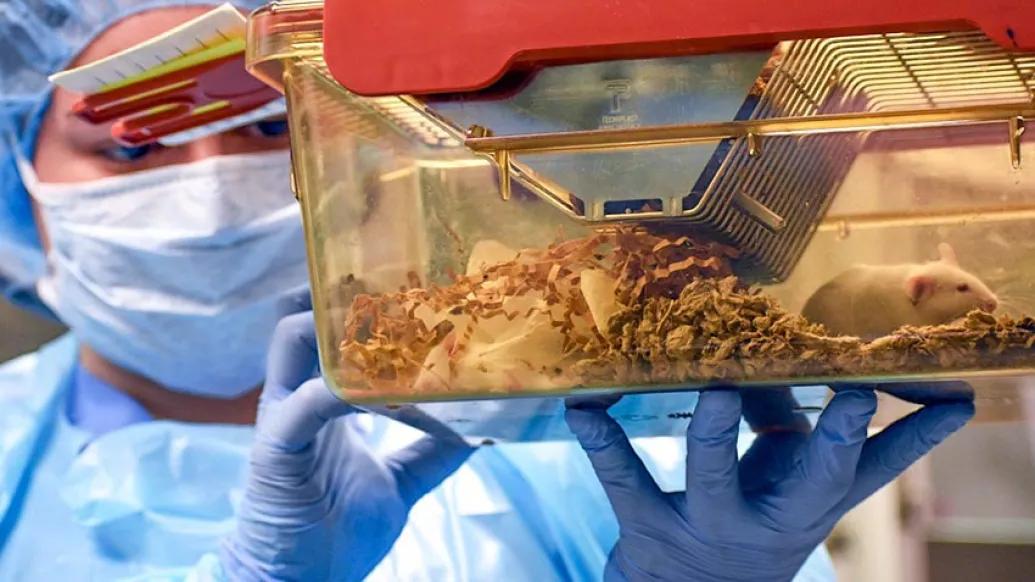
Researchers at the University of Michigan Rogel Cancer Center are shedding new light on the way microorganisms that live in the gastrointestinal tract can affect the development of colorectal cancer.
Some types of gut bacteria are better than others at stimulating certain immune cells, specifically CD8+ T cells, in the body, they found. And while these CD8+ T cells normally help protect the body against cancer, overstimulating them may promote inflammation and exhaust the T cells — which can actually increase susceptibility to cancer, according to new mouse model study published in Cell Reports.
The work will help scientists pinpoint which populations of bacteria are tumor suppressive or tumor promoting and how, says study first author Amy Yu, a doctoral candidate in immunology at U-M.
"There has also been a lot of excitement about the role bacteria may play in improving the effectiveness of immunotherapy," says senior study author Grace Chen, M.D., Ph.D., an associate professor of hematology/oncology at Michigan Medicine and member of the Rogel Cancer Center. "This work suggests it may be a double edged sword — and that promoting T cell exhaustion is something researchers need to watch out for."
In the U.S., colorectal cancer is the third-leading cause of cancer-related death in both men and women, according to the American Cancer Society.
Different mice, different outcomes
The current study builds on previous work from Chen's group, which found that disturbances of the gut microbiome can directly contribute to the development of cancer.
Our data ultimately revealed nine different bacterial populations that may have tumor-suppressive or tumor-promoting activity.Amy Yu
The group found that mice from two different research colonies had vastly different susceptibility to colorectal cancer when they were exposed to a carcinogen as well as an agent that promotes gastrointestinal inflammation.
The mice from the first colony grew an average of five tumors, while the mice from the second colony developed 15 tumors and had a more significant inflammatory response.
When the researchers sequenced fecal bacteria from the two different colonies, they found they had distinct microbiomes composed of different types of bacteria.
"This was exciting because my lab is very interested in which bacteria have the biggest impact on colorectal cancer risk, and by what mechanisms," Chen says.
Same mice, different outcomes
To better understand what was causing the differences the researchers were seeing in the two different colonies of mice, they transplanted gut bacteria from each of the two colonies into genetically identical mice that had been bred in a bacteria free environment.
MORE FROM THE LAB: Subscribe to our weekly newsletter
Once again, mice with bacteria from the second colony fared far worse.
"This showed that the different gut microbiota directly contributed to tumor development," Yu notes. "Our data ultimately revealed nine different bacterial populations that may have tumor-suppressive or tumor-promoting activity."
Investigating mechanisms
The team next conducted experiments to better understand what was driving the increased inflammation and tumor growth associated with the bacteria from the second mouse colony.
Through immune cell profiling, they found that there were more T cells in the colon tissue of mice with bacteria from the second colony, and many more of a type of cell called CD8+.
"It's a little counter intuitive, since T cells and CD8+ cells are usually associated with better outcomes in colorectal cancer patients," Chen says. "We hypothesized that these cells get over-activated in the presence of certain bacteria and then exhausted, leaving them less capable of killing tumor cells."
When the bacteria from the second mouse colony were transplanted into mice that were engineered to lack CD8+ T cells, fewer tumors developed, supporting T cells' role in promoting the growth of the cancer in the presence of certain bacteria, Chen notes.
Meanwhile, the lab continues to build on the research as it investigates the mechanisms by which different bacteria may contribute to promoting or protecting against the development of colorectal cancer.
Additional authors of the study include Lili Zhao, Kathryn A. Eaton, Sharon Ho, Jiachen Chen, Sara Poe, James Becker, Allison Gonzalez, Delaney McKinstry, Muneer Hasso, Jonny Mendoza-Castrejon, Joel Whitfield, Charles Koumpouras, Patrick D. Schloss and Eric C. Martens, all of U-M.
The research was funded by a U-M Rackham Research Grant, the National Institutes of Health (AI007413, CA166879), an American Cancer Society Research Scholar Grant, and the Tom Liu Memorial Golf Tournament Fund from the U-M Rogel Cancer Center.
Paper cited: "Gut Microbiota Modulate CD8 T Cell Responses to Influence Colitis-Associated Tumorigenesis," Cell Reports. DOI: 10.1016/j.celrep.2020.03.035
Like Podcasts? Add the Michigan Medicine News Break to your Alexa-enabled device or subscribe for updates on iTunes, Google Play and Stitcher.

Health Lab
Explore thousands of health news & research stories by visiting the Health Lab homepage for more.
Media Contact

Public Relations
Department of Communication at Michigan Medicine
Stay Informed
Want top health & research news weekly? Sign up for Health Lab’s newsletters today!
Featured News & Stories

Gut Bacterium Jams Colorectal Cancer-Death Button

Intuition pushed mom to keep checking for breast cancer
Immune system protein is a cancer killer on its own, new study shows

Online resources and coaching helped people seek genetic testing for cancer

Liver cancer can be preventable. Do you know the treatable risk factors?