The Danger Behind Certain Biologics
The surprising role of an immune cell that explains some of the drugs' side effects and could lead to better treatments for persistent infections and cancer.
9:39 AM
Author |
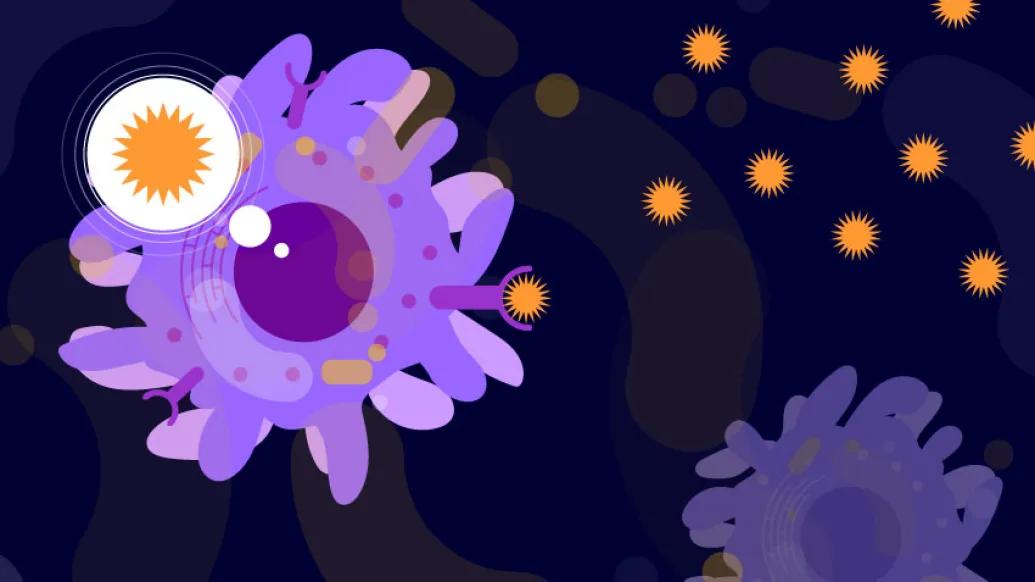
Autoimmune disorders such as rheumatoid arthritis, psoriasis, and Crohn's disease plague tens of millions of Americans and are the result of the body's immune system, whose role is to fight against disease-causing pathogens, turning against itself.
Thankfully, several new drugs designed to fight these diseases are now available. The downside—the drugs, a class of biologics called TNF inhibitors, carry a risk of serious infections and even cancer.
A research team led by Michigan Medicine may have discovered why. Their study, which appears in the journal Science Advances, reveals a previously unknown function of a specific type of immune cell called dendritic cells.
"Dendritic cells are the master orchestrator of the immune response, telling the other cells of the immune system what to do," explains Michal Olszewski, DVM, Ph.D., a research biologist with the Ann Arbor VA Hospital, associate professor of internal medicine at U-M and senior author on the paper.
MORE FROM THE LAB: Subscribe to our weekly newsletter
Dendritic cells are part of the innate immune network, the body's first line of defense against a threat. They help another type of immune cell called T cells, which are part of the adaptive immune system, learn how to respond appropriately to a given germ or disease-causing agent.
This study reveals that the cells have their own form of program memory and hinges on a well-known immune signaling molecule called TNFalpha, which causes the inflammation so painfully familiar to those with arthritis and other autoimmune diseases.
This will be important for vaccine development, for understanding how the immune system responds to chronic infections, and why people who take [these drugs] are particularly vulnerable to these kinds of diseases.Michal Olszewski, DVM, Ph.D.
"Our studies have found that TNFalpha is part of the system that programs dendritic cells so that they know how to program T cells," says Olszewski.
TNFalpha is especially important in helping dendritic cells teach T cells to fight off infections like certain fungal infections and tuberculosis that can hide inside the body's cells. This is why people taking these autoimmune drugs are particularly at risk.
"Some microbes are very clever and fool the immune system so it doesn't detect and kill them, causing disease. But in our study, we found in the presence of TNFalpha, microbes can't do those tricks. With its help, dendritic cells don't get fooled and therefore can activate the protective T cell response," says co-first author Jintao Xu, Ph.D. of the Ann Arbor VA Hospital.
LISTEN UP: Add the Michigan Medicine News Break to your Alexa-enabled device, or subscribe to our daily updates on iTunes, Google Play and Stitcher.
Furthermore, the group found that the dendritic cell programming relied on rapidly developing epigenetic changes affording dendritic cell program stability and conferred to the T cells. This finding has major implications for the development of therapies targeting the immune system.
"This will be important for vaccine development, for understanding how the immune system responds to chronic infections, and why people who take anti-TNF for treatment of autoimmune diseases are particularly vulnerable to these kinds of diseases," comments Olszewski.
In an additional proof-of-concept study, the team found that by removing dendritic cells from mice taking an anti-TNF drug, exposing the cells to TNFalpha and reinjecting them into the mice, they could induce a normal immune response against infection.
This procedure hints at a complimentary therapy for people on anti-TNF drugs as well as a potential advanced immunotherapy for cancer. "Cancer can produce a group of signals that dampen the immune response. We speculate that one could program the dendritic cells outside of the cancerous environment and make them remember that they are to remain activated and continue to fight the cancer instead of ignoring it," says Olszewski.
This study also included the following U-M authors: Alison J. Eastman (co-first author), Jennifer Bermik, Nicole Potchen, Aaron denDekker, Lori M. Neal, Guolei Zhao, Antoni Malachowski, Steven Kunkel, John J. Osterholzer, and Ilona Kryczek.
Paper cited: "Epigenetic stabilization of DC and DC precursor classical activation by TNFα contributes to protective T cell polarization," Science Advances. DOI: 10.1126/sciadv.aaw9051

Health Lab
Explore thousands of health news & research stories by visiting the Health Lab homepage for more.
Media Contact

Public Relations
Department of Communication at Michigan Medicine
Stay Informed
Want top health & research news weekly? Sign up for Health Lab’s newsletters today!
Featured News & Stories

More babies with hypoplastic left heart syndrome surviving critical period between surgeries
Exploring the mind’s mysteries: 130 years of mental health care & innovation at U-M

How U-M helped bring depression out of the darkness
Immune system protein is a cancer killer on its own, new study shows

Online resources and coaching helped people seek genetic testing for cancer