How a social work researcher’s experience with young adult cancer informed his work

Bradley Zebrack reflects on the insights he’s applied from his cancer journey to his job.

5:00 AM

Author | Mary Clare Fischer
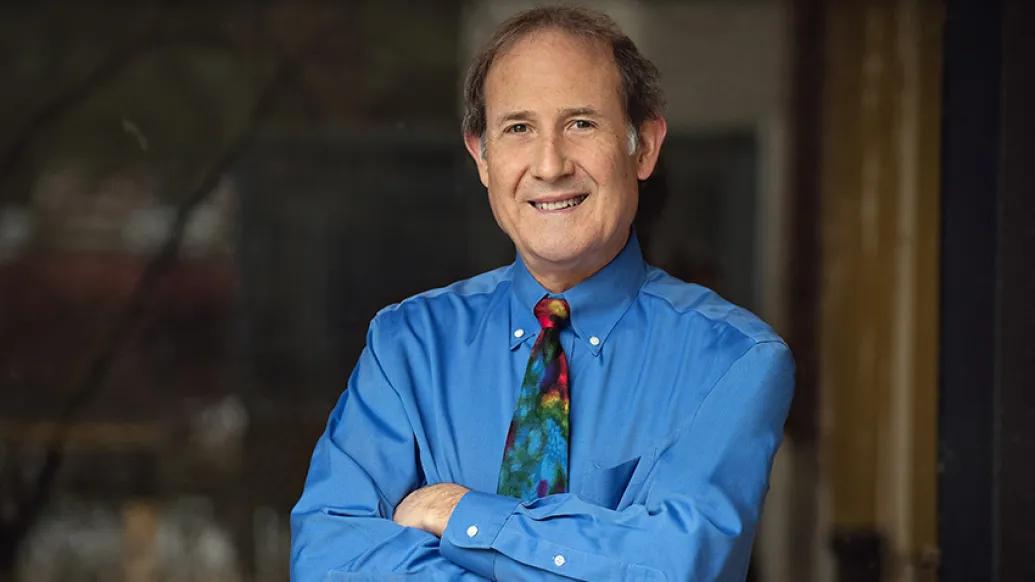
man smiling in rainbow tie in blue shirt
“I’ve always been very clear that I’m doing this work because I just want to help people with cancer,” said Zebrack, a social work research now.

When Bradley J. Zebrack, Ph.D., M.S.W., M.P.H., was 25 he thought he might become a schoolteacher. Then he was diag­nosed with Hodgkin lymphoma, a cancer that originates in the immune system. In an effort to cope, Zebrack went to a meet­ing of what would eventually become the well-known support network Cancer Support Community. He remembers being fascinated by the social worker who facilitated the group.

"I had this lightbulb moment," Zebrack said. "I could see myself doing that kind of work."

Decades later, Zebrack, a professor of social work at University of Michigan, has served as not only a teacher and a social worker but also a researcher who studies the effects of cancer on the growth and development of adolescents and young adults. In a recent edito­rial, he outlined how his experience as a cancer patient has led to and influenced his work.

"I've always been very clear that I'm doing this work because I just want to help people with cancer," Zebrack said, "because I know that cancer sucks."

We spoke with Zebrack to hear more about the lessons he learned from his own cancer and how he's used them to rede­fine the health care experience for patients.

What was a moment during your experience with cancer that affected how you think about your work now?

Zebrack: I go back to when I first started hearing the term "positive attitude."

The story I sometimes tell is I would go for chemotherapy, then afterwards get into bed and pull the covers over my head and endure a couple of days' worth of nausea. (This was 1986, before Zofran.) After those initial waves would pass, I'd be able to lean over and turn on the radio. Eventually, I felt a little bit better, and I could walk down to the kitchen and get myself something to eat. Instead of worrying about what I wasn't able to do, I had to flip that and think about what I was able to do in that very moment. I had to reframe those experiences.

I think that translated into my work later to think about strength and resilience. How did I find that in myself? How do we elicit that in our work with cancer patients and their fam­ilies to try to figure out, while you're going through this very traumatic experience, what resources do you have available to cope? How have you dealt with challenges in the past? If you've been successful in the past, how can you translate that into now successfully managing and adapting to cancer, so you can move forward in your life?

Is there anything you remember a provider or family member saying to you during your cancer experience that was intended to be hopeful and helpful but wasn't?

Zebrack: I had an aunt who I loved very much. She was a big part of my life, before, during and after cancer. Sometimes, she would come over and try to hustle me into a corner and say, "So, how are you really feeling?" as if she was trying to get the real story. It felt like more pressure to me, especially because I wasn't hiding anything.

Where that experience played out in my work is an under­standing of the emotional impact of cancer for young people. At 25 years old, you're barely a few years into learning how to deal with the adults in your life as adults. You don't have much experience managing your own emotions let alone having to carry the emotions of others. It's difficult to figure out how to respond and to carry that burden when it gets unloaded on you, especially from people you love.

In your editorial, you discuss the impact of meeting a man who'd had cancer at a young age, like you, and was doing well years later. Why is having a role model important for young people with cancer?

Zebrack: Particularly for a younger population, they've been having hopes and dreams and thoughts about what they want their future to be. To have cancer disrupts that; you're then left as a young person with no vision of what your life might look like with cancer or after cancer.

But even people in their older years still have hopes and dreams for the future. They want to be around for their grand­daughter's wedding or to take that long-awaited vacation. Without a vision of a future reality, our brains fill in the gaps with informa­tion that tends to be negative, even catastrophizing. And that's scary. So it's important to seek out people who can serve as an example of who you could be after your cancer treatment.


More Articles About:

Industry DX Future Think Health Care Quality Hospitals & Centers Education
Health Lab word mark overlaying blue cells

Health Lab

Explore thousands of health news & research stories by visiting the Health Lab homepage for more.

Media Contact

University Hospital at U-M Health in the spring with flowering trees in foreground and Survival Flight helicopter visible

Public Relations

Department of Communication at Michigan Medicine

[email protected]

734-764-2220

Stay Informed

Want top health & research news weekly? Sign up for Health Lab’s newsletters today!

Subscribe

Featured News & Stories

UMich Med Mosaic on blue background with colorful geometric shapes
UMich Med Mosaic

Beyond the White Coat: Disability, Neurodiversity and Advocacy in Medical School

In this episode of UMich Med Mosaic, host Mackenzie Kay sits down with medical students Jill Maudlin, Sarah Renberg and Bella Johnson to discuss their experiences as disabled and neurodivergent trainees at the University of Michigan Medical School. They reflect on the personal journeys that led them to medicine, the challenges and strengths that accompany living with disabilities and chronic health conditions and the importance of representation within the medical profession. The conversation explores how disability shapes their approaches to patient care, advocacy and teamwork, as well as the role of the Medical Students for Disability Health Advocacy (MSDHA) organization in creating community and advancing accessibility initiatives. They also discuss Michigan’s accommodations in medical education, efforts to improve disability-related curriculum content and the importance of building a culture where disabled and neurodivergent students can thrive.
Minding Memory with a microphone and a shadow of a microphone on a blue background
Minding Memory

Antipsychotic Use in Nursing Homes: Balancing Medication Safety, Policy, and Dementia Care
In this episode, Lauren Gerlach and Matt Davis speak with Theresa Shireman, PhD, Director of the Center for Gerontology and Healthcare Research and a Professor of Health Services, Policy and Practice and Epidemiology at the Brown University School of Public Health. Dr. Shireman’s research focuses on pharmaceutical policy, pharmacoepidemiology, health services research, and medication use among vulnerable populations. Dr. Shireman discusses her recent study, "Impact of Federal Antipsychotic Use Policy in Nursing Homes on New Diagnoses for Approved Indications in Dementia Residents," published in the Journal of the American Geriatrics Society. The study examines whether federal policies designed to reduce antipsychotic use in nursing homes were associated with increases in new diagnoses of conditions, such as schizophrenia, that exclude residents from publicly report antipsychotic quality measures. Using an interrupted time-series design, the researchers examined changes following the 2012 National Partnership to Improve Dementia Care and the 2015 addition of antipsychotic use to the Nursing home Five-Star Quality Rating System. They found that neither policy was associated with an increase in new exclusionary diagnossees, challenging concerns that nursing homes were increasingly assigning these diagnoses to circumvent restrictions on antipsychotic use. The conversation also explores the benefits and risks of antipsychotic medications for people living with dementia, including the potential for serious adverse effects such as sedation, falls, stroke, and increased mortality. Dr. Shireman discusses how public reporting and financial incentives can influence prescribing practices,the limitations of using a single quality measure to evaluate nursing home care, and the importance of balancing medication safety and residents’ individual needs. The discussion highlights the need for shared decision-making among clinicians, nursing home staff, residents, and families, as well as greater investment in staffing, resources, and nonpharmacological approaches to improve quality of life for people living with dementia. The transcript for this episode can be found here.
Well-Being at Michigan Medicine with Dr. Elizabeth Harry
Well-Being at Michigan Medicine

Learning Together: Making Space for Growth at Work

What if well-being starts with how we learn together? On this episode of Well-Being at Michigan Medicine, Elizabeth Harry, M.D., is joined by Rajesh Mangrulkar, M.D., FNAP, Executive Director of U-M’s Center for Interprofessional Practice and Education (IPE), Executive Director of Michigan Medicine RISE (Research. Innovation. Scholarship. Education), and primary care physician of internal medicine whose work focuses on organizational leadership and innovation, and Johnny McGraw, M.A., Marketing & Communications Specialist for both RISE and IPE, about building teams through human connection, psychological safety and learning. They discuss a meeting practice, why leaders shape culture and how investments in collaboration can help health care teams work without asking people to carry everything alone.
cell phone upclose in hands
Health Lab

Emergency room intervention pairs smartphone, telehealth counseling to reduce risky firearm behavior
Among U.S. teens and young adults, firearm violence accounts for about 65,000 emergency department visits annually, and 60% of all firearm deaths in this age group are the result of interpersonal violence.
Catheterized hospital patient's leg
Health Lab

Many hospitals still don’t do enough to prevent UTIs from catheters

Urinary catheters used by hospitals can lead to UTIs, bladder infections and bloodstream infections, yet hospital infection prevention efforts lag even after 20 years of effort.
Two people in medical scrubs are in a blurred hospital setting. In the foreground, hands are holding a digital tablet.
Health Lab

Digital alerts support timely treatment decisions of critically ill cardiac patients

Well-designed alerts for critically ill cardiac patients can change what happens at the bedside, according to new Michigan Medicine research.