TOS: When Swelling in the Arm Turns Serious
Scary symptoms sent a young, healthy woman to the emergency room, resulting in a venous thoracic outlet syndrome diagnosis. What others should know.
7:00 AM
Author |
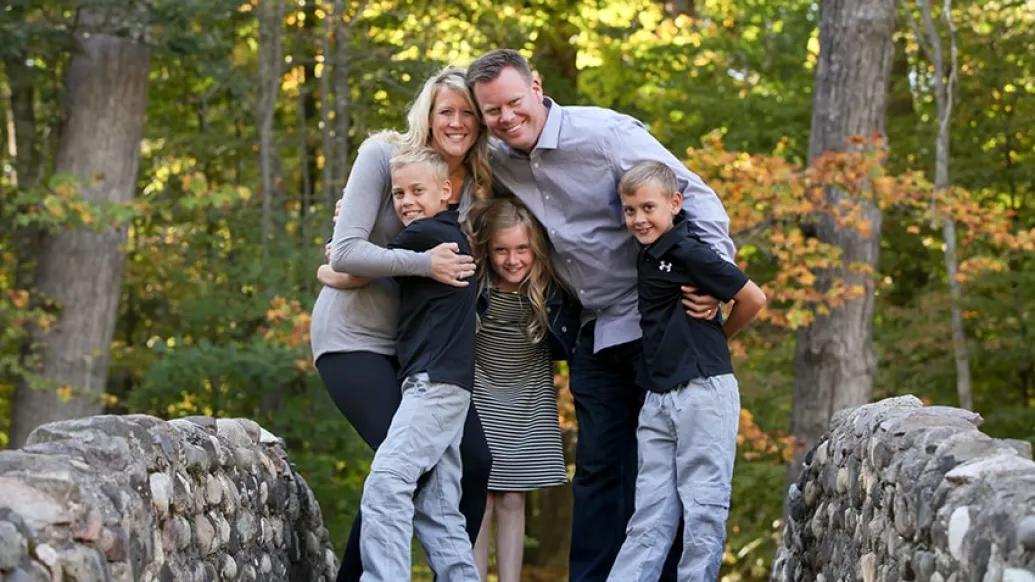
Kristin Dood didn't think much about the swelling in her left arm during a summer trip up north with her husband and 9-year-old triplets. Just a bug bite, she thought, hoping an antihistamine would relieve the swelling.
MORE FROM MICHIGAN: Sign up for our weekly newsletter
But the next morning, she awoke to an arm that had turned blue and nearly doubled in size. Later that day, she felt the swelling moving up to her neck.
"That's when I knew I needed to get to the University of Michigan emergency room," says the 41-year-old fifth-grade teacher from Canton, Michigan.
Initial tests revealed blood clots in Dood's arm had moved to her lungs. She was admitted to the hospital, where a CT scan and an MRI confirmed a type of thoracic outlet syndrome (TOS) called venous thoracic outlet syndrome (VTOS).
TOS describes a group of conditions caused by compression of the nerves or blood vessels that serve the arms. Without treatment, VTOS can lead to blood clots, including pulmonary embolism, a potentially life-threatening blood clot in the lungs.
All three subtypes of TOS — including VTOS — typically affect healthy, young and active people, though symptoms may vary among the types.
The most frequent causes of TOS are sudden trauma, such as a collarbone fracture from an accident or a fall; repetitive movements, such as manual labor; or repetitive injury.
The condition is diagnosed in several ways, including a CT venogram (CTV) or MR venogram (MRV). Both involve an X-ray of the veins, often using contrast dye.
Symptoms
As in Dood's case, symptoms of VTOS can include:
-
Swelling and discoloration of the hand or arm (bluish color)
-
Arm pain with exertion, swelling and fatigue
-
Blood clot (deep vein thrombosis) in veins or arteries in the upper body
-
Development of prominent collateral veins around the shoulder and on the arm
-
Numbness or tingling in the fingers
Treatment options
Treatment for VTOS is based on a patient's symptoms, says U-M Frankel Cardiovascular Center vascular surgeon Chandu Vemuri, M.D.
"If a patient presents with an acute blood clot, the clot is dissolved, the diagnosis confirmed and the patient is put on systemic anticoagulation," he says. "Surgery is then scheduled with the timing based on the results of the venogram.
"If a patient presents with chronic symptoms, often an MRV or CTV is followed by discussion with the patient about the goals of surgery."
Surgery for VTOS involves a complete thoracic outlet decompression, which includes removal of the first rib, surrounding muscle and scar tissue around the jugular, innominate and subclavian veins.
Going the distance
In Dood's case, her subclavian vein was compressed between her collarbone and first rib. (The subclavian vein, located just below the collarbone, is the main vein that takes blood from the arm to the heart.)
SEE ALSO: For Patient Awaiting New Heart, a Ventricular Assist Device Brings Hope
"As this happened over time, her vein became progressively damaged and eventually clotted off," Vemuri says.
Although it is likely she was born with VTOS, Dood thinks her condition was exacerbated by her indoor cycling workouts, which included a 20-day challenge that had her riding twice a day at times.
"In cycling," she explains, "your arms are extended for long periods of time. The more my arms were extended, the more my vein was being pinched."
Vemuri concurs: "When her arms were in this position, the vein was being compressed between the first rib and her clavicle."
This repetitive injury, he says, probably caused her vein to clot.
Dood underwent a procedure to remove the clots and was placed on blood thinners to prevent new clots from forming. Two weeks later, Vemuri performed a complete thoracic outlet decompression.
After a routine, 10-day postoperative stay in August, Dood was discharged with orders to rest her arm. She recently began physical therapy and is looking forward to 100 percent use of her arm.
"It's been a scary experience with a long recovery," says Dood, who has temporarily put the brakes on cycling.
But she plans to be back on the cycling circuit once she gets the all-clear.

Health Lab
Explore thousands of health news & research stories by visiting the Health Lab homepage for more.
Media Contact

Public Relations
Department of Communication at Michigan Medicine
Stay Informed
Want top health & research news weekly? Sign up for Health Lab’s newsletters today!
Featured News & Stories

Reducing infections after heart surgery could save Medicare $441 million per year
Young father survives aortic dissection after delayed diagnosis
Weighing TAVR vs. SAVR for aortic stenosis treatment

Born with half a heart, headed to college with a full life

The Kidney Warning Signs You’re Missing— And Why Waiting is Dangerous