Teen Athlete’s Extra Rib Leads to ‘Dying’ Hand and Vascular Surgery
On the field and court, Taryn Miller is a force. But a hard-to-diagnose condition known as TOS left the athlete unsure she’d ever play again.
7:00 AM
Author |

When Taryn Miller first heard she might not be able to participate in school sports, she and six of her biggest fans — four sisters and her parents — were devastated.
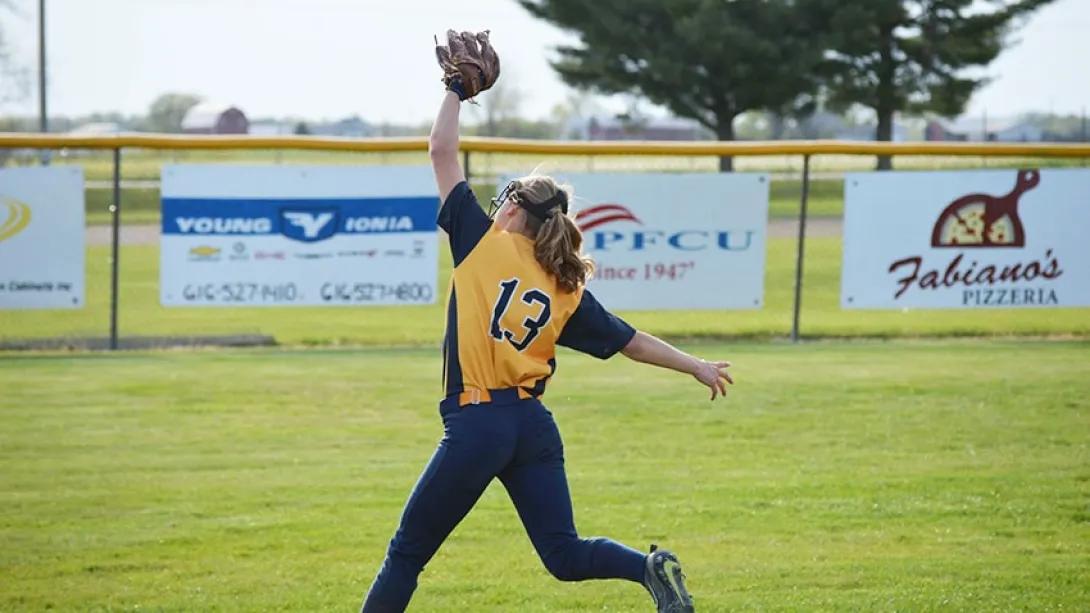
A talented softball and volleyball player, Miller was enjoying the last few months of the softball season in spring 2017 when she began experiencing pain in her right biceps.
LISTEN UP: Add the new Michigan Medicine News Break to your Alexa-enabled device, or subscribe to our daily audio updates on iTunes, Google Play and Stitcher.
The pain eventually subsided, but when volleyball practice began last August, Miller's fingers became numb and swollen.
Her family physician initially suspected Raynaud's disease or rheumatoid arthritis, but further examination by an orthopedic doctor revealed a low pulse in Miller's brachial artery, the major blood vessel in the arm.
By February, Miller's middle three fingers were turning blue.
The 16-year-old was referred to a vascular physician who diagnosed blood clots in her radial and ulnar arteries — clots that were cutting off critical blood flow to the hand.
"Taryn's hand was slowly dying," says her mother, Jamie Parker.
Miller underwent surgery to remove the clots and was put on a blood thinner for the next month to prevent more clots from forming.
She was then referred to Michigan Medicine vascular surgeon Chandu Vemuri, M.D., who confirmed the suspected cause of the patient's blood clots: arterial thoracic outlet syndrome (TOS).
Signs of trouble
Thoracic outlet syndrome includes a group of conditions caused by compression of the nerves and blood vessels that pass through the space between the collarbone and first rib (the area known as the thoracic outlet) on their way from the chest cavity to the arm and hand.
The exact cause of TOS can't always be determined. Some individuals are born with an extra rib that reduces the size of the thoracic outlet and compresses the nerves and blood vessels.
Other causes include a traumatic injury to the area and repetitive activities such as lifting heavy objects, working on a computer or playing sports.
MORE FROM MICHIGAN: Sign up for our weekly newsletter
Without treatment, TOS can lead to blood clots — such as the ones Miller experienced.
"In some cases," says Vemuri, "TOS can be life-threatening if the blood clot embolizes to the brain and causes a stroke."
The condition found a wider audience this week when it was revealed that country star Eric Church almost died last summer from blood clots related to TOS.
In Miller's case, her subclavian artery was being compressed between her cervical rib and her first rib. A cervical rib is a congenital condition (present at birth) in which an extra rib forms above the first rib near the neck.
The compression resulted in blood clots that embolized to Miller's hand.
Symptoms and treatment
Vemuri calls Miller a "textbook" arterial TOS patient because of her symptoms, which included exercise-induced arm discomfort, numbness and tingling in her fingers and the formation of black spots on her fingers caused by necrosis (a lack of blood or oxygen to tissues).
SEE ALSO: TOS: When Swelling in the Arm Turns Serious
The Fowler, Michigan, resident and her family were comforted to know that a surgeon experienced in TOS could treat her condition.
"Dr. Vemuri made it easy for me and my family," Miller says. "He explained it all very clearly."
Vemuri performed surgery to restore blood flow to Miller's right hand. The procedure included thoracic outlet decompression, removal of the cervical rib, first rib and scalene muscle as well as scars that had formed around her artery and nerves.
Surgery was followed by an ultrasound so Vemuri could make sure the artery appeared normal.
Miller remained in the hospital for five days and had limited lifting restrictions for the first two months, along with four months of physical therapy.
A strong recovery
Today, Miller has a clean bill of health and her doctor's approval to resume her pursuits.
"I'm super happy I can play again. I'm all set to go," the energetic teen says.
Her father and coach, Brian Miller, shares his daughter's joy.
"To see the smile on her face now that she's back on the field is incredible," he says. "She's a much happier kid, and that makes me happy."
The rest of the family agrees as they gear up for another season of cheering for their favorite athlete, back and strong as ever.

Health Lab
Explore thousands of health news & research stories by visiting the Health Lab homepage for more.
Media Contact

Public Relations
Department of Communication at Michigan Medicine
Stay Informed
Want top health & research news weekly? Sign up for Health Lab’s newsletters today!
Featured News & Stories

Reducing infections after heart surgery could save Medicare $441 million per year
Young father survives aortic dissection after delayed diagnosis
Weighing TAVR vs. SAVR for aortic stenosis treatment

Born with half a heart, headed to college with a full life

The Kidney Warning Signs You’re Missing— And Why Waiting is Dangerous