Surgery Team Keeps Fighting to Save Veteran
No one thought John Canning could survive his ruptured abdominal aortic aneurysm until this cardiovascular team stepped up to save his life.
9:59 AM
Author |
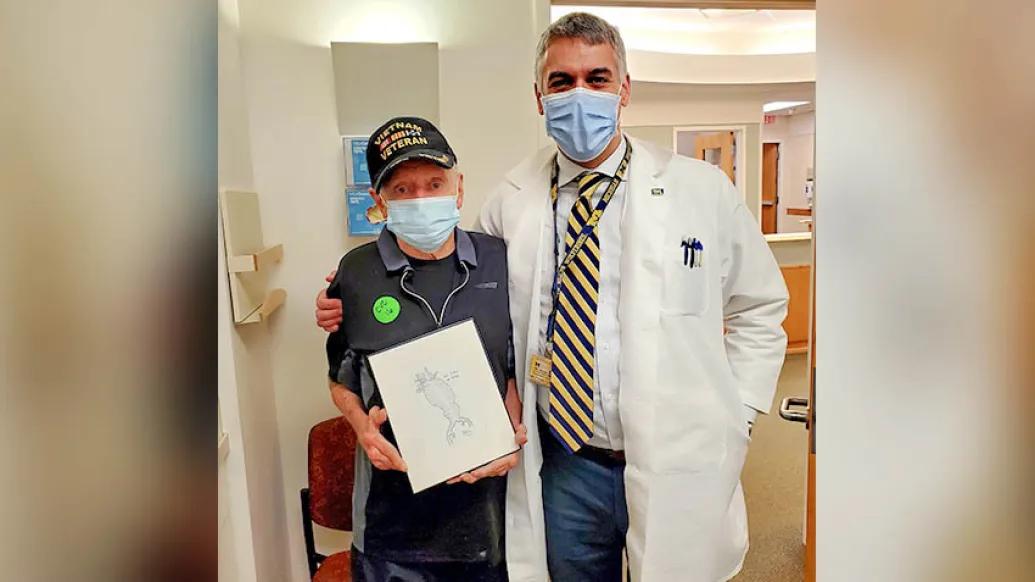
As many look forward to closing the door on 2020, John Canning will remember it as the year he was given a second chance at life.
Luck was on his side in more ways than one last January 23. Canning's emergency surgery to repair a life-threatening ruptured abdominal aortic aneurysm happened on the cusp of COVID-19. It also put him in the hands of Michigan Medicine vascular surgeon Matthew Corriere, M.D., who refused to give up despite a grim outlook for the 72-year-old.
An abdominal aortic aneurysm, or AAA, occurs when the abdominal aorta, a critical blood vessel that feeds the legs and lower body, begins to enlarge. Depending on the size of the aneurysm and how fast it's growing, treatment might include watchful waiting or surgery. Sudden death can occur if the aneurysm ruptures. Most individuals with an AAA experience no symptoms until the aneurysm becomes large, often causing pain in the groin and abdomen.
From watchful waiting to urgency
Canning's AAA was detected six years ago, measuring at 3 centimeters. Under the care of his cardiologist, the plan was to keep a close eye on the aneurysm, still considered small, until it reached approximately 6 centimeters, at which point surgery would be the likely next step.
But things changed in September 2019 when it was discovered Canning's aneurysm had doubled in size to nearly 8 centimeters. Because of underlying conditions, including pulmonary disease, his doctors felt open surgery to repair the aneurysm posed significant risk for the grandfather of two.
"Doctors told me that repairing the aneurysm would be a very risky procedure – one that I may not survive," Canning says.
After weighing all the information, the Livonia, Michigan, resident made the decision to forego surgery and spend the time he had left enjoying life as best he could. "I figured I would just go in my sleep," he says.
Against the odds
But four months later, Canning was rushed to the emergency room of a local hospital with extreme stomach pain. His aneurysm was rupturing.
Canning's daughter, Gena, was out of town on a business trip when she got the phone call. "Doctors gave a grim prognosis saying he wouldn't survive more than three hours," she recalls. "He was fading quickly. We needed to decide if we should bring in hospice or find someone willing to attempt a risky surgery."
The decision was made to airlift Canning to Michigan Medicine via its Survival Flight program, where a team of specialists led by Corriere would attempt to repair the aneurysm. "Our team knew exactly what to do once the patient arrived in the Emergency Department," says Corriere.
MORE FROM MICHIGAN: Sign up for our weekly newsletter
Canning was quickly moved to the Michigan Medicine Frankel Cardiovascular Center where he arrested before he made it onto the operating table. The nurses quickly prepped the patient while anesthesia was induced. Canning regained a pulse and blood pressure once his aorta was clamped to stop extensive internal bleeding. During the six-hour procedure, the aneurysm was opened and replaced with a graft.
"We knew the patient's risk of complications was high and it would be a rough ride to get him through," Corriere acknowledges, noting that Canning's heart had stopped during the flight to Michigan Medicine and several more times on the operating table. At the direction of Corriere and despite perilous odds, the team continued to fight to save the man whose life was in their hands.
"Through it all, the team never gave up," says a grateful Gena. "Dr. Corriere was determined to get my father off the table."
The ongoing fight
Despite surviving the surgery, Canning was nowhere near out of danger as he laid in the intensive care unit on life support. "Weeks went by," says Gena. "He was on 24-hour dialysis due to blood loss during the surgery, which now impacted his kidneys. There were several attempts to take him off the ventilator, which resulted in reintubation. For every stride there always seemed to be a setback."
But eventually, Canning began to recover. During his 36-day hospital stay, Gena recalls many medical professionals stopping by her father's room. "They would share with me that they were in the room the night of my dad's surgery and heard he was still alive. They said they wanted to see the miracle for themselves."
No one was more surprised than Corriere himself when he saw Canning for his first post-op clinic visit following rehabilitation. "I thought he would still be on dialysis, maybe in a wheelchair and with his trach still in," he says. "I was stunned to see him get up to shake my hand when I entered the room."
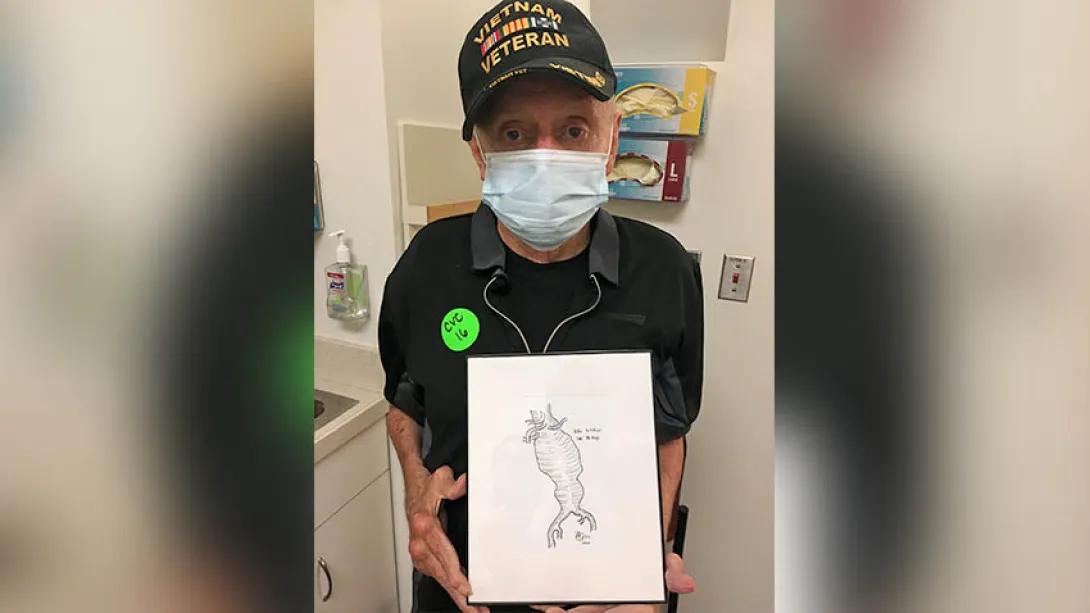
Corriere was especially moved to receive a sketch of Canning's aneurysm by a fellow who was part of the surgical team.
"He told me he learned that night the importance of not giving up. It's very rewarding to know we did everything we could to save the patient," Corriere says.
Sweet serenity
Canning and his family couldn't be more thankful for his second chance at life. "We think about Dr. Corriere and his team always," says Gena.
These days the family patriarch happily spends his time playing taxi driver to his two grandsons and helping his family out in any way he can. He often reflects on his experience, saying, "I like to sit and ponder what could have been versus what actually is. I'm now enjoying my life and all its serenity."

Health Lab
Explore thousands of health news & research stories by visiting the Health Lab homepage for more.
Media Contact

Public Relations
Department of Communication at Michigan Medicine
Stay Informed
Want top health & research news weekly? Sign up for Health Lab’s newsletters today!
Featured News & Stories

Many older adults make Medicare decisions quickly and most don’t change plans, poll finds

Many hospitals still don’t do enough to prevent UTIs from catheters

Digital alerts support timely treatment decisions of critically ill cardiac patients

Is the United States Lagging Behind Europe in Memory Improvement?

Reducing infections after heart surgery could save Medicare $441 million per year