A Young Woman Shares Her Battle with Heart Valve Disease
Candice Tarter’s struggles with valve disease led her to Michigan Medicine and, finally, a successful outcome.
7:00 AM
Author |
Candice Tarter was only 16 when rheumatic fever led to serious heart issues, and four open-heart surgeries over the next 12 years.
It was a devastating blow. Tarter had dreamed of taking her high school basketball talent to the college level, and several schools had been actively pursuing her.
LISTEN UP: Add the new Michigan Medicine News Break to your Alexa-enabled device, or subscribe to our daily audio updates on iTunes, Google Play and Stitcher.
And although her life took an unexpected path, today Tarter is living another dream.
The strong, determined 28-year-old woman is a teacher at Detroit's Marion Law Academy, where she encourages her 5th-grade students to be responsible for their own actions, education and life — lessons she herself has learned the hard way.
From the start
Rheumatic fever is a bacterial infection caused by certain strains of streptococcal bacteria. Among other things, it can lead to rheumatic heart disease, a condition in which the heart's valves become damaged and stiffened, disrupting the normal flow of blood through the heart.
Tarter's rheumatic heart disease was initially detected by a heart murmur in 2006. A pediatric cardiac surgeon performed emergency open-heart surgery to replace her severely damaged aortic valve and mitral valve with bioprosthetic valves, replacement valves made of human or animal tissue.
MORE FROM MICHIGAN: Sign up for our weekly newsletter
Two years later, while attending college, extreme fatigue led to the discovery of an infection that had damaged the new valves.
In another open-heart surgery, both valves were again replaced, and a pacemaker was implanted to correct a newly diagnosed arrhythmia, or irregular heartbeat.
In December 2016, Tarter experienced ongoing chest pain, which she attributed to heartburn. But a visit to her doctor revealed something far more serious: an aortic pseudoaneurysm, a contained rupture of the aorta likely caused by a post-operative infection.
Tarter underwent a third open-heart surgery to repair the rupture.
The next year, she experienced a series of fainting episodes. She originally thought they were related to fatigue and stress. Unfortunately, they were the result of surgical fluid that had collected in her chest, requiring a fourth operation.
Although not an open-heart procedure, this one, too, required a sternotomy, a vertical incision from just below the collarbone and extending to the end of the sternum.
A second opinion and, finally, relief
When the fainting episodes continued, and her doctors felt the only option was a heart transplant, Tarter was referred to the University of Michigan Frankel Cardiovascular Center.
Tests there revealed her aortic root had ruptured from her heart. The blood was flowing underneath her breastbone, with scar tissue the only thing keeping the blood from free rupture. She would need yet one more open-heart procedure. This time, it would be extremely complex.
Despite initial hesitancy to undergo another operation, support and encouragement from her family and friends gave her the strength to go forward with the recommended surgery in November 2017.
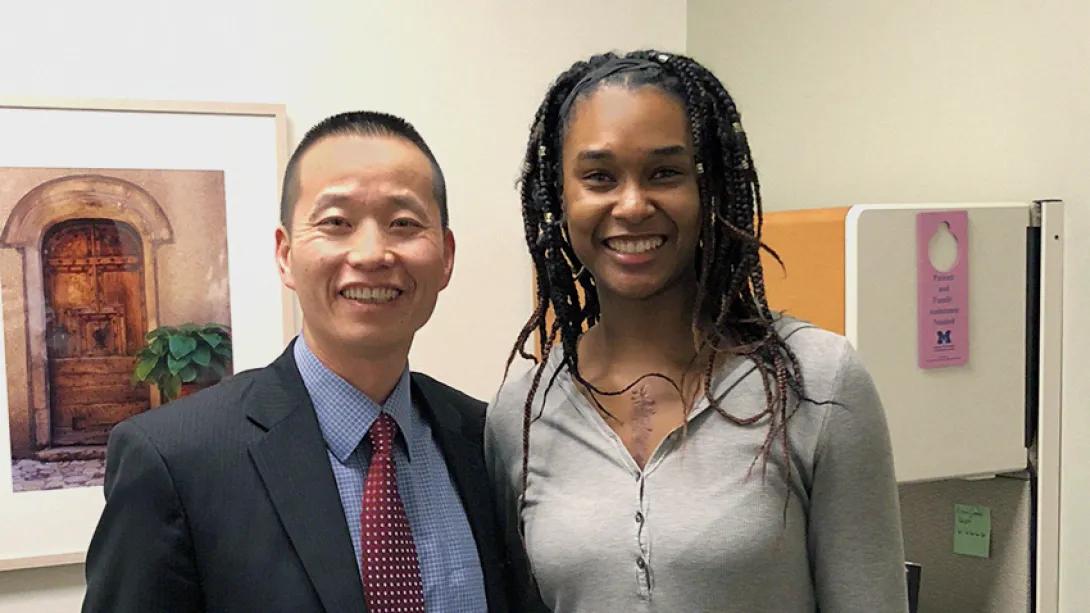
"The patient's former surgeons had tried everything and felt they had run out of options," says Michigan Medicine cardiac surgeon Bo Yang, M.D.
But he and his team were confident they could treat Tarter's condition, avoiding a heart transplant.
"We created a new left ventricle outflow tract, a new aortic root and aortic valve, preserved the mechanical mitral valve and performed a bypass graft on her right coronary artery, which was completely closed," says Yang. "The patient was discharged a few days after surgery without any complications. Today, she is doing very well and is living a normal life."
Today, she is doing very well and is living a normal life.Bo Yang, M.D
Partnerships for success
"I felt so much better after my last surgery," says Tarter, who appreciates the partnership she developed with her Michigan Medicine care team. "They allowed me to be very involved in the process. It was a give and take. I was a part of my own medical care."
Today, Tarter truly is "living a normal life" as she especially enjoys family time, movies and nature walks, often accompanied by her boyfriend.
She's also thankful to be able to interact with her students, learning from them as well as teaching them in what has also become a give-and-take partnership.
"I hold my students accountable to learn, to challenge themselves and to grow," says Tarter, who enjoys it when she sees her students' eyes light up in the classroom. She equates it to her own personal growth that has come from conquering monumental health challenges in her young life.

Health Lab
Explore thousands of health news & research stories by visiting the Health Lab homepage for more.
Media Contact

Public Relations
Department of Communication at Michigan Medicine
Stay Informed
Want top health & research news weekly? Sign up for Health Lab’s newsletters today!
Featured News & Stories

Jalen Hurts’ blood clot diagnosis: doctors answer common questions

Could a diabetes medication be the next wonder drug?

Digital alerts support timely treatment decisions of critically ill cardiac patients

Is the United States Lagging Behind Europe in Memory Improvement?
Reducing infections after heart surgery could save Medicare $441 million per year