App Calculates Risk of Delaying Cancer Care During Pandemic
The University of Michigan’s OncCOVID app draws on global cancer and coronavirus data to create an individualized mortality risk assessment for receiving immediate versus delayed cancer treatment.
12:05 PM
Author |
Editor's note: Information on the COVID-19 crisis is constantly changing. For the latest numbers and updates, keep checking the CDC's website. For the most up-to-date information from Michigan Medicine, visit the hospital's Coronavirus (COVID-19) webpage.
Interested in a COVID-19 clinical trial? Health research is critical to ending the COVID-19 pandemic. Our researchers are hard at work to find vaccines and other ways to potentially prevent and treat the disease and need your help. Sign up to be considered for a clinical trial at Michigan Medicine.
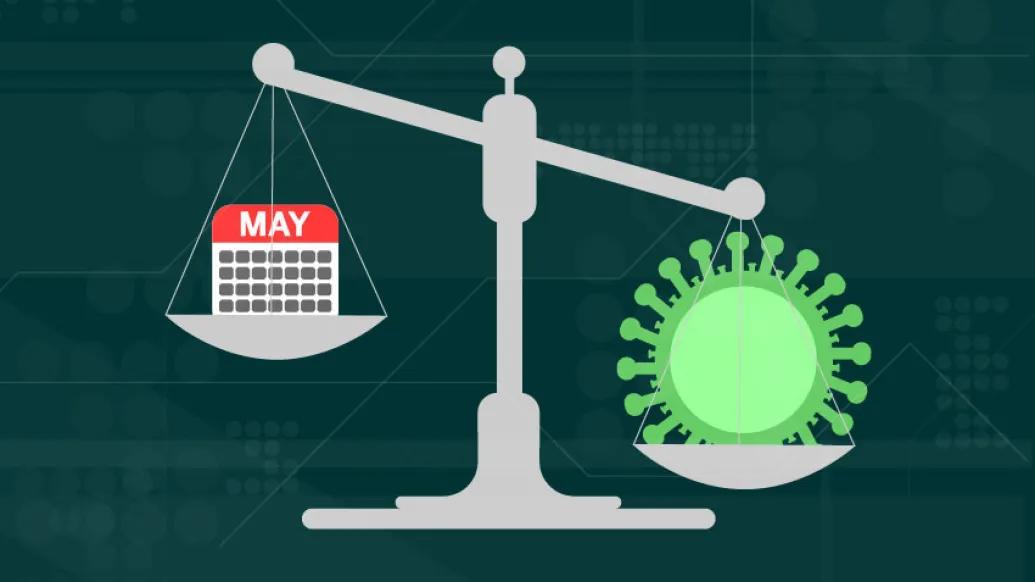
As the COVID-19 pandemic has overwhelmed healthcare systems across the country, doctors have postponed surgery and other treatments for thousands of patients with cancer. These delays may last for months, especially for those with early stage and less aggressive disease.
Unfortunately, there hasn't been a good way for doctors to compare the long term risk to a patient from a months-long postponement of care to the additional risk posed by potential COVID-19 infection if they undergo surgery, chemotherapy and/or radiation.
So, a team of data scientists and cancer doctors from the University of Michigan Rogel Cancer Center and the U-M School of Public Health developed a free, web based application to do just that.
The OncCOVID app draws on large, national cancer data sets to help assess the risk from of immediate treatment versus delayed treatment, depending on a patient's individual characteristics, as well as on COVID's impact on their local community.
"For many types of cancer, the data show delays in treatment lead to worse outcomes for patients," says the project's lead researcher, Holly Hartman, a doctoral student in biostatistics at U-M. "But each time a cancer patient goes to the hospital to receive care, they're also putting themselves at higher risk of contracting COVID-19. So, it's essential to balance the need for treatment for this very serious disease and the extra risk that COVID-19 poses for cancer patients, whose immune systems are often compromised."
The researchers envision OncCOVID being used by doctors to help identify patients whose risk from COVID is outweighed by the benefits of immediate treatment.
MORE FROM THE LAB: Subscribe to our weekly newsletter
"We also see the app providing additional reassurance to oncologists and their patients when the data show that delaying treatment will likely have little or no impact on a patient's long-term outcome," Hartman adds.
Meanwhile, OncCOVID could also be used by health care systems that are ramping services back up and need to prioritize a backlog of patients whose treatment was put on hold due to the pandemic, adds Daniel Spratt, M.D., an associate professor of radiation oncology at Michigan Medicine and one of the senior researchers on the project.
"Hospitals have basically been using a three-tiered system during COVID: treat, delay a little, or delay a lot," Spratt says. "Unfortunately, this tiered system is an extremely blunt instrument. Our goal was to create a resource that could be tailored both to the individual patient and to their local community."
The app allows doctors to enter more than 45 characteristics about a patient — including their age, location, cancer type and stage, treatment plan, underlying medical conditions, and the proposed length of a delay in care. It then calculates the patient's likely five-year survival following immediate treatment and delayed treatment.
Under the hood, the app draws on millions of records contained in the National Cancer Institute's Surveillance, Epidemiology, and End Results (SEER) registry and the National Cancer Database, combined with county-level COVID infection data from Johns Hopkins University.
In some cases, the personalized risk assessments run counter to the generic, three-tiered approach.
It's essential to balance the need for treatment for this very serious disease and the extra risk that COVID-19 poses for cancer patients, whose immune systems are often compromised.Holly Hartman
For example, Spratt says, the team's model shows that an otherwise healthy 45-year-old woman from Ann Arbor, Mich. with stage 1 breast cancer actually has a slightly higher risk of dying over the next five years if treatment is delayed by more than three months than if she's treated immediately.
"Under the three-tiered model, care for this patient wouldn't be considered life-threatening and it's likely her care may be delayed for months under most of the published tier-based systems," he notes.
Conversely, under the team's data model, a 70-year-old woman from New York City — where COVID infections have been high — with stage 1 breast cancer and several underlying health conditions would be put at significantly more risk by undergoing immediate treatment than the risk posed by a three-month delay.
For the data savvy, advanced features allow all of the app's underlying statistical assumptions to be adjusted — such as the baseline mortality risk from COVID and the disease's infection rate.
Like Podcasts? Add the Michigan Medicine News Break to your Alexa-enabled device or subscribe for updates on iTunes, Google Play and Stitcher.
In the future, the researchers plan to use the same data model to start looking at the effects that treatment delays due to the coronavirus pandemic may have on cancer mortality nationally, Hartman adds.
The OncCOVID app is not intended to provide medical advice to patients, the researchers caution. A number of factors may figure into a care provider's recommendation to delay or proceed with cancer treatment, including their local hospital's capacity to safely treat cancer patients during the pandemic.
Matthew Schipper, Ph.D., associate professor of radiation oncology and biostatistics at U-M, was also a co-creator of the app. Other collaborators on the project include: Nicholas G Zaorsky, Xi Wang, Ming Wang, and Vonn Walter of Pennsylvania State University; and Yilun Sun, Emily Morris, Elizabeth Chase, Theresa Devasia, Pin Li, Kelley Kidwell, Robert Dess and William Jackson of U-M.
The work was supported, in part, by grants from the National Institutes of Health.
Watch an in-depth discussion of the OncCOVID app by radiation oncologist Daniel Spratt, M.D., a senior researcher on the project.

Health Lab
Explore thousands of health news & research stories by visiting the Health Lab homepage for more.
Media Contact

Public Relations
Department of Communication at Michigan Medicine
Stay Informed
Want top health & research news weekly? Sign up for Health Lab’s newsletters today!
Featured News & Stories

How to discuss health care and end-of-life wishes during the holidays

Court appointed medical guardian study reveals role in care of highly vulnerable older adults
What’s changing in Medicaid and what can you do?

Are you at risk of a genetic disease? Guidelines for testing should be updated, experts say
Small Pauses, Bigger Impact: Mindfulness in Action