Urgent Care vs. the Emergency Room: What’s the Difference?
Do you know the best place to go when you’re sick? A Michigan Medicine emergency department physician offers tips to choose the right care.
7:00 AM
Author |

Knowing where to go after an illness or accident can sometimes be tricky, especially when your primary care doctor is booked — or when you need help after hours.
MORE FROM MICHIGAN: Sign up for our weekly newsletter
Do you head to an urgent care clinic? Or is the situation severe enough to go to the emergency department?
Each option has its place, says Brad Uren, M.D., an assistant professor of emergency medicine at Michigan Medicine.
Choosing one requires self-evaluation. A sinus infection, after all, needn't prompt a trip to the hospital.
"There's an important distinction between a minor injury or complaint and a major injury that requires a whole medical team working together," says Uren.
He spoke about the two types of care and how to pick the right one.
Choosing between urgent care and the hospital
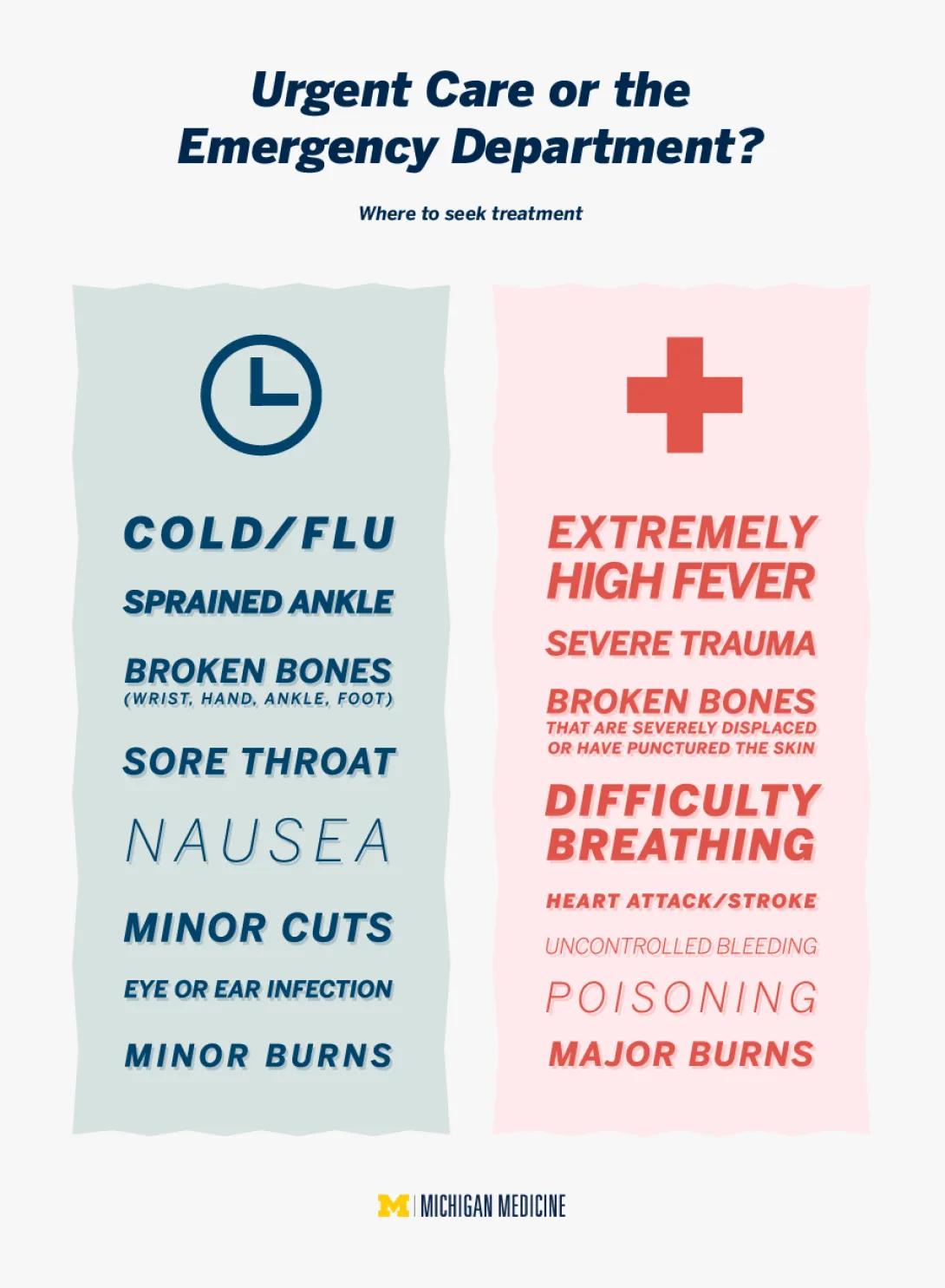
Urgent care can fill in for your regular doctor: The stand-alone clinics, which often are open evenings and weekends, "provide the sorts of routine injury treatment and acute medical care that a primary physician would typically perform in their office," Uren says. That includes treating cold and flu cases, earaches, sprained ankles and minor cuts that require stitches. Urgent care clinics usually lack an operating room but may offer X-rays and simple lab tests.
Hospitals are ready for almost anything: Although equipped to treat minor injuries or sickness, emergency departments are best suited for the bigger stuff. "They can generally respond to just about any emergency within the capabilities of that hospital — 24/7," Uren says. Among these offerings: radiology labs, ultrasounds, CAT scans and MRIs, operating rooms and access to doctors of varying expertise across medical disciplines. Beds are available if a patient needs to stay over.
SEE ALSO: 10 Safety Tips for Fall Yardwork
Wait times will vary: Urgent care clinics might be sparsely staffed (with only a doctor and a nurse practitioner or physician assistant clocked in), but the lower acuity, or sickness, of patients means that most can be seen quickly. An emergency department admits patients using a system known as triage, which gives priority to serious cases. "If you're in need of immediate, lifesaving care, you will absolutely receive it," Uren says. A stroke patient, for example, would take priority over someone with a sore throat.
Costs will differ, too: Most people face a higher copay for emergency room visits compared with an urgent care consultation. So, beyond the prospect of a longer wait in a hospital, those with illnesses that aren't life-threatening might choose the latter setting for fiscal reasons. "In many cases, insurance companies have stratified copays that make emergency department visits more expensive," says Uren. "It is worth considering if your concern can be addressed at a lower, and cheaper, level of care."
Urgent care clinics know their limits: Although patients should try to pick the most suitable place for treatment on the first try, a severely ill person will be quickly and appropriately sent to an emergency department if he or she checks in at urgent care. But that lost time can be deadly when dealing with severe trauma, shortness of breath or loss of consciousness — scenarios ideally suited to hospitals. Says Uren: "In emergencies, every minute counts."

Health Lab
Explore thousands of health news & research stories by visiting the Health Lab homepage for more.
Media Contact

Public Relations
Department of Communication at Michigan Medicine
Stay Informed
Want top health & research news weekly? Sign up for Health Lab’s newsletters today!
Featured News & Stories

Top 7 tips for choosing Medicare prescription drug coverage for 2027

Many older adults make Medicare decisions quickly and most don’t change plans, poll finds

What’s the latest on 7-OH and kratom availability and addiction care?
Better prenatal care data could help prevent maternal complications, experts say
Many hospitals still don’t do enough to prevent UTIs from catheters