Regaining Lost Function with the Help of Video Games
Gaming technology enjoyed by millions in leisure time is finding a new audience: Michigan Medicine rehabilitation patients.
11:00 AM
Author |
At first glance, the Michigan Medicine Inpatient Rehabilitation Computer Therapy Lab might appear to be all fun and games.
MORE FROM MICHIGAN: Sign up for our weekly newsletter
That's the intent. Many of the rehabilitation programs developed in the lab are based on gaming technologies — and designed to get patients active and engaged.
Such patients include those recovering from strokes as well as spinal cord and head injuries. Most are eager to get started on any given day, says Rob Ferguson, MHS, OTRL, a manager at the University of Michigan Stroke Rehabilitation Program and an occupational therapy clinical specialist.
The reason? Gaming promotes the repetition, intensity and task-oriented training needed to support an individual's rehabilitation goals.
It also offers a distraction for some patients.
"They often have no idea they're doing so many repetitions because they become immersed in the experience," Ferguson says. "They lose track of their effort."
Launched in 2008 and associated with the Stroke Rehabilitation Program, the Computer Therapy Lab is one of only a few such facilities in the country. It incorporates the therapeutic use of technology to help develop physical, cognitive, perceptual and visual skills to improve a patient's level of function and independence.
A winning strategy
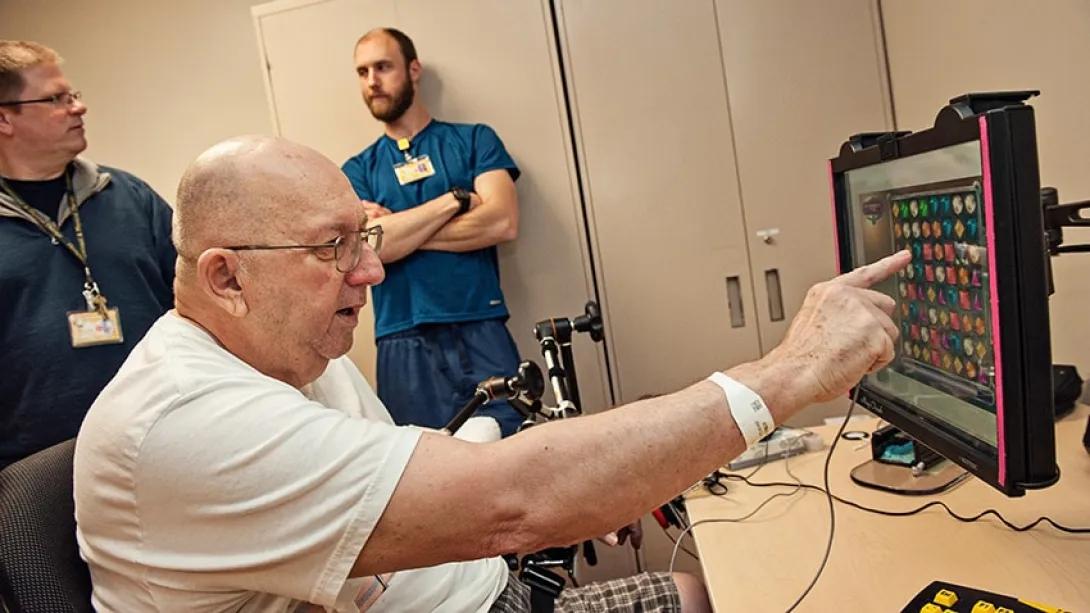
The lab's team analyzes thousands of games, choosing ones that work best for each patient.
SEE ALSO: How Rehabilitation Helps Stroke Patients Recover Faster and Better
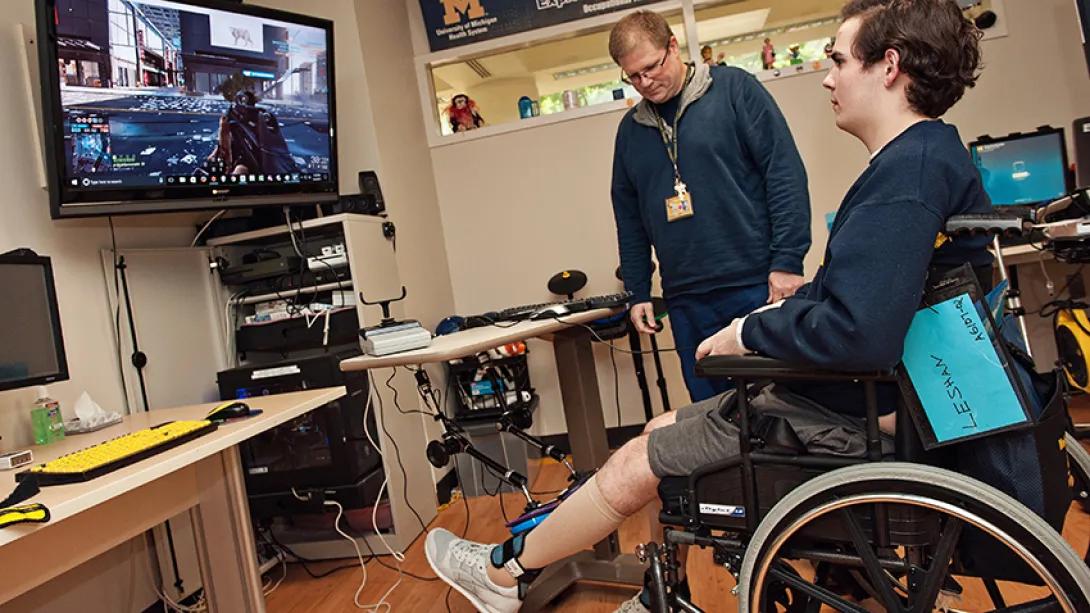
"We match the interests of the patient with a game, possibly one they already play," says Ferguson, noting that virtual reality and first-person shooter titles such as Battlefield 4 and Rocket League are popular with younger patients.
Gameplay is designed according to a person's capabilities.
"The games might be played by shooting with the legs or controlling the game with the feet, depending on a patient's needs," says Ferguson.
The concept has paid off for Michael Heinrich, who doesn't need to be reminded when it's time for his rehabilitation sessions. An experienced gamer, the 22-year-old, who is receiving treatment for a spinal cord injury, is always eager to get started.
That motivation, experts agree, is crucial in gaining back lost function.
Says Ferguson: "He's building the capacity to relearn how to do the things he was able to do before his injury."
Patients needn't be tech-savvy or experienced gamers.
In some cases, says Ferguson, "we might set up a familiar activity like a bridge or euchre game that's played by lifting the foot. This might be for someone who is working on putting their pants on or getting their legs in and out of bed."
Gaming newbies typically become enthusiasts, Ferguson says, recalling an 80-year-old woman who at first was skeptical of the idea.
"Her therapist learned that she was a fan of Parcheesi, so they set up a Parcheesi game that incorporated movements to help her build the skills to lift her arms high enough to feed herself," Ferguson says. "When patients can work toward their goals and have a meaningful experience, they want to come back."
Focused on goals
Deeper purpose lies beneath the gameplay.
SEE ALSO: A Team Approach to Concussion Care Changes One Athlete's Outlook
"It's not about technology, but about the skills a patient builds to support their rehabilitation goals," Ferguson says. "The process has to link to a meaningful outcome."
Objectives run the gamut and include relearning how to use an affected arm or leg, bathing and dressing, turning over in bed, washing dishes and reinforcing balance.
One example is a patient who needs to build the capacity to put his shirt on. In this case, Ferguson says, "the joystick is positioned so the patient has to reach overhead to play the game."
The movement simulates the functional movement a person needs to put on a shirt. This might entail hundreds of repetitions per session.
The rehab team also uses mobile computer carts that can be taken to patients' bedsides if they aren't able to get to the Computer Therapy Lab.
Still, no matter the game title or setting, the effort is just one part of a larger recovery process.
"Therapeutic gaming, including various types of virtual reality, is adjunct therapy for patients," Ferguson says. "They still need to work with their occupational and physical therapists, but therapeutic gaming can help the patient reach his or her goals."

Health Lab
Explore thousands of health news & research stories by visiting the Health Lab homepage for more.
Media Contact

Public Relations
Department of Communication at Michigan Medicine
Stay Informed
Want top health & research news weekly? Sign up for Health Lab’s newsletters today!
Featured News & Stories

5 things to know about ALS

Expanding camp adventure for all
A method to prevent falls before they happen
Giving with gratitude: planned gifts support nursing, research, and patient care

A smarter helmet for the smallest patients