Young Patient Feeling ‘Supercharged’ After Bicuspid Aortic Valve Surgery
One young man’s complications from a bicuspid aortic valve were life-threatening, but perseverance and expert care helped him make it through.
1:00 PM
Author |

Jeffrey Howell didn't know he was born with a bicuspid aortic valve until December 2015. In fact, like most people, the 25-year-old had never heard the term before.
MORE FROM MICHIGAN: Sign up for our weekly newsletter
Howell also didn't know how much better he would feel after having the compromised valve replaced with a mechanical one.
"Supercharged" is how he describes it.
That's a big change from November 2015, when Howell, despite losing 40 pounds and making healthier lifestyle choices, began to feel sick.
Just a bad cold, he thought.
But his health wasn't improving and by Thanksgiving, Howell had become extremely weak. His mother, Denise, noticed her son's feet were swollen and his cough was worsening.
"I pulled the turkey out of the oven and headed straight for the nearest emergency room with Jeffrey," Denise recalls.
There, a CT scan revealed the unthinkable.
"The doctors told me: 'You have congestive heart failure,'" Howell says.
Diagnosis: bicuspid aortic valve
A follow-up transesophageal echocardiogram — a procedure in which a scope is passed down a patient's throat into the esophagus to provide a detailed view of the heart — revealed several problems.
SEE ALSO: 5 Basics to Know About Bicuspid Aortic Valve Disease
First, Howell was found to have a bicuspid aortic valve — a defect in the heart's aortic valve present at birth — that was severely leaky.
The aortic valve in a typical healthy heart has three flexible leaflets (also known as flaps or cusps) that open and close to send oxygenated blood from the heart to the aorta. A person with a bicuspid aortic valve has only two leaflets.
Some people with a bicuspid aortic valve have no symptoms. Others may experience any of the following:
-
Shortness of breath
-
Ongoing fatigue
-
Coughing at night or when in bed
-
Rapid or fluttering heart palpitations
-
Dizziness
-
Chest pain (tightness, angina)
-
Fainting episodes
Approximately 2 percent of the population has a bicuspid aortic valve. The most common congenital heart condition, it is twice as common in males than females.
Over time, the bicuspid aortic valve can become calcified and may not completely open, preventing blood from being pumped out of the heart into the body. Or, as in Howell's case, the valve may not completely close, causing blood to flow backward into the heart.
Complications of bicuspid aortic valve disease include aortic stenosis (a blocked valve), aortic insufficiency (a leaky valve), aortic aneurysm and aortic dissection, all of which may be life-threatening.
A bicuspid aortic valve wasn't Howell's only problem.
Doctors also discovered two more troubles: an aneurysm, or enlargement, of the aortic root and an abnormal connection (known as sinus of Valsalva fistula) between the aortic root and another chamber of the heart.
A complex surgery
Howell was referred to the University of Michigan Frankel Cardiovascular Center, where G. Michael Deeb, M.D., and Karen Kim, M.D., performed an eight-hour operation to repair the fistula and replace his bicuspid valve and aortic root with a composite graft consisting of a mechanical valve and synthetic graft.
During the operation, Deeb and Dr. Kim found that one part of Howell's aortic root had become thin and that a hole had formed in the thin tissue connecting the aortic root to the right ventricle.
"The backward flow through both the aortic valve and the sinus of Valsalva fistula had made Jeffrey's heart work overtime to keep pumping blood forward — and it was clearly tired," says Dr. Kim. "Both pumping chambers were showing signs of the extra burden. They were dilated, and their function was diminished."
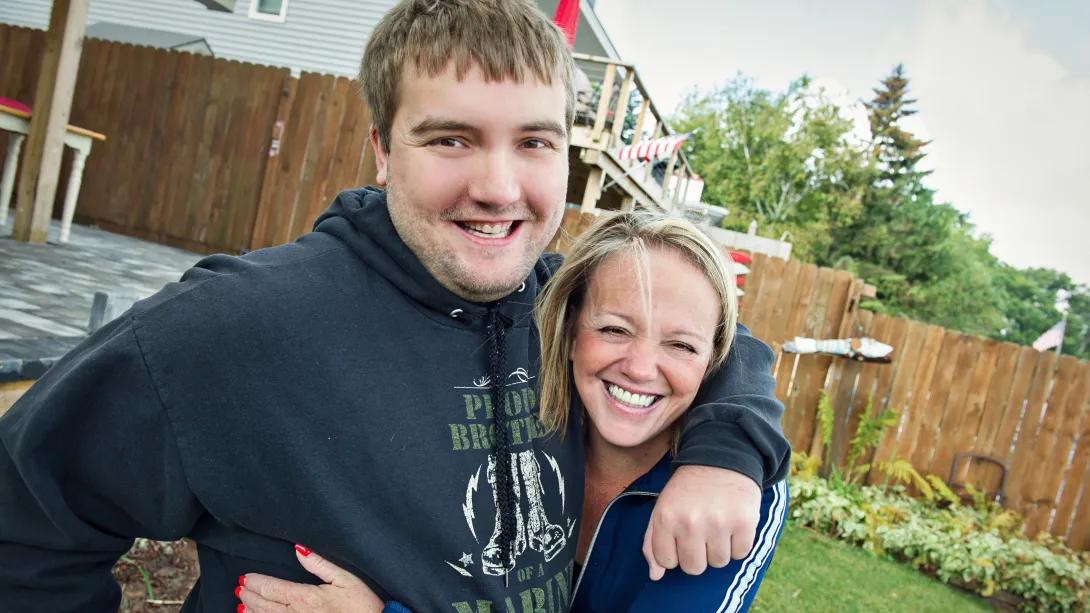
From fear to relief
"The day of surgery was the scariest day of my life," says Denise, who remembers feeling a huge sense of relief when she saw Kim give her two thumbs up from down the hall after the surgery.
SEE ALSO: What to Expect from Heart Disease Genetic Counseling
Howell remained in the intensive care unit for two more weeks to support his heart function while it recovered and to treat a heart arrhythmia that followed his surgery.
The dynamic young man says he's good as new now, feeling recharged and ready to tackle the world. He recently graduated from continuing education classes and is working as a courtesy clerk at a local Kroger grocery store.
His last appointment with Kim was in January, and all tests were clear.
"He was quite sick but recovered nicely," says Kim. "His follow-up echocardiogram showed that his heart function has recovered back to normal, and the valve is working well."
Howell hopes to continue corresponding with the doctor. The two have a special connection and a competitive spirit, says Denise, referring to the opposing football teams they each root for.
Still, she notes, her son's loyalties have shifted a bit. A lifelong Michigan State University football fan, Howell is now a firm believer in the University of Michigan.
Photos by Leisa Thompson

Health Lab
Explore thousands of health news & research stories by visiting the Health Lab homepage for more.
Media Contact

Public Relations
Department of Communication at Michigan Medicine
Stay Informed
Want top health & research news weekly? Sign up for Health Lab’s newsletters today!
Featured News & Stories
Reducing infections after heart surgery could save Medicare $441 million per year
Young father survives aortic dissection after delayed diagnosis
C.S. Mott Children’s Hospital first in country to implant expandable heart valve during FDA review phase
Weighing TAVR vs. SAVR for aortic stenosis treatment

Born with half a heart, headed to college with a full life