A worsening lung disease deemed hopeless, until doctors tried this treatment
Lakeitha Perry was sent home from her local hospital with no options for treating her pulmonary hypertension, but innovative treatment methods changed her prognosis and her life.
5:00 AM
Author |
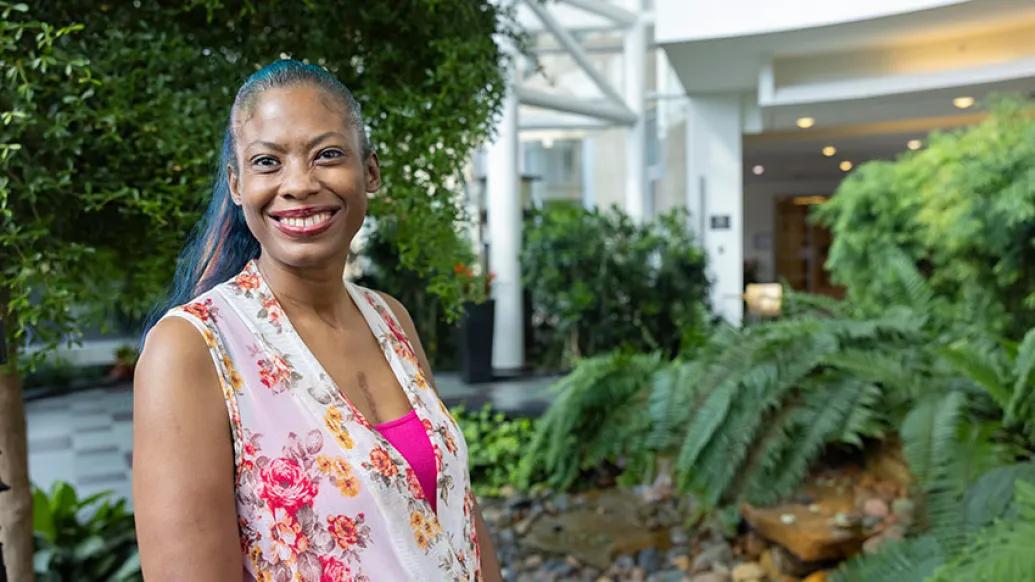
Lakeitha Perry has been dealing with significant health issues for nearly 11 years, including chronic pulmonary embolisms, also commonly known as PE, or blood clots in her lungs.
But thanks to advanced treatment methods and the expertise of doctors at the University of Michigan Health Frankel Cardiovascular Center, the grandmother of seven is now "living on the healing side" of her health scare.
How it started
With symptoms that began in 2010 with shortness of breath and exhaustion, Perry, 43, was treated with blood thinners at her local hospital to dissolve the clots that had formed in her lungs.
"I was put on warfarin for eight months, then taken off because doctors assumed the clots had dissolved," said the Detroit resident.
But when her symptoms persisted, she was eventually diagnosed with chronic thromboembolic pulmonary hypertension, or CTEPH, a rare form of high blood pressure in the arteries of the lungs that develops in roughly 4% of PE patients.
Like Podcasts? Add the Michigan Medicine News Break on iTunes, Google Podcasts or anywhere you listen to podcasts.
CTEPH is caused by pulmonary embolisms that fail to dissolve despite treatment with blood thinners. These embolisms can lead to scarring in the blood vessels of the lungs, blocking normal blood flow and forcing the right side of the heart to work harder.
Unique expertise for CTEPH
Perry was referred to the Frankel Cardiovascular Center in 2015, where a specialized team provides advanced care to patients with PE and CTEPH. There, she met with cardiac surgeon Jonathan Haft, M.D., an expert in pulmonary endarterectomy (PEA), a novel treatment for CTEPH.
U-M is the only center in Michigan to offer the extremely complex open heart procedure in which old and fibrotic blood clots are carefully peeled away from the inside of the pulmonary arteries. The procedure requires a technique known as hypothermic circulatory arrest, in which the patient's blood is cooled to slow the body's metabolism.
"This allows brief pauses in circulation to best visualize the fragile layer between the old fibrous clot and the wall of the pulmonary artery," said Haft. "PEA is best used for patients whose obstructions are located predominantly in the larger branches of the pulmonary arteries."
"Lakeitha recovered and was doing well following the procedure, and returned to her local physician's care," said nurse practitioner Susanne McDevitt, N.P. "However, she was still experiencing pulmonary hypertension symptoms and needed to be on lifelong blood thinning medication."
In early 2020, Perry was in and out of her local hospital with severe symptoms of pulmonary hypertension. "She had worsening right-sided ventricular failure due to additional pulmonary embolisms and was considered to be extremely ill," said McDevitt, adding, "She had limitations in all activities of daily living due to shortness of breath and fatigue."
Finding hope
According to Perry, she was given no hope for further treatment from her local doctors.
"The doctors told me there was nothing more they could do for me and I was sent home with hospice care," she said.
But with the urging of her sister, Perry returned to U-M and cardiologist Victor Moles, M.D., who suggested she might be a candidate for balloon pulmonary angioplasty (BPA), a highly specialized procedure brought to U-M by interventional cardiologist Vikas Aggarwal, M.D., for the treatment of CTEPH.
Because of the complexity of her health, Perry was in the exact right place for treatment once again when she came back to U-M, said Moles.
"We are the only institution in the state offering both pulmonary endarterectomy and balloon pulmonary angioplasty procedures. Our CTEPH team meets regularly to review all treatment options for our patients," Moles said, noting the decision to perform a balloon pulmonary angioplasty on Perry was unanimous.
"While pulmonary endarterectomy allows us to treat blood clots in the larger branches of the pulmonary arteries, patients with blood clots in the smaller arteries are treated with balloon pulmonary angioplasty," said Aggarwal. "PEA and BPA are complementary procedures sometimes used in conjunction to treat patients who have blood clots in larger and smaller branches of the pulmonary arteries, respectively.
"BPA is performed in the cardiac catheterization laboratory where a balloon catheter is used to open up the smaller branches of the pulmonary arteries that often can't be reached through a pulmonary endarterectomy," said Aggarwal. "For years, there wasn't a good treatment for reaching these smaller blocked branches, but now with balloon pulmonary angioplasty, we can give our patients hope."
The right team for the job
BPA is typically performed in a series of four to eight procedures. During the minimally invasive percutaneous treatment, a long, thin catheter is inserted into the artery through the neck or groin and a second hollow tube is introduced through the catheter and passed to the diseased lung vessels. Using X-ray images, a wire is guided through the vessels and a deflated balloon is directed to the site of blockage. The balloon is inflated to press the clots against the walls of the arteries, opening a pathway and restoring blood flow. The balloon is then deflated and removed. Multiple vessels are treated during each BPA procedure. Patients are given a mild anesthesia and are typically discharged the next day.
MORE FROM MICHIGAN: Sign up for our weekly newsletter
"Balloon pulmonary angioplasty is performed by our multidisciplinary team specially trained in this intervention," said Aggarwal, who performed the procedures on Perry last summer. "At one time, balloon pulmonary angioplasty was considered very high risk, but today we have the right team and the expertise for treating patients with CTEPH. This is a new frontier in interventional cardiology."
The season of living
Most patients have good results, said Aggarwal, including restored blood flow to the lungs, reduced shortness of breath and increased exercise tolerance.
Perry is living proof.
"This is the best I've felt in 11 years," she said, adding, "I have much clearer lungs and more energy. I no longer need a motorized cart at the grocery store and don't use a walker."
Best of all, Perry is keeping up with her seven grandchildren, all under the age of 4 years. "I had to get better to keep up with them," she said. "They keep me going, especially during hardships. They are my greatest inspiration."
Perry is looking forward to "living on the healing side of this condition. I was sick for 11 years and could have died. But now I'm in the season of living," said the woman who wants to inspire others in some way and help them with their health journeys.
McDevitt believes she'll succeed in whatever path she chooses, thanks to her restored quality of life.
"Lakeitha is absolutely strong and resilient, and now has a whole new lease on life with her specialty CTEPH interventions and therapies."

Health Lab
Explore thousands of health news & research stories by visiting the Health Lab homepage for more.
Media Contact

Public Relations
Department of Communication at Michigan Medicine
Stay Informed
Want top health & research news weekly? Sign up for Health Lab’s newsletters today!
Featured News & Stories

Top 7 tips for choosing Medicare prescription drug coverage for 2027

Gene editing is coming for common diseases. Are we ready?

Many older adults make Medicare decisions quickly and most don’t change plans, poll finds
What’s the latest on 7-OH and kratom availability and addiction care?
Better prenatal care data could help prevent maternal complications, experts say