When mom and dad’s DNA don’t match up, the embryo finds a way
The findings could explain why some embryos stall in development while others progress
1:45 PM
Author |
When a sperm meets an egg, a lot has to go right for an embryo to develop into a complete organism.
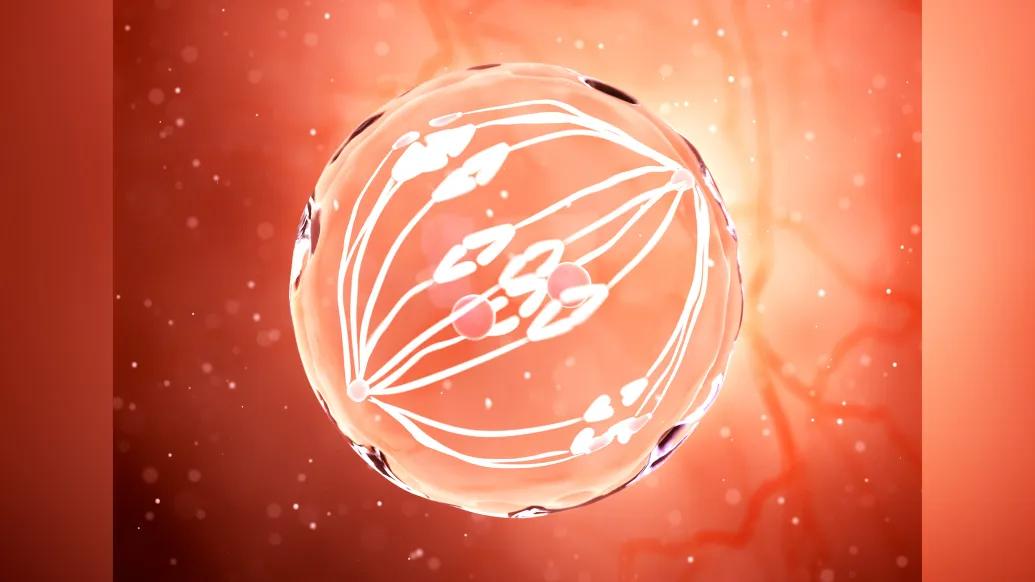
One critical step of early development is the reorganization of parental DNA to form a new unified genome, before the embryo can undergo its first cell division.
Scientists have long known that sperm and eggs bundle their DNA differently.
But it’s been assumed that their centromeres - the special regions of each chromosome that act like handles to pull DNA apart during cell division - were essentially the same.
That assumption rested on the presence of centromere protein A, or CENPA, a unique histone protein that marks centromeres and preserves their identity across each cell division and across generations.
Because CENPA acts like a molecular tag, preserving these sites as “do not erase” regions of the genome, the centromeres were thought to be functionally indistinguishable between maternal and paternal chromosomes.
New U-M research shows otherwise.
The team from the lab of Sue Hammoud, Ph.D., of the Department of Human Genetics and Obstetrics and Gynecology found that sperm mark these regions with only a fraction of the CENPA present on the egg centromere DNA.
“If left uncorrected, this imbalance can compromise chromosome segregation, raising the risk of chromosomal errors known as aneuploidies, which are a leading cause of miscarriage or developmental disorders such as Down syndrome,” said Catherine Tower, a Ph.D. candidate and co-first author of the study.
“These observations raised a simple question: How do embryos fix this mismatch before the first division?” said Emily Ferrell, M.D., the study’s co-first author.
To find out, the researchers tracked maternal and paternal CENPA in a mouse embryo generated by in vitro fertilization.
What they saw surprised them.
A second protein, CENPC, piled up preferentially on the father’s chromosomes, acting like a recruiter.
It drew extra CENPA - stored in the egg’s cytoplasm - to the paternal centromeres until the amount of CENPA was equalized.
“This suggests that maternal and paternal chromosomes must equalize their centromeric strength before cell division happens,” said co-author Dilara Anbarci, Ph.D.
This asymmetry in CENPA levels is not an oddity of mice but is also present in humans, notes Hammoud.
Additionally, these levels appeared to be highly variable across individual eggs and across individuals.
“This could help explain why some embryos stall in development while others progress,” said Hammoud.
“It also points to new possibilities for future therapies, possibly especially in cases where a woman’s eggs may carry unusually low levels of CENPA,” added Anbarci.
Additional authors: Kelsey Jorgensen, Ph.D., Binbin Ma, Ph.D., Mansour Aboelenain, Ph.D., Rajesh Ranjan, Ph.D., Saikat Chakraborty, Ph.D., Lindsay Moritz, Ph.D., Arunika Das, Ph.D., Michele Boiani, Ph.D., Ben E. Black, Ph.D., Shawn Chavez, Ph.D. Erica E. Marsh M.D., Ariella Shikanov, Ph.D., Karen Schindler, Ph.D., Xin Chen Ph.D.
Funding/disclosures: This research was supported by National Institute of Health (NIH) grants 1DP2HD091949-01 (S.S.H.), R01HD104680 01 (S.S.H.), NIGMS: GM148028(S.S.H, R01HD058730 (B.E.B.), 1F31HD117648-01 (C.A.T.), F31HD100124 (G.M.), R35GM127075 (X.C.), and R35GM136340 (M.A. and K.S.); training grants T32GM145470 (G.M.) and T32GM007544 (C.A.T.), Rackham Predoctoral Fellowship (G.M.); and Open Philanthropy Grant 2019-199327 (5384) (S.S.H.).
Michigan Research Core(s): Transgenic Animal Model Core
Paper cited: “Maternal CENP-C restores centromere symmetry in mammalian zygotes to ensure proper chromosome segregation," Developmental Cell. DOI: 10.1016/j.devcel.2025.08.017
Sign up for Health Lab newsletters today. Get medical tips from top experts and learn about new scientific discoveries every week.
Sign up for the Health Lab Podcast. Add us wherever you listen to your favorite shows.

Health Lab
Explore thousands of health news & research stories by visiting the Health Lab homepage for more.
Media Contact

Public Relations
Department of Communication at Michigan Medicine
In This Story

Sue S Hammoud, PhD
Associate Professor
Stay Informed
Want top health & research news weekly? Sign up for Health Lab’s newsletters today!
Featured News & Stories
Mouse model of gender-affirming testosterone treatment and fertility finds decrease in egg yield but not quality
The Link Between Obesity and Puberty
Induced Pluripotent Stem Cells Harnessed to Reliably Create Embryo-like Structures
New Insights on Sperm Production Lay Groundwork for Solving Male Infertility

How Stem Cells Grow into Structures That Could Aid Understanding of Infertility