What every performing artist should know to avoid injury
If you’re a performing artist, the things that put you at highest risk for injury are under your control.
5:00 AM
Author |
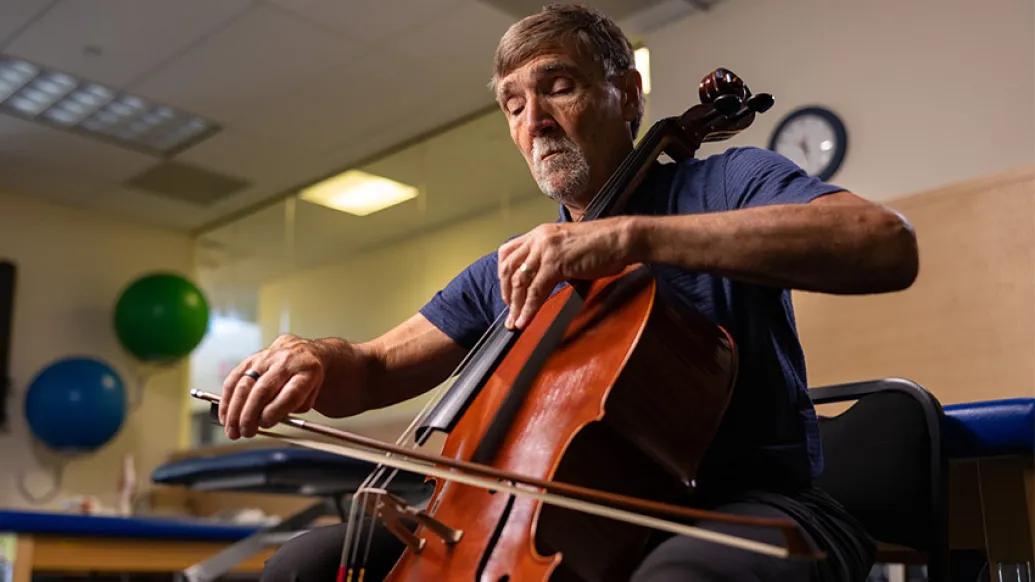
For performing artists, including dancers and instrumentalists of any age, fatigue and tension are your biggest enemies. These are the things that can put you at highest risk for injury, says Kristen Schuyten, D.P.T., coordinator of the University of Michigan Health MedSport Performing Arts Rehabilitation program.
But they're also things that are completely under your control, she adds.
Schuyten's goal is to educate performing artists and instructors about the importance of a physical warmup prior to practicing or performing as well as cooling down afterward.
"The number one thing you have control over is warming up and cooling down," she said.
In fact, says Schuyten, proven warmup and cooldown exercises are often more efficient than traditional methods used by many performers.
This is information 70-year-old Eric Keydel wishes he had known more than 60 years ago when he began playing the cello. Today, as a lifelong cellist, the talented musician says he's paying the price, with hand, back and shoulder pain that could have been prevented.
"When I grew up there was no emphasis on preparing your body before you started practicing. The 'warmup' consisted of scales and arpeggios. We didn't know there are things you can do to get the blood moving to the right muscles and to help limber up," said Keydel, who played for many years with the Michigan Philharmonic Orchestra and most recently with the Livingston Symphony Orchestra. "As I've gotten older, I've realized that a quick physical warmup routine for seven or eight minutes, along with occupational therapy exercises for my left hand, absolutely make a big difference."
Whether you're seven or 70, Schuyten stresses the importance of performers adopting good habits. "It's never too early or too late to start with proper physical warmups and cooldowns to prevent injury," she said.
As one of her patients, Keydel is now committed to embracing an exercise program recommended by Schuyten. And it's working, he says.
Choosing the cello
Keydel began to play the cello as a child and continued throughout high school, graduating from Michigan's Interlochen Arts Academy, one of the country's most highly regarded high schools for young performers. After graduating, he transitioned to the field of engineering at the University of Michigan, but he never gave up the cello, playing with a variety of orchestras and chamber groups — often four or five times a week.
"That's a lot of playing," reflected Keydel. "Over the years, with all that focus on playing, I developed curvature of the spine and other issues."
Adding to the demands on his body was his love of sailing.
"Sailing can be a physically demanding activity, particularly for your upper body," he said, noting a tear in his right shoulder labrum that caused a great deal of pain while sailing as well as performing. "My choices were either have it operated on or take my chances and hope it doesn't get worse."
Time to act
Keydel decided to take his chances, but when an opportunity to perform a difficult concerto came up two years ago, he knew it was time to address the pain in his shoulder.
"About a year before I was to perform the concerto, my shoulder and muscles in my back were getting tight, which is just not good for playing. It has to do with age but also with not having the proper habits drilled into me in terms of physical preparation for practice."
With his right shoulder and left hand "acting up," Keydel began to worry about the challenges of a lengthy onstage performance.
His concern led to a visit with his primary care physician at University of Michigan Health, who recommended he meet with Schuyten.
Accustomed to working with performing artists, Schuyten knew exactly what to do.
"Eric presented with shoulder pain and tightness related to playing the cello and sailing. This limited his ability to practice and get ready for his big performance coming up," said Schuyten. "We did a full evaluation on him and I definitely saw there was limitation of strength and range of motion caused by the positions he had to be in to play his cello. We needed to loosen things up and get him a good home program focused on warming up and cooling down."
A simple solution
Schuyten's rehabilitation program for Keydel translates to all types of performers — even those who haven't experienced an injury. In this case, preventive measures focus on wellness education for performers and instructors to help decrease the risk of injury.
It's never too early or too late to start with proper physical warmups and cooldowns to prevent injury.Kristen Schuyten, D.P.T.
"Even if you might not have an injury, there are benefits to a program focused on warming up and cooling down."
The warmup is moving through different stretching positions, says Schuyten.
"You feel the stretch but you are moving through it – holding positions only for a few seconds at a time. We call it a 'dynamic warmup.' The cool down is more about relieving the tightness of holding an instrument after the practice or performance. You can loosen the muscles by holding the stretch position for at least 30 to 60 seconds."
Specialists with the MedSport Performing Arts Rehabilitation program assesses patients for deficits, asymmetries, tightness, aches and pains.
"We institute warmup and cooldown exercises that give patients a streamlined approach to their at-home exercise program to reduce the risk of another injury or to avoid an injury altogether."
In addition to wellness education, injury risk screenings and assessments, the MedSport Performing Arts Rehabilitation program also offers on-site and backstage treatment services as well as an injury clinic.
Finding relief
"Kristen worked to strengthen my shoulder and release the knots, and gave me warmup and cooldown exercises," said Keydel. "She got the muscles that are supposed to be doing the work to actually do the work, which prevents other muscles from knotting up. It's quite clear to me that when I haven't done the exercises for a while, the muscles knot up again."
The bulk of the work is up to each patient, says Schuyten — and Keydel is convinced of that.
"I didn't take it seriously until I got put on the line with my performance. It got my attention."
Now, he wants to get the attention of other performers.
"A physical warmup is absolutely necessary and needs to be part of the practice routine. It needs to be taught by instructors.
"Before I start playing a note on my cello I do a quick warmup routine that I learned from Kristen and have a set of left hand exercises for my wrist and fingers. These eight-minute exercises are invaluable."
An added benefit
Keydel saves time now by doing the physical warmup instead of his prior routine.
"You can save time by doing something a bit more focused for your whole body before beginning to play. I estimate the eight-minute physical warmup saves me at least 45 minutes of instrument practice time," he said.
Schuyten reiterates her message that it's never too late.
"You can see that in Eric's case," she said.
With his concerto performance behind him, Keydel is now gearing up for the fall season, fully intending to continue his warmup and cooldown routines.
"This absolutely makes a big difference," Keydel said of his warmup. "I never gave physical warmup much credence – but now I don't practice without it."
Resources:
Whole Body Stretching for Performing Artists
Whole Body Warm-Up for Performing Artists
Quick In-Class Warm-Up for Performing Artists

Health Lab
Explore thousands of health news & research stories by visiting the Health Lab homepage for more.
Media Contact

Public Relations
Department of Communication at Michigan Medicine
Stay Informed
Want top health & research news weekly? Sign up for Health Lab’s newsletters today!
Featured News & Stories

Digital alerts support timely treatment decisions of critically ill cardiac patients

What’s changing in Medicaid and what can you do?

Rabies is on the rise: Experts offer advice

E-Bikes are everywhere, but most parents say they don’t know enough about them
Young father survives aortic dissection after delayed diagnosis