Warning Signs of Eating Disorders and Proven Treatments to Help
Eating disorders affect people of all ages and body types. A Michigan Medicine expert speaks about warning signs and how to approach the subject.
7:00 AM
Author |

An eating disorder is a type of mental illness involving abnormal eating patterns that can negatively impact an individual's health and feelings about their body.
And it can be a constant match with the mind: A person may perceive food as an enemy — or dictate his or her self-worth based on body weight.
About 30 million Americans have an eating disorder, according to the National Eating Disorder Association. Worldwide, that number is nearly 70 million.
Eating disorders can affect people of all ages, sizes and demographics, says Jessica Van Huysse, Ph.D., clinical director for the Comprehensive Eating Disorders Program at Michigan Medicine.
"We try to remind people that it's not anyone's fault," Van Huysse says. "We don't typically place blame when someone develops a physical illness. We need to think of eating disorders that way as well; they are biologically based illnesses."
While anyone can develop an eating disorder, some people may be more susceptible. Those with a childhood history of mood or anxiety disorders, for example, are more at risk. Stressors such as bullying or trauma may also contribute to eating disorders.
Eating disorders can impact other mental health illnesses such as depression and anxiety, often due to irregular food intake and lack of proper nutrients, Van Huysse says.
"A history of depression or anxiety disorders in childhood is associated with increased risk for an eating disorder, and the symptoms associated with eating disordered behaviors (e.g., restrictive eating, malnourishment, binge eating) can contribute to worsening symptoms of depression or anxiety," Van Huysse says.
Restricted diets can also trigger eating disorders — but they aren't entirely to blame.
"Maybe not surprisingly, eating disorders do start with some food restrictions, or dieting, or the attempt to lose a little bit of weight," Van Huysse says. "We know it can't just be that. Plenty of people go on diets and don't develop an eating disorder, but that is the primary risk factor."
But the risks are high. They often include cardiac problems such as a low or abnormal heart rate, low blood pressure, low temperature, dehydration, fatigue, or muscle wasting or weakness.
According to the National Association of Anorexia Nervosa and Associated Disorders, at least one person dies from an eating disorder every 62 minutes, giving eating disorders the highest mortality rate of a mental illness.
Signs of an eating disorder
Eating disorders can sometimes mask themselves as other things.
"People who aren't getting adequate food intake often experience a lower or anxious mood, and they're more likely to withdraw socially," Van Huysse says. "They may seem depressed, but when we treat the eating issue the depression dissipates."
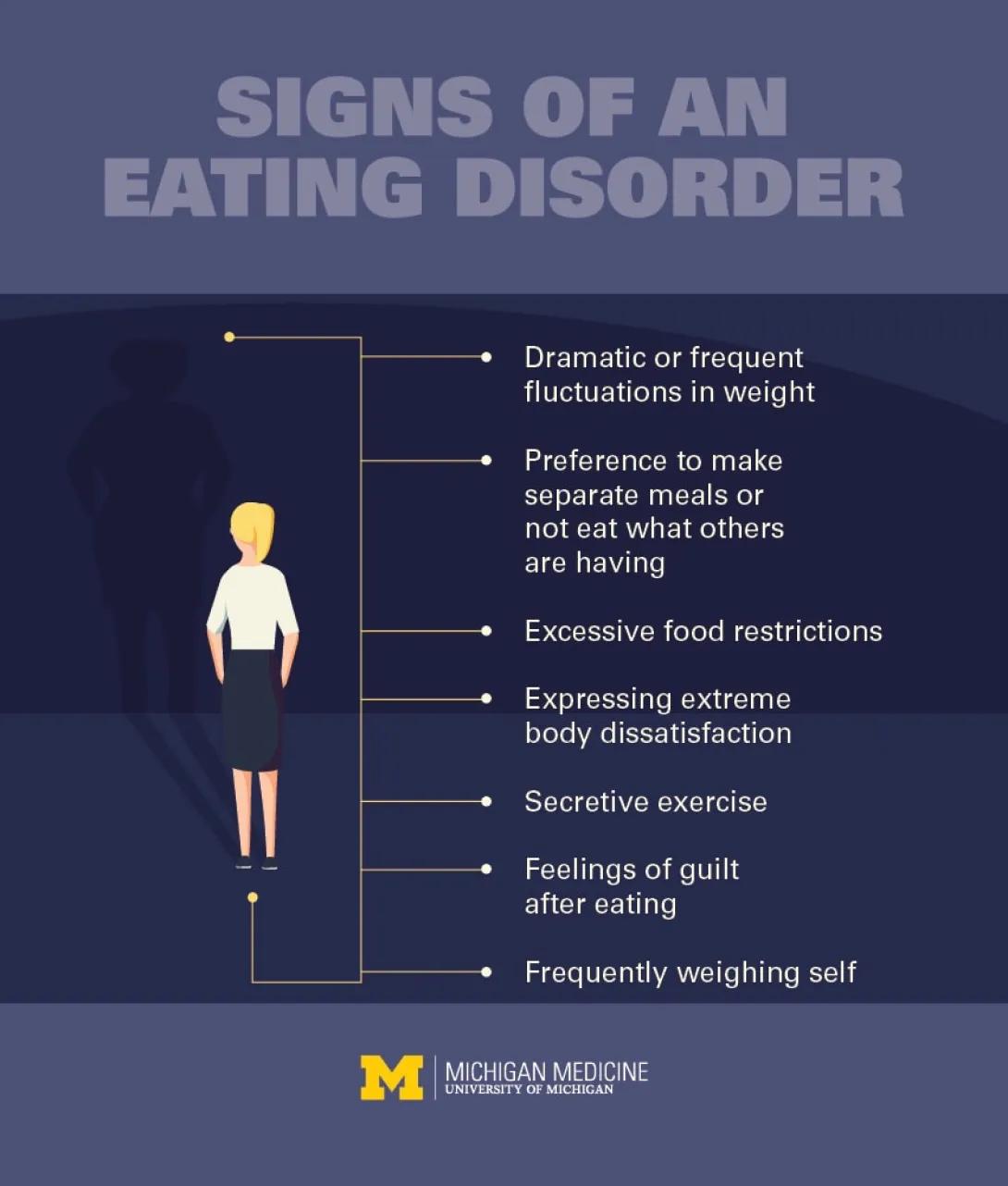
Common indicators of an eating disorder include:
- Dramatic or frequent fluctuations in weight
- Preference to make one's own meals, not have what others are having or eating something different from the rest of the family
- Extreme food restrictions
- Expressing excessive body dissatisfaction
- Secretive exercise
- Feelings of guilt after eating
- Frequently weighing self
If you suspect a loved one or someone you know is battling an eating disorder, it's important to offer help and support.
However, maintaining sensitivity is key.
Van Huysse suggests gently pointing out observations in a nonconfrontational way, replacing "I think you have an eating disorder" with something like "I've noticed you've been having a hard time when we go out to dinner together; it seems like you're not ordering anything to eat. Is something going on?"
Anorexia vs. bulimia
Anorexia nervosa and bulimia nervosa are two well-known types of eating disorders.
Anorexia nervosa is the inability to maintain an appropriate body weight for one's age, height and growth history — combined with an undue influence of body image on self-evaluation and body dissatisfaction. Often, these people are unable to realize their low weight is dangerous.
There are subtypes of anorexia, one being restrictive, which is characterized by significant undereating that can include cutting out entire food groups from a diet. This is what may come to mind when people think of anorexia.
But many people may not know that there is also a binge-eating and/or purging subtype of anorexia nervosa, in which individuals engage in binge eating or purging in addition to restricting their food intake.
Bulimia nervosa is identified by recurrent binge eating and compensatory behaviors. Unlike those with anorexia nervosa, these individuals aren't underweight.
Binge eating involves eating a large amount of food in a short period of time combined with loss of control.
"This isn't the normal overeating we might all do on a special occasion; this is overeating given the circumstances," Van Huysse says. "Binge eating is combined with a loss of control over eating, which is the sensation that somebody can't stop or control what they're eating."
In addition to binge eating, people with bulimia nervosa may also engage in compensatory behaviors such as purging or self-induced vomiting, misuse of laxatives or diuretic medication, fasting or excessive exercise in response to binge eating.
Eating disorders treatment
Because eating disorders can affect people of all body weights, shapes and sizes, it is crucial not to overlook individuals who don't fit the stereotypical image of someone who struggles with eating, Van Huysse says.
"Let them know that you are willing to be there for them for whatever they need," she says. "If they are ready to seek professional help, support them in doing so in whatever way you can, whether that's sitting with them while they make the phone calls or helping them find resources."
Eating disorder treatment often involves a combination of psychological and nutritional counseling, such as cognitive-behavioral therapy.
CBT is an individual therapy style particularly effective for adults with bulimia nervosa or binge-eating disorder. It can also be used with individuals with anorexia nervosa.
For children or adolescents living at home, family-based eating disorder treatment is an effective approach. With this method, parents and family play an integral role and help shape food choices and normalize eating.
"We focus on fueling the body with a variety of foods, eating flexibly and avoiding a mindset that 'forbids' certain foods," Van Huysse says.
Still, receiving treatment for an eating disorder can be a struggle in and of itself.
"Many people realize that the treatment is going to involve doing things that they are terrified of," Van Huysse says. "If it's someone who's lost a lot of weight as a result of an eating disorder and they're terrified of gaining weight, coming to treatment can be a scary thing.
"Also, people often feel shame around eating disorder behaviors and might have a lot of difficulty and embarrassment describing them."
Due to a continued stigma around eating disorders that might dissuade people from reaching out for help, Van Huysse stresses the need for continued education and discussion.
The Comprehensive Eating Disorders Program is currently accepting new patients for treatment in the intensive partial hospitalization program. The program treats individuals ages 8 to 24. The clinic utilizes the family-based treatment approach and primarily treats anorexia nervosa and bulimia nervosa.

Health Lab
Explore a variety of health care news & stories by visiting the Health Lab home page for more articles.
Media Contact

Public Relations
Department of Communication at Michigan Medicine
Stay Informed
Want top health & research news weekly? Sign up for Health Lab’s newsletters today!
Featured News & Stories

Are 988 and other mental health crisis lines missing people over 50?
Granger family continues support of local health care with major donation for new behavioral health hospital

What is looksmaxxing?
AI chatbots spark mental health concerns, including psychosis risk
Teens need private time with doctors, but many aren’t getting it