An upgrade to U-M developed tech enables researchers to see even finer transcription detail inside cells
Seq-Scope technology has now been expanded with improved resolution
10:38 AM
Author |
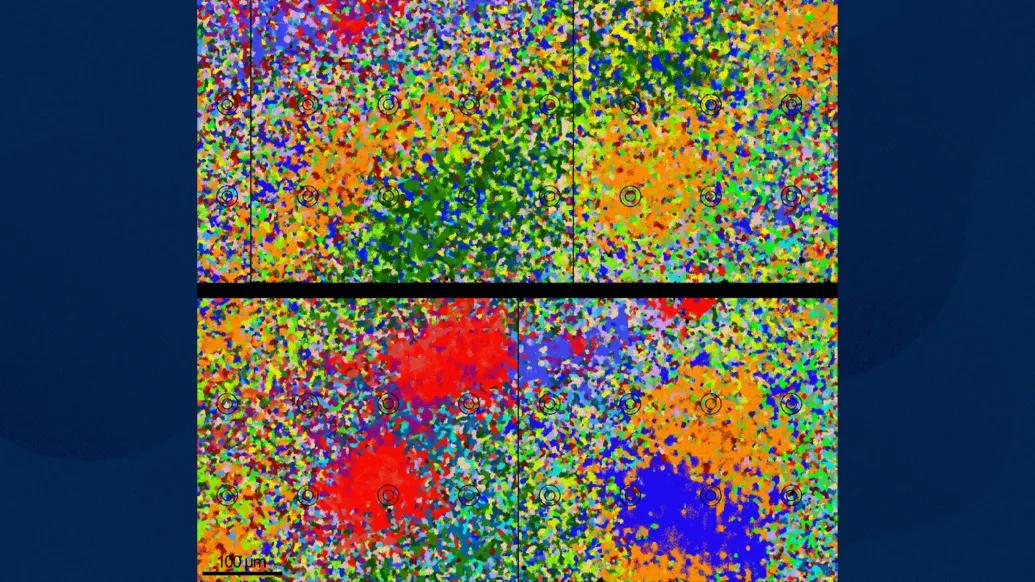
In 2021, a technology developed at University of Michigan, called Seq-Scope, revolutionized the ability to map gene activity within intact tissue at microscopic resolution, enabling researchers to measure all expressed mRNA molecules and determine precisely where they are located within the tissue, using an Illumina sequencer machine.
The team behind the Seq-Scope method, led by Jun Hee Lee, Ph.D., has recently taken the technology even further.
Their findings are described in Nature Communications.
“We wondered what we might see if we had even better resolution,” said Lee, Professor of Molecular & Integrative Physiology at U-M Medical School.
“But we realized that that is actually physically impossible.”
Why?
Preparing a tissue slide to be read by an Illumina sequencer involves diffusing molecules from the tissue to the array that is ultimately read by the sequencer.
That diffusion is limited to around a micron.
To get beyond this barrier, Lee’s team made the tissues in question proportionately larger, by embedding the tissues in hydrogel then infusing them with water so that they grow.
The expansion strategy was first conceived by Lee’s graduate student Angelo Anacleto, who incorporated chemical tissue expansion methods into Seq-Scope in collaboration with Hee-Sun Han, Ph.D., Professor of Chemistry at the University of Illinois Urbana-Champaign.
“We made the tissue bigger and then analyzed it the using our SeqScope methodology,” explained Lee.
“And we were able to show that it is indeed a precisely and accurately captures the transcriptome from the tissue.”
Using their aptly named Seq-Scope-eXpanded, or Seq-Scope-X, method allowed them to see with even greater resolution the delineation between cells and even the transcripts of different structures within cells, like the nucleus and cytoplasm.
Computational methods developed by Hyun Min Kang, Ph.D., Professor of Biostatistics at U-M School of Public Health, enabled the team to identify differences between mRNAs transcribed in the nucleus vs. the cytoplasm in liver cells.
Lee says the tool could be used to make discoveries that weren’t possible using previous methods.
“We have kind of pushed the that limit by another order of magnitude so we can get richer information. This technology is really moving fast, with resolution improving roughly four-fold each year for nearly a decade. We are glad that University of Michigan is at the major inflection point.”
Additional authors: Additional authors include Weiqiu Cheng, Qianlu Feng, Anna Park, Chun-Seok Cho, Yongha Hwang, Yongsung Kim, Yichen Si, Jer-En Hsu, Qingyang Zhao, Xiaoya Zhao, Daniel Kim, Mitchell Schrank, Alex William Schrader, Seokjin Yeo, Rosane Teles, Robert L. Modlin, Olesya Plazyo, Johann E. Gudjonsson, Myungjin Kim, and Chang H. Kim.
Michigan Research Core(s): U-M Advanced Genomics Core
Tech transfer(s)/Conflict(s) of interest: Jun Hee Lee is an inventor on an existing and pending patent applications related to Seq-Scope.
Paper cited: “Seq-Scope-eXpanded: spatial omics beyond optical resolution,” Nature Communications. DOI: 10.1038/s41467-026-69346-8
Sign up for Health Lab newsletters today. Get medical tips from top experts and learn about new scientific discoveries every week.
Sign up for the Health Lab Podcast. Add us wherever you listen to your favorite shows.

Health Lab
Explore thousands of health news & research stories by visiting the Health Lab homepage for more.
Media Contact

Public Relations
Department of Communication at Michigan Medicine
In This Story

Jun Hee H Lee
Professor
Stay Informed
Want top health & research news weekly? Sign up for Health Lab’s newsletters today!
Featured News & Stories
The AI is listening: Implications of machine generated clinical notes on health care
Can Your Voice Reveal Early Signs of Alzheimer’s?

15 years of data will help uncover how flu spreads—and how to reduce its impact
$3.9 million NIH grant to fuel U-M effort to develop first targeted therapy for fatal childhood brain disorder

Digital alerts support timely treatment decisions of critically ill cardiac patients