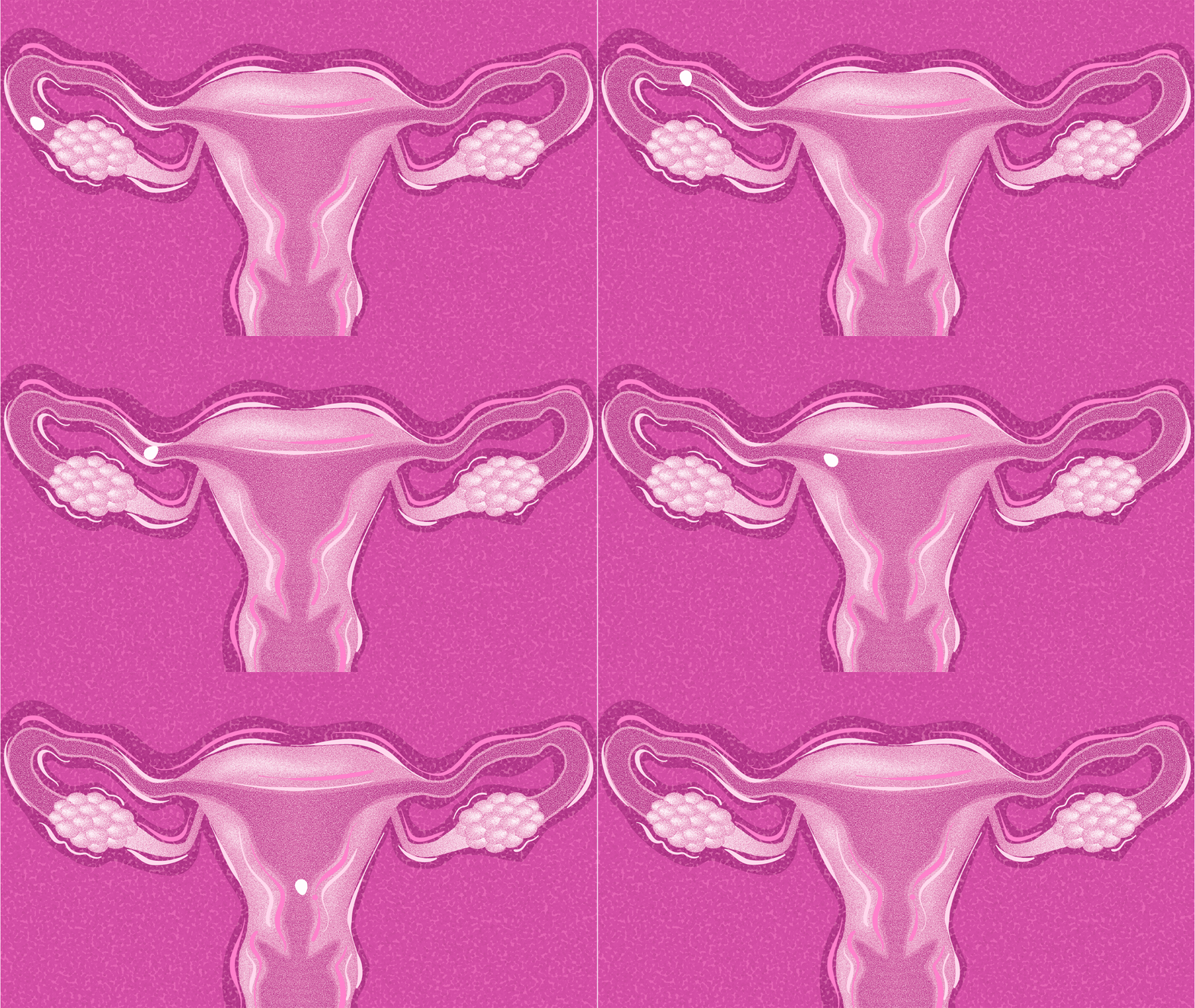
Unique team gives mom and babies a fighting chance
Complicated heart issues put one woman at high risk for pregnancy, but a team of skilled doctors helped her give birth to two healthy children.
5:00 AM
Author |

Growing up, Hannah Hawley didn't know if she'd ever be able to have children. With a history of health issues, beginning with a heart defect at birth, no one was more surprised than Hawley when she learned of her pregnancy in 2019.
Today, the 31-year-old is mom to Luna, 2, and Axel, 14 months, thanks to a comprehensive University of Michigan Health care team, the clinical arm of Michigan Medicine, that cautiously navigated significant health issues for Hawley as well as potential complications for the babies she carried.
Facing challenges at a young age
Hawley's congenital heart defect — anomalous left coronary artery from the pulmonary artery (ALCAPA) — involved her left coronary artery as well as her mitral valve, which can be damaged in patients with this type of congenital defect. For Hawley, it led to surgery when she was just 3 years old, followed by a second surgery a year later.
The coronary artery supplies oxygen-rich blood to the heart muscle on the left side of the heart. The mitral valve controls the flow of blood going in one direction from the lungs to the body. If the valve doesn't function properly, as in Hawley's case, the heart has to work twice as hard to do its job.
Hawley's condition was closely monitored and treated with medication during her childhood and teenage years until she was healthy enough to stop the medication. But in the winter of 2017, the Houghton, Michigan, resident was diagnosed with endocarditis, a potentially life-threatening infection of the inner surface of the heart that typically affects the valves.
Her condition was serious and would require the expertise of a team skilled in treating mitral valve disease. She was air lifted from a hospital near her home in Michigan's Upper Peninsula to U-M Health, where it was determined she would need to have her mitral valve replaced with a bioprosthetic valve. The open-heart procedure was performed by cardiac surgeon Jonathan Haft, M.D.
"A bioprosthetic valve was used instead of a mechanical valve in case I would ever try to get pregnant," said Hawley, doubtful that a pregnancy would be in her future. With a bioprosthetic valve she could avoid a lifetime of blood thinners required with a mechanical valve.
Even so, if she were to get pregnant, doctors informed her that her heart condition would put her at high risk for complications.
An unexpected pregnancy
To her surprise, Hawley became pregnant with daughter Luna in 2019. During her pregnancy, she was monitored by the Michigan Medicine team consisting of maternal-fetal medicine, adult congenital cardiology, anesthesiology, nursing, interventional cardiology and cardiac surgery.
"She was a very complex patient who required the care of our collaborative team," said Elizabeth Langen, M.D., of U-M Health's Cardio-Obstetrics Program. "She was quite ill with cardiac issues before, during and after her pregnancy."
"The patient truly received a unique level of care that very few health systems are able to offer," said Hawley's adult congenital heart disease cardiologist Timothy Cotts, M.D. "Not only were we able to bring a skilled team together with expertise in so many areas, we could also offer state-of-the-art procedures."
Throughout Hawley's pregnancy, the medical team worked together to make sure her condition remained stable, particularly when she began to experience fluid retention and difficulty breathing – symptoms that can be attributed both to pregnancy and heart issues.
A second mitral valve replacement
In Hawley's case, the symptoms were a result of rapid deterioration of her valve due to worsening stenosis, said Cotts. "She was hospitalized prior to her scheduled cesarean delivery to ensure the best outcome."
"Our team worked together to determine where in the hospital system she would receive the best care during each stage of her pregnancy and postpartum care," said Langen.
The answer was the Von Voigtlander Women's Hospital prior to delivery followed by the cardiac intensive care unit at C.S. Mott Children's Hospital post delivery, where Hawley would be in close proximity to her baby. "We wanted to optimize care for both the mother and baby," said Cotts.
The patient truly received a unique level of care that very few health systems are able to offer. Not only were we able to bring a skilled team together with expertise in so many areas, we could also offer state-of-the-art procedures.Timothy Cotts, M.D.
While hospitalized, Hawley learned she would be facing a second mitral valve replacement due to her narrowing valve. But timing for the surgery was uncertain. "We didn't know if it would be before my baby's birth or after," she said.
The situation was a stressful one as Langen, Cotts and the entire medical team were hopeful Hawley would be able to carry Luna for as long as possible, knowing that her health and that of the baby could be in jeopardy with each passing day.
But Hawley was determined and successfully reached 33 weeks before Luna was born via cesarean delivery.
"We knew we would need to do the mitral valve procedure very soon," said Cotts. The goal was to get Hawley through her pregnancy, then determine the timing for another valve replacement.
Six days after the birth, however, Hawley went into congestive heart failure, a condition in which the heart can't pump enough blood to meet the body's need for nutrition and oxygen. Symptoms include exhaustion, shortness of breath and high blood pressure.
Hawley was experiencing all of these symptoms and learned that her valve would need to be replaced sooner than expected, but this time cardiac surgeon Matthew Romano, M.D., Stanley Chetcuti, M.D., and the U-M Health mitral valve team would use a catheter-based procedure, eliminating the need for open surgery and weeks of recovery.
During the minimally invasive procedure, known as a valve-in-valve replacement, a catheter is inserted into the patient's femoral artery and routed to the heart. The new bioprosthetic valve is then inserted inside of the failing mitral valve and released.
Hawley remained in the cardiac intensive care unit for a week while her daughter was carefully monitored in the neonatal intensive care unit due to her premature birth.
"It was such a hard experience," said Hawley. "I was just trying to hang on."
Thankful for a positive experience
Today, Hawley is feeling strong following the birth of her second baby, Axel, who was also born via cesarean delivery at Von Voigtlander Women's Hospital.
"Her heart did much better during her second pregnancy," said Langen, noting that Hawley was able to remain close to home in the Upper Peninsula for much of her pregnancy, thanks to video visits as well as Michigan Medicine's maternal-fetal medicine and adult congenital heart outreach clinics in Marquette.
"A team of our doctors goes to Marquette to provide patients with a high level of care without them having to travel far from home," said Cotts, who is part of the adult congenital heart outreach clinic traveling to the Upper Peninsula each month.
But when it came time to deliver the baby, Hawley wanted the reassurance of Michigan Medicine's collaborative medical team in Ann Arbor to handle any unexpected issues. "I wanted to be near my doctors in case there was an issue with my mitral valve," she said, or any other unexpected incident related to her pregnancy.
Currently monitored by Cotts' team, Hawley knows the importance of paying attention to any new symptoms.
"I still get winded going up and down the stairs carrying my babies," she said, adding that doctors observed mild narrowing of her valve during her second pregnancy, but it has improved since the birth of her son.
Meanwhile, Cotts is following the function of Hawley's new bioprosthetic valve, noting that at some point she may require another valve. "We want her to get as many years as possible with this valve," he said.
Hawley is hopeful for that, too, as she enjoys motherhood and everything that goes along with it. She's also thankful for the collaborative expertise of her Michigan Medicine team.
"They gave me peace of mind."

Health Lab
Explore thousands of health news & research stories by visiting the Health Lab homepage for more.
Media Contact

Public Relations
Department of Communication at Michigan Medicine
Stay Informed
Want top health & research news weekly? Sign up for Health Lab’s newsletters today!
Featured News & Stories
Better prenatal care data could help prevent maternal complications, experts say

Digital alerts support timely treatment decisions of critically ill cardiac patients

What’s changing in Medicaid and what can you do?

Is the United States Lagging Behind Europe in Memory Improvement?

PMOS is the New PCOS