Treatment for Restless Legs Syndrome Helps Patients Get Shut-Eye
One man’s struggle to get a good night’s sleep was a nightmare. An unexpected diagnosis of RLS helped him pinpoint the problem and find ways to cope.
1:00 PM
Author |
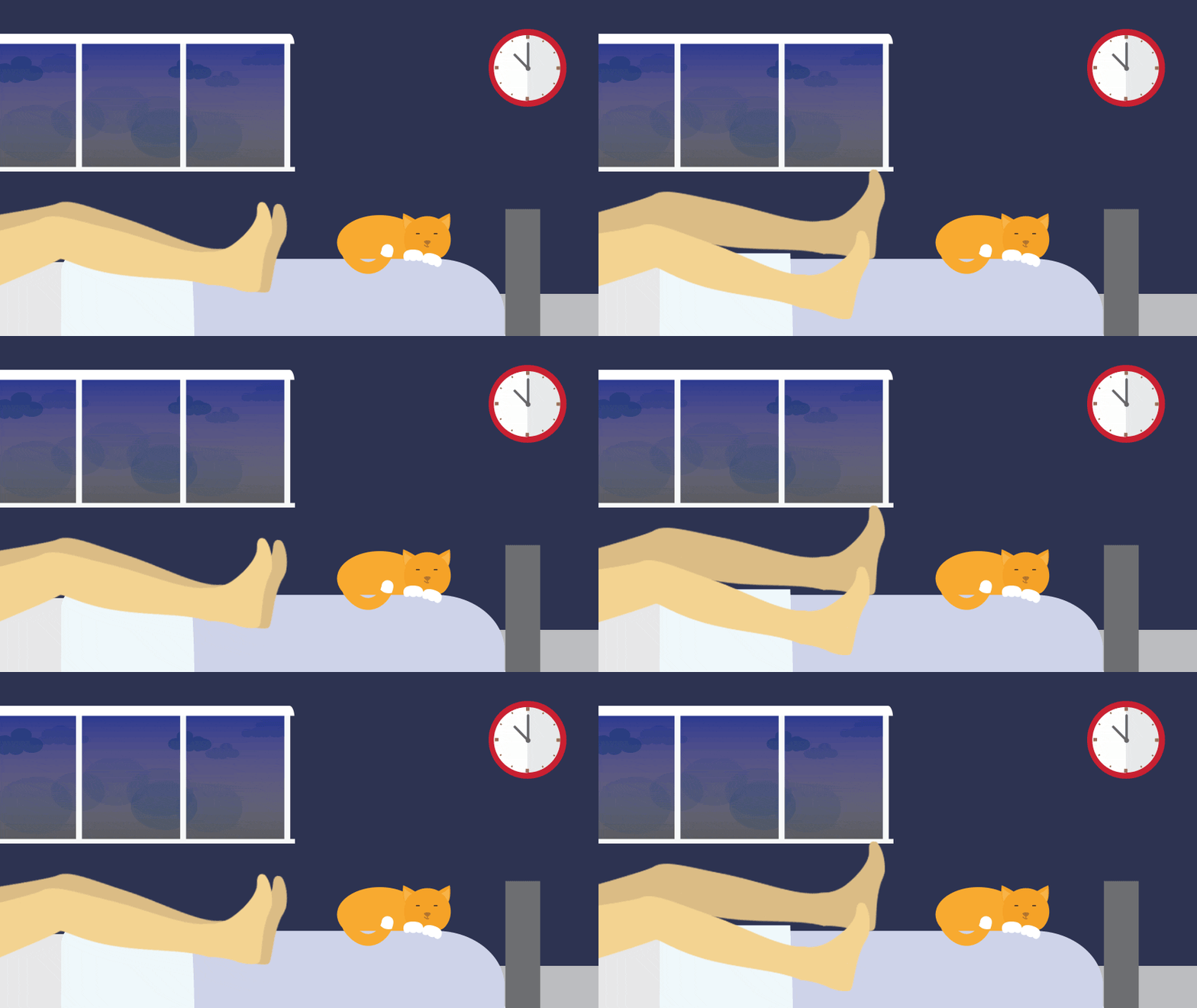
Restless legs syndrome (RLS) causes a range of uncomfortable or painful sensations in the legs — and for some people, in the arms or torso — followed by an overwhelming need to move, twitch or shake to provide temporary relief.
MORE FROM MICHIGAN: Sign up for our weekly newsletter
For Gary McConnell, of Chesaning, Michigan, the condition went undiagnosed and untreated for about 20 years. Although his legs would "move a lot" during the day, the problem persisted after sundown.
"I'd have this crawling, prickly, aching feeling in my leg, and I couldn't control the urge to kick," says McConnell, now 68. "I actually tore holes in the bedsheets. I even kicked my wife."
Getting a restful night's sleep was virtually impossible.
His struggles aren't unusual. By some estimates, as many as 10 percent of Americans may suffer from RLS. And McConnell assumed nothing could be done about it.
A chance encounter with a neurologist six years ago helped change his mind.
"I went with my wife to her appointment with a local neurologist," McConnell recalls. "As usual, my legs kept moving, and the doctor asked me about it."
Thinking that McConnell might be suffering from RLS, she suggested medications to relieve the symptoms. The visit was the first step on his road to recovery.
Diagnosing and treating RLS
Contrary to its name, RLS doesn't start in a person's legs.
"Restless legs syndrome originates in the brain," says J. Andrew Berkowski, M.D., a Michigan Medicine neurologist and sleep medicine specialist. "There's no definitive test for it, and we're not certain what causes it, although we believe it's related to how the brain transports dopamine."
SEE ALSO: 5 Tips for Better Sleep (Counting Sheep Not Required)
Dopamine is a chemical the brain uses to help direct muscles to move easily and voluntarily.
Doctors typically diagnose RLS by examining a patient's family history, health conditions and lifestyle habits. A sleep study known as a polysomnography may follow.
The Food and Drug Administration has approved a range of dopamine-modifying medications to treat RLS. Other options include anti-seizure medications and opioid pain relievers.
While none of these drug options is without risks or side effects, they have been shown to help relieve the symptoms of moderate to severe RLS when properly managed by an experienced physician.
A review of other medications a patient is taking is also important. Antidepressants, for example, can make RLS worse.
For patients with mild RLS, nonpharmaceutical options can help. Doctors recommend reducing or eliminating caffeine, alcohol and tobacco — as well as incorporating massage, moderate exercise and stretching. Iron supplements are sometimes used as well.
Most RLS patients also benefit from adjustments to their daily routines, nighttime liquid intake and sleeping environment, among other things.

Finding relief — and solving a mystery
In McConnell's case, his initial medication plan offered only temporary relief.
"The first medicines I was prescribed worked to a degree," he says, "but the doctor kept increasing the dosages. The more I took, the worse my legs got."
A relative referred him to Berkowski and the U-M Sleep Disorders Centers.
"Gary came to us with a fairly typical experience," says Berkowski, whose research focuses largely on RLS. "His medications were making his RLS much worse. We know that medicines that activate the brain's dopamine receptors may become less effective over time, and taking larger or more frequent doses of them can actually worsen RLS."
"In Gary's case," Berkowski says, "we needed to safely wean him off of them before he could recover."
Eventually, the only medication Berkowski needed to prescribe for McConnell was a low dose of the opioid methadone to be taken as needed.
"Once the dopamine meds were out of my system, my legs began calming down and I started sleeping much better," McConnell says. "Now, I take a very small dose of methadone once in a while if I have a flare-up."
In learning more about RLS, he also confirmed a long-held suspicion: The condition runs in families.
"My mother had it and never got any relief. My brother has a mild case, and my daughter really suffers with it," McConnell says. "I've encouraged both of them to get treatment like I did."

Health Lab
Explore thousands of health news & research stories by visiting the Health Lab homepage for more.
Media Contact

Public Relations
Department of Communication at Michigan Medicine
Stay Informed
Want top health & research news weekly? Sign up for Health Lab’s newsletters today!
Featured News & Stories

A pediatric epilepsy fundraiser that changes lives

Psychedelics and anesthetics create mirror image patterns in the brain

Can blood tests detect Alzheimer’s disease in its early stages?

Treating obstructive sleep apnea in children with Down syndrome

Why you might be having sleep problems