Stent Surgery Reduces Risk and Recovery Time for Some Glaucoma Patients
A newly approved stent designed to treat glaucoma is a new option for some patients at U-M’s Kellogg Eye Center, one of the first centers in the country to offer it.
1:00 PM
Author |
Glaucoma affects millions of Americans. Common treatments, although highly effective, remain invasive and prone to complications. New technology could help preserve a patient's vision while reducing those risks.
In a first for glaucoma treatment, the University of Michigan Kellogg Eye Center is using a tiny tube, permanently implanted in the eye, to preserve vision.
Known as the XEN Gel Stent, the device creates an opening between the inside of the eye and the eye's outer layer to allow fluid to drain, potentially decreasing pressure in the eye to a normal level.
Made of a soft but permanent gelatin material, the stent is 6 millimeters long and about the width of a human hair. Doctors inject the stent through a small, self-sealing corneal incision using a preloaded injector.
Kellogg is among the first eye centers in the country to offer the treatment from Allergan after clinical trials showed it was safe for patients.
"Overall, this is a potentially safer alternative to traditional glaucoma filtration surgery," says Kellogg glaucoma specialist Manjool Shah, M.D. "But with any implant, there is a theoretical risk of implant exposure."
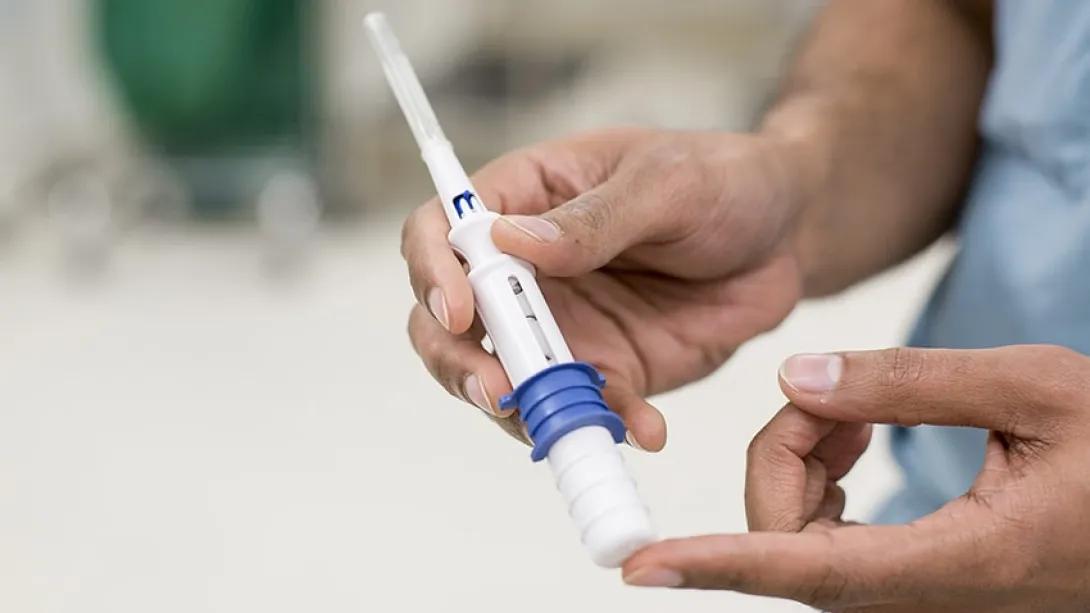
Tiny yet powerful
Approved in November 2016 by the U.S. Food and Drug Administration, the XEN Gel Stent represents a new way to treat glaucoma.
SEE ALSO: Nearly 60% of Patients Receive Antibiotic Eye Drops, But They're Seldom Necessary
And the stent differs from current approaches: Most glaucoma patients begin with medical therapy, including eyedrops, followed by laser trabeculoplasty — which uses a very focused beam of light to treat the drainage angle of the eye. After that, they'll receive either a trabulectomy (creating an opening for fluid to drain out) or a glaucoma drainage device.
It is part of a growing field known as minimally invasive glaucoma surgery (MIGS) to help adults with mild to moderate glaucoma.
About one dozen Xen implant procedures have been performed at Kellogg — and the facility expects to do more — but the option isn't suitable for everyone.
"Choosing the right candidates is a clinical decision based on a number of factors, including the type and severity of glaucoma as well as previous surgical history," says Shah, a clinical instructor in the Department of Ophthalmology and Visual Sciences at U-M.
Still, he adds, "MIGS procedures are generally faster than trabulectomy and tube shunt surgeries, and shortened surgical and recovery times can be very important to patients."
Recipients might agree.
Sandra Hodel, 83, had received a Xen implant at Kellogg in February after previous surgery to bring down ocular pressure. Left untreated, such pressure can damage one's optic nerve and cause a slow but steady loss of vision.
No longer: "The difference was like night and day," Hodel says of the short recovery period after the procedure.

Health Lab
Explore thousands of health news & research stories by visiting the Health Lab homepage for more.
Media Contact

Public Relations
Department of Communication at Michigan Medicine
Stay Informed
Want top health & research news weekly? Sign up for Health Lab’s newsletters today!
Featured News & Stories
Innovative children’s vision research gets a boost from the Knights Templar Eye Foundation

Nerf gun accident causes retinal detachment in pediatric patient

Kellogg care inspires gift to vision research

Mediterranean diet can slow progression of age-related macular degeneration

Patient with retinitis pigmentosa receives new hope at Kellogg’s low vision clinic