Solid Tumor Board Changes Childhood Cancer Treatment Courses
A multidisciplinary meeting at Mott elevates pediatric cancer cases to dozens of experts. A new review finds it’s improving care and comforting families in the process.
7:00 AM
Author |

As diseases go, childhood cancer is considered rare. That's good news for families, but it can complicate childhood cancer diagnosis and treatment.
SEE ALSO: Harnessing Immunology to Fight Lethal Pediatric Cancer DIPG
"Childhood cancers are not like adult cancers," says Erika Newman, M.D., a pediatric surgeon and director of the Solid Tumor Oncology Program at University of Michigan C.S. Mott Children's Hospital. "They're fortunately less common than adult cancers, but these cancers react to treatment differently and advance differently."
When an adult gets cancer, it often starts in the lungs, breasts, colon, prostate or skin.
When a child gets cancer, however, it may be in the white blood cells or the nervous system, the brain or bones, the lymphatic system, muscles or kidneys.
That young children can't explain or aren't sure how to articulate how they feel complicates diagnoses. Further, children are resilient.
"They find a way to play right through the early stages of cancer. I've seen children with advanced stage cancers living full, active lives, with a diagnosis coming only after a fall from the jungle gym requires an X-ray that shows something abnormal," Newman says.
An accurate, prompt diagnosis can be one of the most important factors to treatment success. But without deep experience diagnosing childhood cancers, an immediate, correct diagnosis can be elusive.
"With many of these types of tumors being as rare as they are, relying on one or two people's experience can be a real limiting factor," says Newman. "The more minds you can get working on a child's diagnosis and treatment plan, the better."
The more minds you can get working on a child's diagnosis and treatment plan, the better.Erika Newman, MD
Big table, bright minds
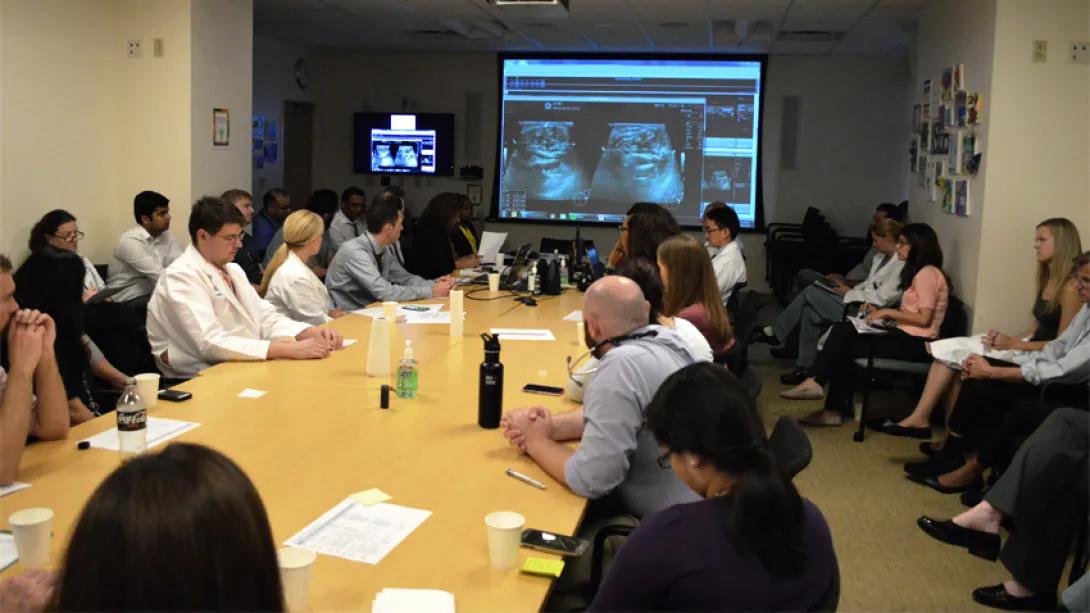
If it's noon on Wednesday, you'll find more than 40 people gathered around a long conference table and lining the walls of a conference room in the hospital.
"When our formal multidisciplinary solid tumor board meetings began about four years ago, we had between eight and 12 people attend on average," says Newman. "Today, we're often standing room only."
Tumor board participants discuss each pediatric patient with a possible or confirmed diagnosis of a solid tumor. The group includes pediatric oncologists, surgeons, diagnostic and interventional radiologists, pathologists, geneticists, nuclear medicine specialists, nurses, dietitians and social workers involved in childhood cancer care.
"We review each and every patient's images, pathology results and proposed treatment plan," explains Tammy Stoll, P.A., the clinical care coordinator for the Solid Tumor Oncology Program. Stoll works with the team to collect all available clinical information for the patients scheduled to be discussed each week.
In addition to patients being seen at C.S. Mott Children's Hospital, the tumor board consults on patients referred from outside institutions for a second opinion.
During the weekly meetings, each patient's medical history, physical examination findings, diagnostic tests, imaging studies, pathology results and original proposed treatment plans are presented and discussed.
Tumor board participants collectively confirm diagnosis, staging and recommended cancer treatment plans.
"The conversations are animated. We don't hold back — it's a lively discussion with specialists from all parts of the hospital really engaging in precise details, from CT scan reviews to pathology results," Stoll says.
Many patients are presented several times during the course of treatment, allowing clinicians to continue deploying expertise from every available specialty to provide follow-up analysis and make further treatment recommendations.
Referring physicians are also kept in the loop and are often invited to participate in tumor board conversations remotely through secure teleconference systems.
"As a physician treating children with these conditions, you feel the benefit of teamwork and collaboration that come out of these multidisciplinary meetings," says Newman, "but we wanted to take things a step further and document whether the multidisciplinary participation was measurably improving the quality of care for the patients we were caring for."
Measuring impact
Newman and her colleagues set out to quantify the multidisciplinary tumor program's value. The team reviewed medical records of 158 patients the tumor board saw between July 2012 and April 2014.
What they found was striking.
Fifty-five of the 158 children (35 percent) had alterations in radiologic, pathologic, medical or surgical interpretation of clinical data after multidisciplinary discussion. Of these, 64 percent had changes to the initial recommendation for clinical management.
Review of imaging studies resulted in interpretation changes in 30 of 158 patients studied (19 percent), with 12 clinical management changes. Six of 158 patients (4 percent) had changes in pathologic interpretation, with four patients (almost 3 percent) requiring treatment changes. In eight patients (5 percent), a change in medical management was recommended, while in 11 patients (7 percent) there were changes in surgical management based solely on discussion and not on interpretation of imaging or pathology.
Results from the study, which is the first examining the impact of a pediatric multidisciplinary tumor board's approach on clinical management of children with cancer, were published in the journal Pediatric Blood & Cancer in August.
Moving forward
Newman and colleagues are gratified that data show the multidisciplinary approach has potential to improve care for families of children with solid tumors, but the results weren't necessarily surprising to families.
SEE ALSO: Balancing Treatment and Toxicity for AML Patients
"Families are comforted to know that their child had an entire team of specialists — including many renowned experts in certain tumor types — actively participating in creating their child's treatment plan," notes Stoll. "When we share the tumor board's consensus recommendations with families, I see their confidence build, and, more often than not, I see relief. It empowers them and gives them a sense of direction over their child's disease."
"We've really come to depend on the formalized multidisciplinary model. I can't imagine doing it any other way now. It's not just hallway conversations: Each case has the attention of dozens of cancer specialists," says Newman. "Every patient deserves that level of attention."
This post is part of a series of articles on breakthrough pediatric cancer research during Childhood Cancer Awareness Month. Learn more about how you can play a role in the fight to Block Out Cancer.

Health Lab
Explore thousands of health news & research stories by visiting the Health Lab homepage for more.
Media Contact

Public Relations
Department of Communication at Michigan Medicine
Stay Informed
Want top health & research news weekly? Sign up for Health Lab’s newsletters today!
Featured News & Stories
U-M-led consortium to receive up to $52 million in NIH funding to study why viral respiratory infections affect children differently
4 in 5 parents say having a baby is too expensive

E-Bikes are everywhere, but most parents say they don’t know enough about them
C.S. Mott Children’s Hospital named No.1 children’s hospital in Michigan by U.S. News & World Report
Talent show brings joy to kids at children’s hospital