The scent of death?
Worms experience altered fertility and lifespan when exposed to dead counterparts
8:26 AM
Author |

The mere presence of a dead counterpart elicits strong responses across species.
For example, many insects such as bees and ants will instinctively remove dead members from the hive, seemingly to keep the nest clear of any potential pathogens.
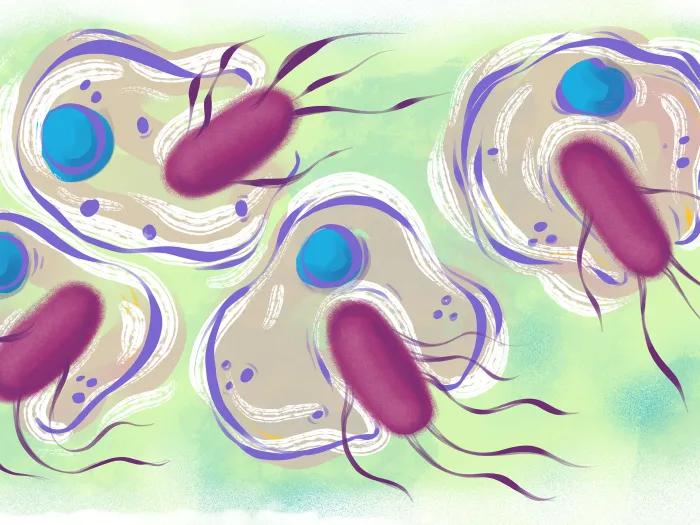
Research from a team at University of Michigan describes a similar aversion for decedents among the roundworm C. elegans.
They’ve discovered that the presence of dead members of their species has profound behavioral and physiological effects, leading the worms to more quickly reproduce and shortening their lifespans.
“We felt this was quite a unique opportunity to start diving into what is happening mechanistically that enables C. elegans to detect a dead conscript and then what drives their reaction,” said Matthias Truttmann, Ph.D., of the Department of Physiology at U-M Medical School, senior author on the paper, published in Cell Reports.
First author was graduate student and Truttmann lab member Mirella Hernandez-Lima.
Truttmann’s lab studies the maintenance of proper protein function with aging.
C. elegans, due to their relatively short lifespans, is an ideal model for studying life and life extension.
Their recent study sprung from an observation that worms in a dish would move as far away as possible from deceased counterparts.
The team wondered how the worms – who do not have eyes– determined that their plate-mates were dead and whether there could be a universal death signal emitted by corpses.
To test this, they introduced either worm corpses or fluid from the broken-down cells of worm corpses to different feeding areas on a plate.
They observed that C. elegans showed strong avoidance behavior for both.
Furthermore, they found that death perception led to reduced fitness in exposed worms and a short term increase in egg laying.
They then systematically tested the worms’ sensory neurons to determine which were necessary for the perception of death.
They found two neurons that respond to olfactory information, AWB and ASH—essentially the worms could smell death.
Specifically, the team identified two metabolites, AMP and histidine, which are normally found inside of cells, were the death cues for C. elegans.
“The neurons we identified are well known to be involved in behavioral responses to a variety of environmental cues,” said Truttmann.
“We have now found that they also detect a couple of intracellular metabolites that are not typically found in the environment. If they are around, it indicates that a cell has died, popped open, and that something has gone wrong."
The presence of cellular metabolites where they should not be could very well be an evolutionarily maintained signal of death, says Truttmann.
He points to a recent finding in humans that cells undergoing apoptosis (cell death) release metabolites that result in transcriptional changes in neighboring tissue.
How the detection of this signal ultimately translates into altered health and behavior needs further research.
Additional authors: Brian Seo and Nicholas D. Urban.
Funding/disclosures: This research was made possible by the University of Michigan Metabolomics Core. It was also supported by the following NIH grants: P40 OD010440; AG000114; 1F31DC02039701; 1F99NS135768, GM008322; AG000114; 1F31AG08589101 and 1R35GM142561.
Paper cited: “Modulation of C. elegans behavior, fitness, and lifespan by AWB/ASH-dependent death perception.” Current Biology. DOI: 10.1016/j.cub.2025.03.071

Health Lab
Explore thousands of health news & research stories by visiting the Health Lab homepage for more.
Media Contact

Public Relations
Department of Communication at Michigan Medicine
In This Story

Matthias Truttmann PhD
Associate Professor
Stay Informed
Want top health & research news weekly? Sign up for Health Lab’s newsletters today!
Featured News & Stories

New insight into how lipodystrophy can affect overall health
FDA-approved drug offers hope for patients with polycythemia vera, a rare bone marrow disorder
Engineered nanoparticles sensitize gliomas to radiotherapy

Who’s at risk for painful periods?
Identifying avoidant, restrictive food intake disorder in gastroenterology patients