Say bye-bye to blood thinners?
Certain patients with atrial fibrillation may be able to toss their blood thinners away, thanks to two devices designed to prevent blood clots that can lead to stroke.
10:42 AM
Author |
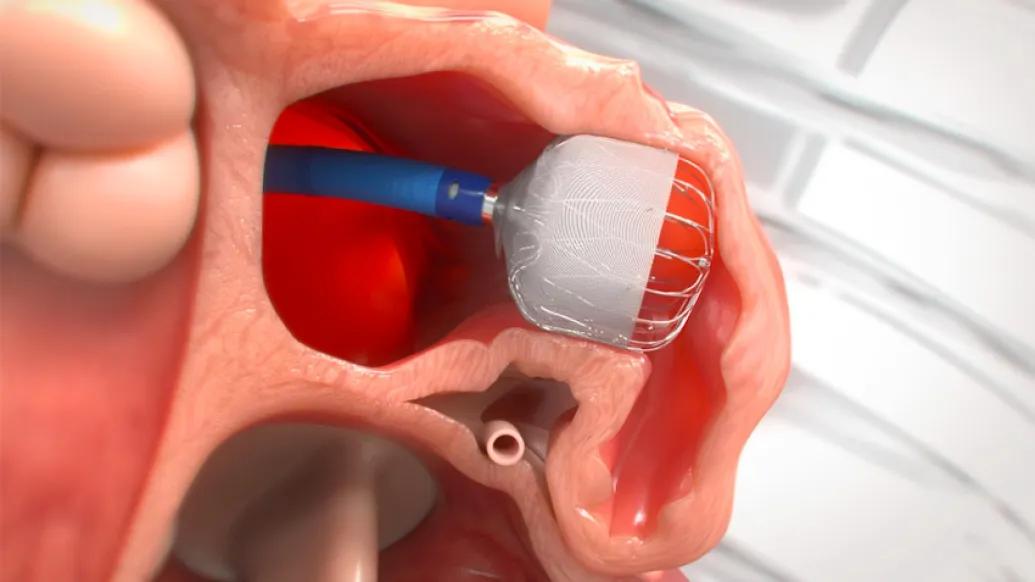
If you're one of the more than 5 million Americans with atrial fibrillation, a heart arrhythmia also known as AFib, you might be able to say goodbye to your blood thinner. It's all thanks to innovative devices and procedures that reduce the risk of AFib-related stroke by closing off the left atrial appendage, commonly referred to as LAA, an area of the heart where blood clots tend to form.
AFib patients have traditionally faced a lifetime of taking blood thinners to reduce the risk of stroke. But new devices and minimally invasive procedures, including the Watchman FLX and AtriClip, are eliminating the need for blood thinners while reducing the risk of stroke in certain patients who may not be good candidates for anticoagulants. This includes patients with such risks as increased bleeding, occupational restrictions or frequent falls.
With atrial fibrillation, an irregular heartbeat causes blood flow through the heart to slow down, increasing the risk of blood clots in the LAA. The left atrial appendage is a windsock-like pouch within the heart's upper left chamber. In patients with AFib, more than 95% of stroke-causing clots originate in that area.
New procedures, unparalleled expertise to reduce stroke risk
Procedures known as left atrial appendage "closure" and left atrial appendage "clipping" have emerged as effective strategies for stroke prevention in patients who qualify, said University of Michigan Health electrophysiologist Hakan Oral, M.D., who is part of a collaborative team dedicated to minimizing the risk of stroke in AFib patients.
"Our multidisciplinary, collaborative program brings together cardiologists, electrophysiologists, cardiac surgeons, anesthesiologists, neurologists and nurses, all with special expertise in this area," said Oral. "Our team is highly qualified in treating complex patients with atrial fibrillation using advanced techniques and devices to reduce the risk of clots entering the blood stream and causing a stroke."
These devices — the FDA-approved Watchman FLX and AtriClip — are recommended based on each patient's specific condition, said Oral. "Patients are typically referred by their primary doctor or cardiologist because of their AFib condition and inability to withstand blood thinners. Our team then evaluates them to determine the best approach for each patient, offering the most advanced options."
U-M Health vascular neurologist Sadhana Murali, M.D., is part of this collaborative team. "If a patient has a history of stroke and is referred as a potential candidate for an LAA closure device, I evaluate them to determine why the stoke occurred and the best course of action." Recommendations might be a more effective blood thinner than what they previously were on or a device to close off the LAA.
Who's eligible for a Watchman FLX or AtriClip?
Candidates for a left atrial appendage closure or clip procedure undergo a transesophageal echocardiogram and CT scan of the heart to measure the shape and size of the LAA to ensure it is compatible with the prospective device, said Oral, noting that, "Over 95% of patients are compatible."
U-M cardiologist Richard Hennig, D.O., said the Watchman device is an underused technique that has benefitted many of his patients who can't tolerate anticoagulants. "Atrial fibrillation patients who have a tendency to fall or who experience gastrointestinal bleeding are often good candidates for the Watchman device."
If a patient has unfavorable anatomy or contraindications for the Watchman device, they can be considered for the AtriClip device, said U-M cardiac surgeon Matthew Romano, M.D.
"Commonly this is a minimally invasive procedure and extremely effective in excluding the LAA . Additionally, if appropriate, an accompanying Maze procedure can be performed at the same time with elimination of atrial fibrillation more than 80% of the time."
The Maze procedure is a surgical ablation that blocks abnormal electrical signals that cause an irregular heartbeat such as atrial fibrillation.
How the devices work
The minimally invasive Watchman FLX, approximately the size of a quarter, is implanted using a narrow tube (catheter) inserted through a small incision in the right groin and guided into the heart while the patient is under general anesthesia. Once in place, the self-expanding device is opened (similar to an umbrella) to seal off the appendage.
The AtriClip device is often placed during a minimally invasive procedure in which the LAA is accessed via four small incisions in the left side of the chest. The device is guided and positioned around the base of the LAA, clamped shut and then released to permanently seal that area, preventing blood from reaching this structure. The AtriClip can also be placed during open heart surgery when other procedures are being performed.
"Our skilled team can perform all advanced procedures to reduce the risk of stroke in these patients," said Oral. "We work together to determine what's right for each patient.

Health Lab
Explore thousands of health news & research stories by visiting the Health Lab homepage for more.
Media Contact

Public Relations
Department of Communication at Michigan Medicine
Stay Informed
Want top health & research news weekly? Sign up for Health Lab’s newsletters today!
Featured News & Stories

Gene editing is coming for common diseases. Are we ready?

Digital alerts support timely treatment decisions of critically ill cardiac patients

Young father survives aortic dissection after delayed diagnosis

C.S. Mott Children’s Hospital first in country to implant expandable heart valve during FDA review phase

Weighing TAVR vs. SAVR for aortic stenosis treatment