One doctor’s American dream: to stop hate
A gastroenterologist shares his immigrant father’s legacy and recounts life as an Asian American
5:23 PM
Author |

This story was originally published on May 20, 2021 and was updated on June 13, 2025.
As the COVID-19 pandemic surged, so did the number of reported hate crimes against individuals of Asian descent in the United States.
According to the advocacy group, Stop AAPI Hate, they received 6,603 reports of racially-motivated incidents directed towards Asians and Asian Americans just last year.
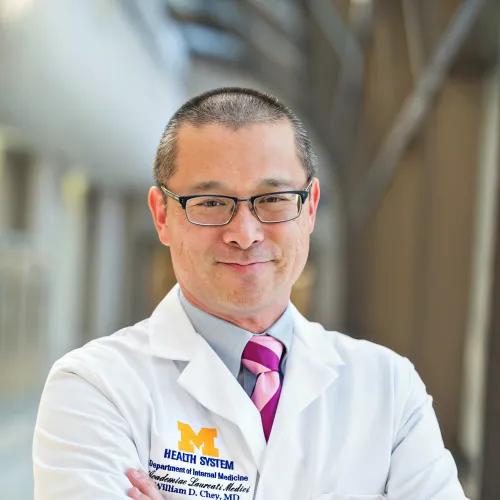
William D. Chey, M.D., a professor of gastroenterology and nutritional sciences at Michigan Medicine, was recently featured on a panel hosted by the American College of Gastroenterology entitled, "Allyship and Action: In Solidarity Against Anti-Asian Racism."
His father, William Y. Chey, M.D., D.Sc., is a retired gastroenterologist who recently published his memoir, "American Dreams, Still Alive: Memoir of an Immigrant Dreamer."
William D. wrote the foreword to the book and spoke to Michigan Health about what it means to be an Asian American during these contentious times.
What's your own personal experience with racism?
Chey: My father is from Korea and my mother is from China. They immigrated to the United States and I grew up in a small suburb of Rochester, New York.
At my high school, I was just one of two Asian American students. And this was in a school with well over 2,000 people.
Fortunately, I can't say that I was led down a path of discrimination during my younger years. In fact, I actually felt embraced by my community – I had a lot of friends and a lot of support.
I later attended the University of Pennsylvania for my undergraduate studies and encountered a much larger Asian population. Because the area I grew up in was far less diverse, this was really my first introduction to Asian culture outside of my family.
I started to make friends with people who were much more aware of their cultures, and it was a really eye opening experience.
The first time I experienced racism was in college, when there was a lot of Vietnamese immigration happening within the U.S. This, like many other cultural transitions, led to a lot of animosity and fear.
At the time, I was in an interracial relationship with an African American woman.
We were walking down the street together and holding hands when a group of individuals started taunting us.
This was my first real taste of true racism; an experience where I was concerned for our safety.
Throughout my life, I've experienced the full gamut of racism as an Asian American.
If I walk into a store or a restaurant with a Caucasian friend, for example, they will almost always be greeted and attended to first.
It's almost inherent in our culture, which definitely says something.
While experiences like this cannot always be defined as overt racism, they do shine a light on our unconscious biases.
Also, they are microaggressions, or subtle and oftentimes unintentional discrimination against members of marginalized groups.
A lot of people are unfamiliar with this term.
Sometimes our biases are not expressed in a malicious way, but they still have resounding negative consequences.
How would you define your father's legacy?
Chey: My father has a remarkable story. He came to the U.S. from a small farming community in Korea.
His father was a Korean patriot who suffered through the Japanese occupation.
Many people are unfamiliar with the history of what happened in Korea during this occupation, but it certainly took a toll on its survivors.
Eventually, my father attended medical school and served in the Korean military. He was a medic and attended to his fellow soldiers.
He came to this country with very little and through blood, sweat, and tears, worked his way up the ladder of academic medicine.
He eventually became a renowned gastroenterologist who truly was a luminary in the field.
He was one of the key scientists when it first came to studying how our guts impact disease.
It's incredible to think about everything he has accomplished since leaving that small farming community across the world.
He experienced many different twists and turns, but he was always able to create bright spots.
As both his son and a fellow physician, I find this incredibly inspiring.
I imagine that many other immigrants throughout our country can identify with my father's story.
It's not uncommon, but it's seldom told. And I think that's what makes it so important.
It is America's story; it is the American dream.
This sentiment is all the more important at a time when the American zeitgeist views immigrants as a problem rather than a critical part of the solution to many of our nation's problems.
I hope we can someday get to a place where we judge each other on our merits rather than appearance or accent.
I like to think that I would be just as selfless and brave as he was if we swapped places, but I just don't know if that's true.
His story took grit, and I'm proud to call him my father.
What advice can you offer young people in marginalized groups and communities?
Chey: As the father of three young adults, I find it refreshing to see that a great deal of our younger generation chooses to look beyond our differences.
It's interesting, though, because as someone who has lived to see other generations start with tolerance, a cautionary tale still exists: It's important for our youth to always remember to uphold the values that they revere – like diversity, equity and inclusion – throughout their lives. Not just when it's socially convenient.
Our country, as a whole, is counting on our young people to continue down the path of acceptance and tolerance.
While it's a beautiful way to live, there will be many opportunities for them to stray from this path.
So, my advice to them is to remain strong and vigilant about these values. Ultimately, they make up the foundation for a truly equitable society.

Health Lab
Explore thousands of health news & research stories by visiting the Health Lab homepage for more.
Media Contact

Public Relations
Department of Communication at Michigan Medicine
In This Story
William D Chey, MD, MACG, AGAF, FACP, RFF
Professor
Stay Informed
Want top health & research news weekly? Sign up for Health Lab’s newsletters today!
Featured News & Stories
Rheumatologist finds contentment and community through family farm
How gastroenterology nutrition therapy has evolved
What’s the latest on 7-OH and kratom availability and addiction care?
Blood-based multi-cancer screening tests: Ready for primetime?

Many parents face challenges getting kids to eat a healthy breakfast before school