New Technique Improves Efficiency and Accuracy of Single-Cell RNA Sequencing
A deeper dive into genomic data can enable scientists to identify previously unrecognized differences between tumor cells.
1:00 PM
Author |
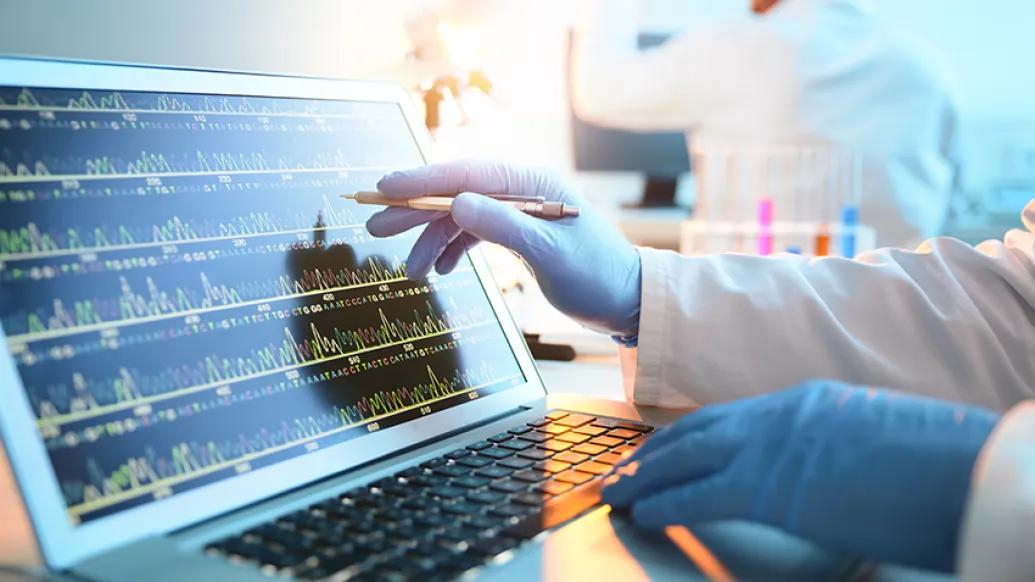
In the era of personalized medicine, scientists are using new genetic and genomic insights to help them determine the best treatment for a given patient.
LISTEN UP: Add the new Michigan Medicine News Break to your Alexa-enabled device, or subscribe to our daily audio updates on iTunes, Google Play and Stitcher.
In the case of cancer, the first step toward these treatments is an investigation into how tumor cells behave in an effort to figure out the best drugs to use to attack them. Researchers then use DNA and RNA sequencing to look at populations of cells, examining which genes are expressed within a sample of cancerous tissue.
However, traditional sequencing methods can hide the fact that not all tumor cells necessarily behave in the same way. Not recognizing this means that if you target a tumor with a specific type of drug, some cells may be just different enough to survive and thrive.
In a major advance for genomics, it's now possible to look at what one single cell is doing at any given time with a technique called single-cell RNA sequencing. This method looks at the amount of messenger RNAs in a cell and compares those to other cells to look for differences in gene expression.
But the results can depend on how an experiment is run — and how the data are analyzed, says Lana Garmire, Ph.D., associate professor of the Department of Computational Medicine and Bioinformatics at Michigan Medicine.
Her team recently developed a new comparison technique, recently described in Nature Communications, while studying ways to eliminate some of the biases that can make interpreting single-cell RNA sequencing data difficult.
"A lot of the noise in this type of sequencing comes from the fact that you have to measure samples in extreme low quantities and in different batches," Garmire says.
For example, the tissue sample a researcher is analyzing might not fit on one plate, a piece of equipment used to house cell samples, and therefore has to be split onto two plates. Differences that arise due to this split are called batch effects.
Genomics researchers must correct for these batch effects, but this process can raise a conundrum: How do you know if a difference is a batch effect or a true difference between cells?
This gives us information on different subpopulations of tumor cells and becomes sort of like a fingerprint that can be marked to identify cell-to-cell differences.Lana Garmire, Ph.D.
New uses for data
Bioinformatics is the term for collecting and analyzing complex biological data using computer programs. It is a relatively new field born out of the ability to gather enormous amounts of biological data, such as DNA and protein sequences.
MORE FROM THE LAB: Subscribe to our weekly newsletter
Researchers rely on bioinformatics techniques to determine which genes are expressed in single cells. But they've had to work around the noise introduced through different research protocols and batch effects.
Formerly of the University of Hawaii, Garmire is the new faculty director at the University of Michigan Medical School Bioinformatics Core, where she has discovered a more efficient way of identifying differences between cells using the same set of data produced during sequencing experiments.
Instead of relying on gene expression, she found that looking at what are known as single nucleotide variants (or SNVs) can eliminate some of this uncertainty.
"With SNVs, you are dealing with numbers that are binary, 0 and 1," Garmire says. "Either the mutation is there or not."
Genes are made up of nucleotides represented by the letters A, T, G and C that make up a code that is translated into a protein. Garmire's method looks for differences in single nucleotides, knowing that an A can only be replaced by a T and a G by a C.
This new work developed a novel set of procedures to process single-cell RNA sequencing data and retrieve this variant information. Further, using a computer program called SSrGE, they can link this variant information to more traditional gene expression information.
"This gives us information on different subpopulations of tumor cells and becomes sort of like a fingerprint that can be marked to identify cell-to-cell differences," says Garmire.
Future potential
Ultimately, drug makers and clinicians use these targets to guide pharmaceutical treatments.
"When you want to attack the issue, you go at it by attacking the fundamental features of that issue: the mutations," Garmire says. "Clinicians may be able to use this information later on to guide their therapeutics."
SEE ALSO: Stressed-Out Cells Pack Away Their Most Precious RNA, Researchers Find
Garmire looks forward to bringing bioinformatics out of the lab, helping researchers who amass large amounts of data to use them and develop downstream clinical applications.
"We divide the body up and specialize but at the end of the day, you need to look holistically and ask 'What am I doing and who is this helping?'" she says. "We are developing computational tools to bring bioinformatics researchers and bench scientists and clinicians together to connect the dots and ultimately make change."
This research was performed during Garmire's tenure at the University of Hawaii and supported by grants K01ES025434 awarded by NIEHS through funds provided by the trans-NIH Big Data to Knowledge (BD2K) initiative (www.bd2k.nih.gov), P20 COBRE GM103457 awarded by NIH/NIGMS, R01 LM012373 awarded by NLM, R01 HD084633 awarded by NICHD and Hawaii Community Foundation Medical Research Grant 14ADVC-64566.

Health Lab
Explore thousands of health news & research stories by visiting the Health Lab homepage for more.
Media Contact

Public Relations
Department of Communication at Michigan Medicine
Stay Informed
Want top health & research news weekly? Sign up for Health Lab’s newsletters today!
Featured News & Stories
Timing is of the essence for RNA during stress

Exploring the mind’s mysteries: 130 years of mental health care & innovation at U-M
Mobile health app improves heart failure medication use, dosing after hospitalization
Understanding family history key to early detection of pancreatic cancer

Patient with rare form of diabetes finds answers in genetic testing, clinical trials