Mental health, substance abuse treatment facilities don't provide communication access to Deaf, Hard of Hearing patients
Services were largely inaccessible to people who use sign language, discriminating against already ‘severely marginalized’ population in the United States.
5:00 AM
Author |
In a paper published in Health Affairs, Tyler G. James, Ph.D., MCHES, post-doctoral research fellow, and his co-authors examined the rate at which federally-funded mental health and substance use treatment facilities complied with federally mandated requirements to provide accessible communication to Deaf and Hard of Hearing patients.
His paper, “Communication Access to Mental Health and Substance Use Treatment Facilities for Deaf American Sign Language Users,” was published in the leading United States health policy journal. He also presented his findings at the Health Affairs Disability & Health Virtual Symposium held on the same day.
James co-authored the paper with associate professor Michael M. McKee, M.D., M.P.H., of the University of Michigan’s Department of Family Medicine; Michael S. Argenyi, M.D., MPH, MSW, of the University of Iowa; Donna L. Guardino, Ph.D., of the University of Rochester; Jaime A. B. Wilson, Ph.D., LP, ABN, of Wilson Clinical Services in Tacoma, Wash.; Melissa L. Anderson of the University of Massachusetts, Ph.D., as well as Meagan K. Sullivan of the University of Florida; and Eiryn Griest Schwartzman of the organization COVID Safe Campus.
The team used data collected by the U.S. Substance Abuse and Mental Health Services Administration in 2019, to identify the 24,416 facilities receiving federal funds—including Medicaid, Medicare, Tricare insurance, or SAMHSA grants. Those facilities receiving such funding are required to comply with Section 1557 of the Patient Protection and Affordable Care Act, which prohibits discrimination in health care programs or activities based on race, color, national origin, sex, age or disability.
Section 1557 also requires organizations receiving federal funding to provide patient access to language assistance services and auxiliary aids and services. For DHH patients who use ASL, this means facilities are required to provide an interpreter.
As part of the SAMHSA study, facilities included in the organization’s database were asked if they provided services in ASL, including the use of fluent staff or an interpreter, to deaf patients. Federally-funded entities that responded ‘no’ were deemed ‘non-compliant’ with the ACA mandate.
An analysis led by James found that:
-
Forty-one percent of mental health facilities in the U.S., mandated under Section 1557, were deemed non-compliant.
-
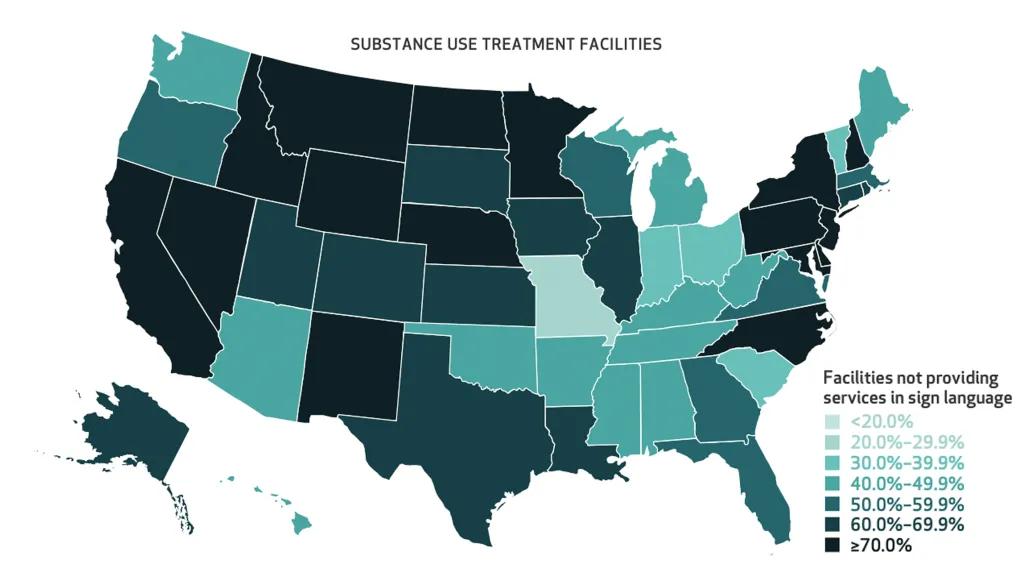
Fifty-nine percent of substance use facilities in the U.S., mandated under Section 1557, were deemed non-compliant.
-
Seventeen states had 50% or more mental health facilities in non-compliance.
-
Thirty-five states had 50% or more substance use treatment facilities in non-compliance.
The researchers concluded that mental health and substance use services are largely inaccessible to DHH people who use sign language. They argue that this discriminates against an already ‘severely marginalized’ population in the U.S.
In response, James and his colleagues call for a redesign of grievance procedures, with assistance from leading Deaf consumer organizations, to improve advocacy efforts.
“The Office of Civil Rights of the U.S. Department of Health and Human Services, the Substance Abuse and Mental Health Services Administration, state mental health authorities, and federal and state policymakers must be responsive to this evidence and implement proactive policies – such as inspecting facility compliance when receiving government funds,” James et al wrote.
Article citation: James, T. G., Argenyi, M. S., Guardino, D. L., McKee, M. M., Wilson, J. A., Sullivan, M. K., Griest Schwartzman, E.; Anderson, M. L. (2022). Communication access in mental health and substance use treatment facilities for deaf American Sign Language Users. Health Affairs, 41(10), 1413–1422. DOI: 10.1377/hlthaff.2022.00408

Health Lab
Explore thousands of health news & research stories by visiting the Health Lab homepage for more.
Media Contact

Public Relations
Department of Communication at Michigan Medicine
Stay Informed
Want top health & research news weekly? Sign up for Health Lab’s newsletters today!
Featured News & Stories
What’s changing in Medicaid and what can you do?

Study outlines a new framework for direct cell reprogramming

New insight into how lipodystrophy can affect overall health

Nerf gun accident causes retinal detachment in pediatric patient

FDA-approved drug offers hope for patients with polycythemia vera, a rare bone marrow disorder