‘Master Regulator’ in Genes May Make Women More Susceptible to Autoimmune Diseases
New research identifies an inflammatory pathway in women that could help explain why they develop autoimmune diseases at a much higher rate than men.
11:00 AM
Author |

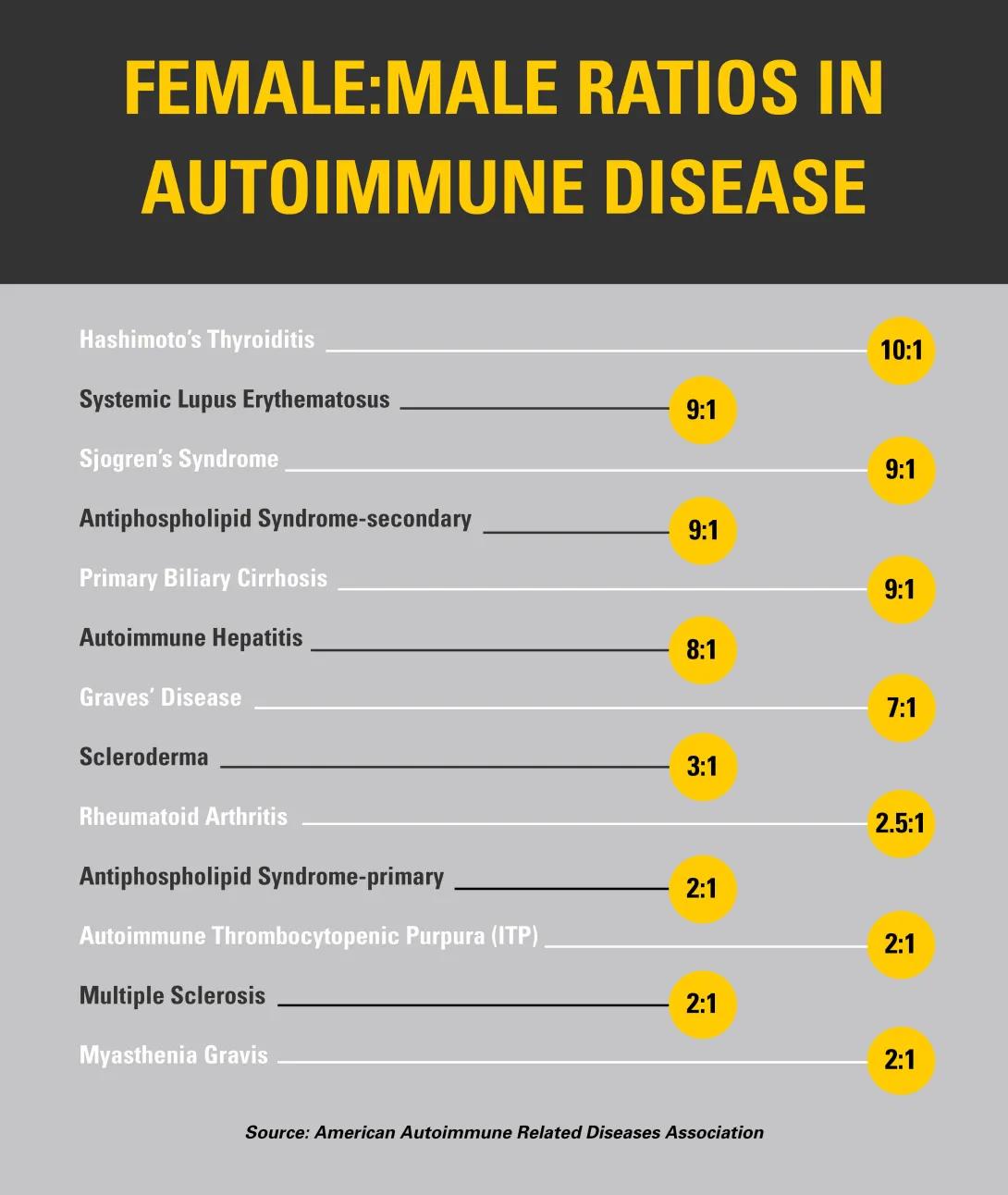
Women represent nearly 8 out of every 10 people with autoimmune diseases. Although the statistics are well-known, the scientific community is still trying to figure out why women's immune systems are more likely to become overactive and attack their own healthy cells.
MORE FROM THE LAB: Subscribe to our weekly newsletter
Researchers at the University of Michigan recently published a study in Nature Immunology that explores why women are so disproportionately afflicted. The paper propels their research — and eventual goal of finding successful treatment — in a different direction from other existing work focused instead on sex hormones.
"We found a completely new angle," says senior author Johann Gudjonsson, M.D., Ph.D., an assistant professor of dermatology at U-M. "Our team identified a gene expression difference between the sexes that is associated with susceptibility to autoimmune disease."
Autoimmune diseases take many forms across the body, from psoriasis patches on the skin to lupus throughout the body to rheumatoid arthritis in the joints, yet all conditions affect women at a higher rate. And it often takes years to get a correct diagnosis for these chronic diseases.
There are no cures for the estimated 7.5 percent of affected Americans; current treatments come with devastating side effects such as infections and cancer.
Finding clues in skin
Because Gudjonsson's lab has focused on autoimmune diseases of the skin, the researchers decided to take a broader approach with this study by investigating gene expression in the skin of healthy subjects — including biopsy samples from 31 females and 51 males.
SEE ALSO: Investigating Kidney Biomarkers to Track Lupus
"It's important to examine changes to the skin in diagnosis and treatment of autoimmune disease," Gudjonsson says. For example, he notes, four of 11 criteria for a lupus diagnosis relate to the skin, with signifying features such as rashes.
The gender breakdown, meanwhile, revealed additional clues.
"We found some striking differences in gene expression between the women and men," says first author Yun Liang, Ph.D., a U-M dermatology research investigator. In total, 661 genes were expressed differently between the sexes.
"Many of those genes had immune function, and overlapped with genetic pathways and risk genes that related to autoimmune diseases," Liang says.
That led the team to identify what they're calling VGLL3, a "master regulator" of the female-biased immune network.
"This previously unknown inflammatory pathway promotes autoimmunity in women," says Gudjonsson, also the Frances and Kenneth Eisenberg Emerging Scholar in the Taubman Emerging Scholars Program.
VGLL3 was also active in men with autoimmune diseases, though to a much smaller degree.
The role of sex hormones
Much of the existing work on gender differences in autoimmune diseases focuses on sex hormones by investigating the effects of hormones on women's immune systems to explain the disparity.
However, the novel inflammatory pathway U-M researchers identified as VGLL3 is not hormonally regulated.
"We found no evidence of involvement of estrogen or testosterone in the immune differences we observed between women and men," Gudjonsson says. "Identifying a separate regulatory mechanism could be a huge advance in gender-focused autoimmune research."
The study, Gudjonsson says, provides direction for future investigations into the identified pathway and how it is regulated.
It also might put greater focus on women's unique biology. According to the researchers, this is one of the first studies to conclusively demonstrate that it is critical for immunological research to study and analyze female and male samples differently.
"Learning more about these disease processes in each gender will provide opportunities for therapeutic interventions we did not imagine before, including both prevention and treatment," Gudjonsson says.
Funding: National Institutes of Health (K08-AR060802, R01-AR069071, R03-AR066337, K08-AR063668), Doris Duke Charitable Foundation (2013106), Pfizer Aspire Award, A. Alfred Taubman Medical Research Institute-Kenneth and Frances Eisenberg Emerging Scholar Award.

Health Lab
Explore thousands of health news & research stories by visiting the Health Lab homepage for more.
Media Contact

Public Relations
Department of Communication at Michigan Medicine
Stay Informed
Want top health & research news weekly? Sign up for Health Lab’s newsletters today!
Featured News & Stories

Gene editing is coming for common diseases. Are we ready?

Bigger data reveals the second, third and fourth switches controlling a gene

Navigating Perimenopause and Menopause

Mutations attracted to the X chromosome amplify disease risk

New algorithmic tool enables to scientists to see cells “talk” to one another