Mapping the social lives of mice
A study uncovers neurocircuits underlying prosocial behaviors
2:53 PM
Author |
For those who are extroverted, making friends can seem effortless.
Just go up to someone and start talking to them, right?
But a study from a University of Michigan researcher hints at just how complex introducing yourself to another can be, using a mouse model to uncover the brain processes behind nonsexual social approach and contact.
“Social behavior is not simple behavior; it is governed by sequential processing between individuals,” said Hiro Arakawa, Ph.D., an assistant research scientist in the Department of Pharmacology and member of the Edward F. Domino Research Center.
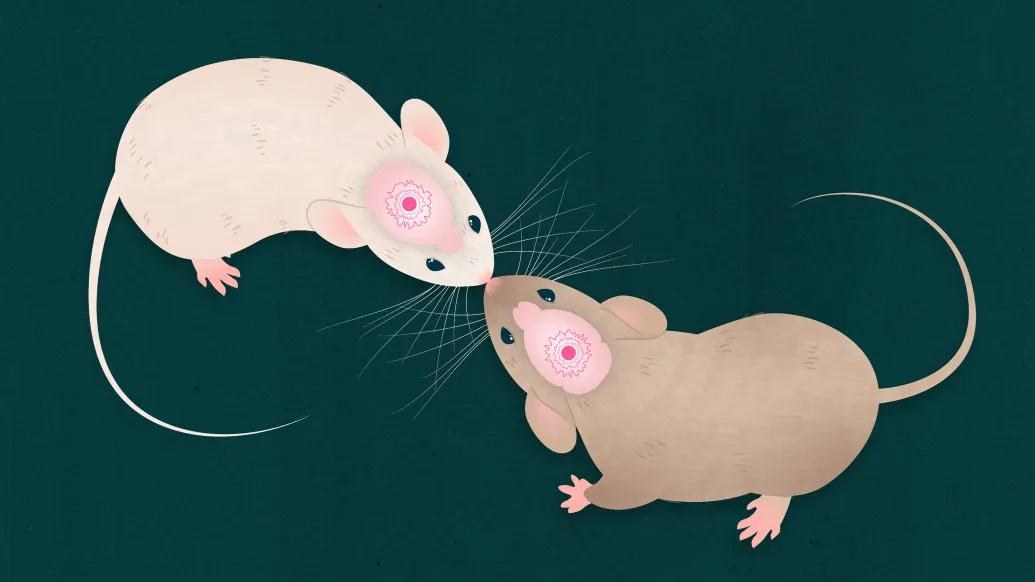
In mice, the “getting to know you” sequence goes like this: a mouse notices another of its species, decides to approach that individual and then decides whether to make contact – which in a mouse’s case involves touching noses together as a prosocial sign.
Each step of this process is regulated by the neurotransmitter oxytocin, says Arakawa, also known as the love hormone due to its established role in forming relationship bonds.
But simply flooding the brain with oxytocin does not induce social behavior, notes Arakawa.
Instead, oxytocin acts through specific projections to different parts of the brain.
Specifically, Arakawa and his colleague Mana Tokashiki hypothesized that oxytocin acts on circuits linking up from the paraventricular nucleus of the hypothalamus (PVN) to the medial amygdala (MeA) and nucleus accumbens (NAc), each of which controls a distinct part of social behavior.
The posterior intralaminar nucleus of the thalamus (pIL) plays a role in switching these two oxytocin circuits to persuade sequence of social behavior.
The thalamus is the relay station for sensory information coming into the brain. A few studies have documented that the pIL relays social tactile and auditory information. The PVN has several roles, including response to stress and production of oxytocin.
Oxytocin projection to the MeA regulates social approach, and oxytocin projection to the NAc maintains prosocial contacts, e.g., huddling together.
The team investigated the role of pIL in the regulation of oxytocin circuits that control sequence of social behavior.
They confirmed using neural tracers and a neuronal activity marker called c-Fos that pIL neurons send projections to the PVN and MeA, both of which are key circuits of oxytocin-mediated social behavior, and these nuclei are activated depending on social context, for example, proximity to a social partner.
At a distance, MeA neurons were stimulated by projections from olfactory bulbs, as mice use scent as a social cue, which activates approach behavior.
In close distance, physical contact with same-sex mice increases activity in pIL neurons.
Using a deactivated virus to non-invasively targeted neural activity, called chemogenetics, they selectively inhibited the pIL neurons, which led to a decrease in the amount of approach and nose-to-nose sniffing of a same-sex mouse along with reduced whisker contact and touching.
“If you silence the pIL in the thalamus in mice, then they show approach behavior but don’t want to contact the other animal and this touch contact is a key to promote prosocial relationship between mice,” explained Arakawa.
Furthermore, if this circuit is stimulated, oxytocin is produced, which projects to the brain’s reward circuits, maintaining pro-social huddling contact.
While people rely more on sight and sound and less on smell and touch unlike mice, says Arakawa, the underlying oxytocin-mediated brain processing should be similar.
“It’s important to understand that social behavior is a chain behavior, but more important to understand how the oxytocin circuit interacts with each other and processes through the behavioral sequence,” said Arakawa.
Further exploration of this relay circuit could inform the development of novel therapeutics for disorders characterized by deficits in social interaction, such as severe autism.
Paper cited: “The posterior intralaminar thalamic nucleus promotes nose-to-nose contacts leading to prosocial reception in the sequence of mouse social interaction,” European Journal of Neuroscience. DOI: 10.1111/ejn.16520
Sign up for Health Lab newsletters today. Get medical tips from top experts and learn about new scientific discoveries every week.
Sign up for the Health Lab Podcast. Add us wherever you listen to your favorite shows.

Health Lab
Explore thousands of health news & research stories by visiting the Health Lab homepage for more.
Media Contact

Public Relations
Department of Communication at Michigan Medicine
In This Story

Hiroyuki Arakawa
Assistant Research Scientist
Stay Informed
Want top health & research news weekly? Sign up for Health Lab’s newsletters today!
Featured News & Stories
How to improve mental health safety on social media – not just for young people
New drug combination may help treat advanced prostate cancer
More teens are using AI: What parents should know

How a common virus's hijack of cell repair processes may promote cancer
Study overturns 100-year-old assumption about common bacteria in the lungs